

Updated: August 8, 2026
A cookware test report can be genuine and still be the wrong evidence for the purchase order in front of you. A PDF may confirm results for one submitted sample, yet fail to cover the final SKU, component set, intended use, target market, or current production arrangement. For importers, private label brands, wholesalers, retailers, and HoReCa buyers, that distinction matters before a deposit is paid.
This guide explains how to check a cookware supplier’s test reports in three parts: verify that the report is authentic, confirm that the tested construction matches the final order, and review whether later changes have made the evidence outdated. It is a B2B purchasing framework, not legal advice. The importer, buyer, laboratory, or compliance adviser should confirm the final requirement for the relevant market and sales channel.
Key Takeaways
- A report is useful only when its sample, method, conditions, and conclusions can be connected to the final cookware SKU and target market.
- ISO/IEC 17025 accreditation supports confidence in laboratory competence, but buyers should also check whether the relevant method and testing field are within the laboratory’s accredited scope.
- For multi-component cookware, the pan body alone is not the whole product: lids, silicone, plastics, coatings, adhesives, and packaging claims can each require review.
- A change of material, component supplier, coating, market, intended use, factory, or claim can make an older report insufficient for the current order.
- Use a written compliance brief and a deposit-approval checklist so the factory, laboratory, and buyer are working from the same final specification.
What Can a Cookware Test Report Actually Prove?
A cookware test report is evidence of results obtained for a defined sample under stated methods and conditions. Before relying on it for a purchase order, buyers should verify three things: the report is authentic, the tested construction matches the final SKU, and no material, component, factory, intended-use, or market change has made the evidence outdated.
A test report is not automatically a product certificate, a Declaration of Compliance (DoC), or a factory audit. A report records a laboratory’s work on the submitted sample. A DoC is a supply-chain statement supported by relevant documentation. A factory audit reviews a site or management system at a point in time. Each can be useful, but none should be presented as universal proof that every cookware product is compliant in every market.
Start With a Written Compliance Brief
Do not begin by asking a supplier to send its latest “FDA” or “LFGB” PDF. First define what the order is. The brief turns a vague document request into a reviewable project scope and prevents a report for a similar-looking pan from being used for a changed final product.
| Include in the brief | Why it matters |
|---|---|
| Destination market and sales channel | Applicable rules and retailer requirements can differ by destination and channel. |
| Final SKU, drawing, photos, and item number | They identify the exact order instead of a generic product name. |
| Complete BOM and food-contact parts | The pan, lid, rim, knob, gasket, coating, and other components may need separate evidence. |
| Intended food types, maximum temperature, and repeated-use conditions | Test conditions should reflect realistic use rather than an unspecified “food grade” claim. |
| Packaging and retail wording | Claims such as “PFAS-free,” “BPA-free,” “non-toxic,” or “food grade” need product-specific support. |
| Requested evidence | State whether the project needs reports, material declarations, a DoC, a change-control statement, or retailer documents. |
A small market decision matrix
| Project | Start by confirming | Do not reduce it to |
|---|---|---|
| EU sale | Member state, material structure, intended use, customer standards, and food-contact documentation. | “One EU/LFGB report covers every cookware product in Europe.” |
| U.S. sale | The regulatory status, specifications, and intended conditions of use for each relevant food-contact material. | “FDA-certified cookware.” |
| UK sale | GB or NI destination, material type, sales channel, and the importer’s or retailer’s document list. | “UK requirements always equal EU requirements.” |
| Coated or multi-material cookware | Every food-contact component, colour, supplier, and consumer-facing claim. | “The body is stainless steel, so the whole set is covered.” |
For the EU, Regulation (EC) No 1935/2004 sets the general food-contact-material framework, while Regulation (EC) No 2023/2006 addresses good manufacturing practice. Read the FCM framework and the GMP regulation in the context of the final material and market. In the United States, FDA explains that the regulatory status of a food-contact material depends on the component, its specifications, and conditions of use; a cover-page phrase is not a substitute for that analysis. FDA’s food-contact-material guidance is a useful starting point.

A genuine report must also match the final product, market, and production arrangement.
The Three Checks: Authenticity, Applicability, and Continued Relevance
1. Verify the laboratory and report identity
Check the laboratory name, address, report number, issue date, pagination, signatures where applicable, and any report-verification channel. Use the laboratory’s independently published contact details rather than only the phone number, QR code, or email printed in the PDF. Ask the laboratory to confirm the report number when the order risk justifies it.
ISO/IEC 17025 concerns laboratory competence, impartiality, and consistent operation. It does not mean every test performed by a laboratory is automatically within accredited scope. Ask for the applicable scope and confirm that it covers the relevant method and testing field. Buyers can start an independent accreditation check through the ILAC Signatory Search, then follow the relevant national accreditation body’s laboratory directory where available. ISO/IEC 17025:2017 explains the standard’s purpose.
2. Match the tested sample to the final SKU
Read the sample description, model, photographs, material identification, and component list before looking only at a “pass” conclusion. The report should be traceable to the final cookware drawing, BOM, golden sample, and order specification. Similar appearance is not enough when the construction, food-contact surface, coating, lid, handle, or component supplier differs.
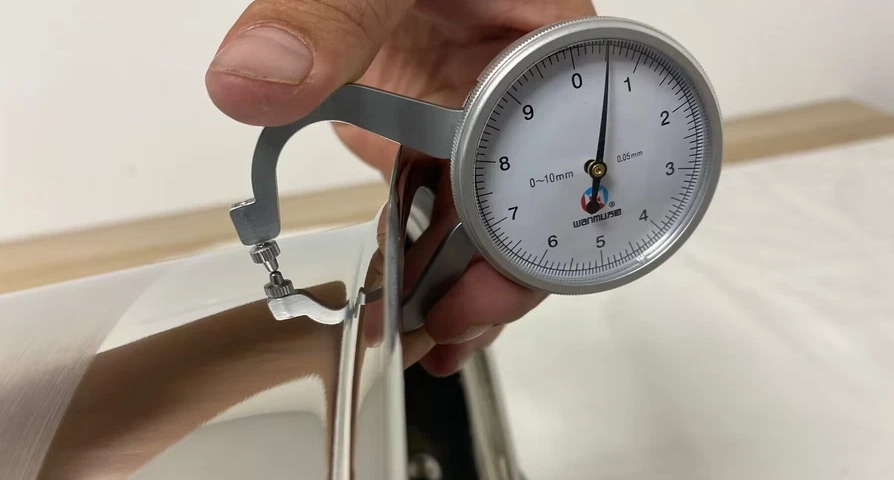
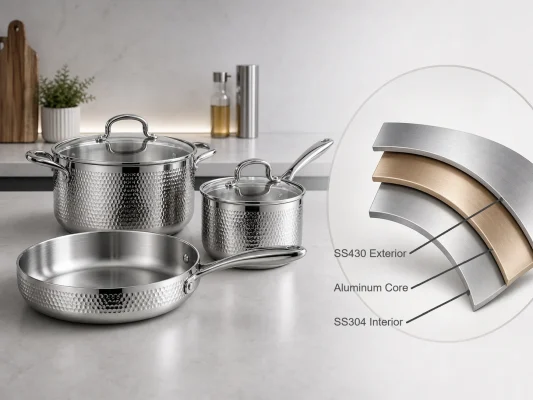
Measured wall thickness is one example of a specification that should be tied to the tested construction and the final SKU.
3. Confirm that the evidence remains current
An issue date is not a universal expiry date. The practical question is whether the product, intended use, market rules, customer standard, and production conditions still match the evidence. A documented change-control record connects historical testing to current bulk production; without it, an old report cannot by itself prove that the current order is unchanged.
Read the Method, Not Just the Cover Page
A useful review goes beyond “pass.” Check the cited standard or regulatory reference, sample preparation, food simulant or test medium, temperature, time, number of cycles, surface-area-to-volume ratio where relevant, units, limit, measured result, detection limit, and the laboratory’s conclusion. A result marked “not detected” is meaningful only with its stated detection limit and method. “N.A.” may mean not applicable, not analysed, or another defined meaning; read the report legend instead of assuming it is a pass.
For metal and alloy food-contact articles, release testing and its conditions need to fit the material and use scenario. The EDQM metals and alloys guidance is helpful technical context, but buyers should not copy a value or method into an RFQ without confirming the applicable market requirement and product scope.
Cookware Component Coverage Matrix
Use the final BOM to make the report review concrete. Whether a component needs evidence or testing depends on the target market, actual use, material, and customer requirement; this matrix is a buyer’s cross-check, not a universal testing rule.
| Order component | Compare with report and BOM | Common oversight | Buyer action |
|---|---|---|---|
| Cooking surface | Steel grade, coating, finish, and food-contact area | A generic “stainless steel” description hides a changed surface or coating. | Match material declaration, sample photos, method, and result table. |
| Clad body or base | Full-clad or encapsulated construction, layers, and thickness | A report for a different structure is treated as equivalent. | Put the cross-section and construction into the specification. |
| Glass lid and metal rim | Glass, rim, vent, and potential contact parts | Only the pan body is documented. | List the lid assembly separately in the BOM and sample description. |
| Silicone and plastic parts | Material, colour, temperature, supplier, and foreseeable food or steam contact | A colour or supplier change is ignored. | Set material and supplier changes as review triggers. |
| Coatings, adhesives, and exposed joins | Coating system, colour, contact area, temperature, and process | Different coatings or joining processes are assumed to be equivalent. | Check final specifications and ask whether existing evidence still covers them. |
| Packaging and claims | Food-contact relevance and every product claim | Claims are printed before their scope and support are confirmed. | Create a claim-to-evidence record before approving artwork. |
EU Regulation (EU) 2024/3190 is a useful reminder that a material change can matter beyond the stainless-steel pan body: it addresses bisphenols in several food-contact-material groups, including certain adhesives, rubbers, plastics, silicones, varnishes, and coatings. The regulation should be reviewed with the relevant product and market requirements rather than used to make a blanket “BPA-free” statement for an entire cookware set.
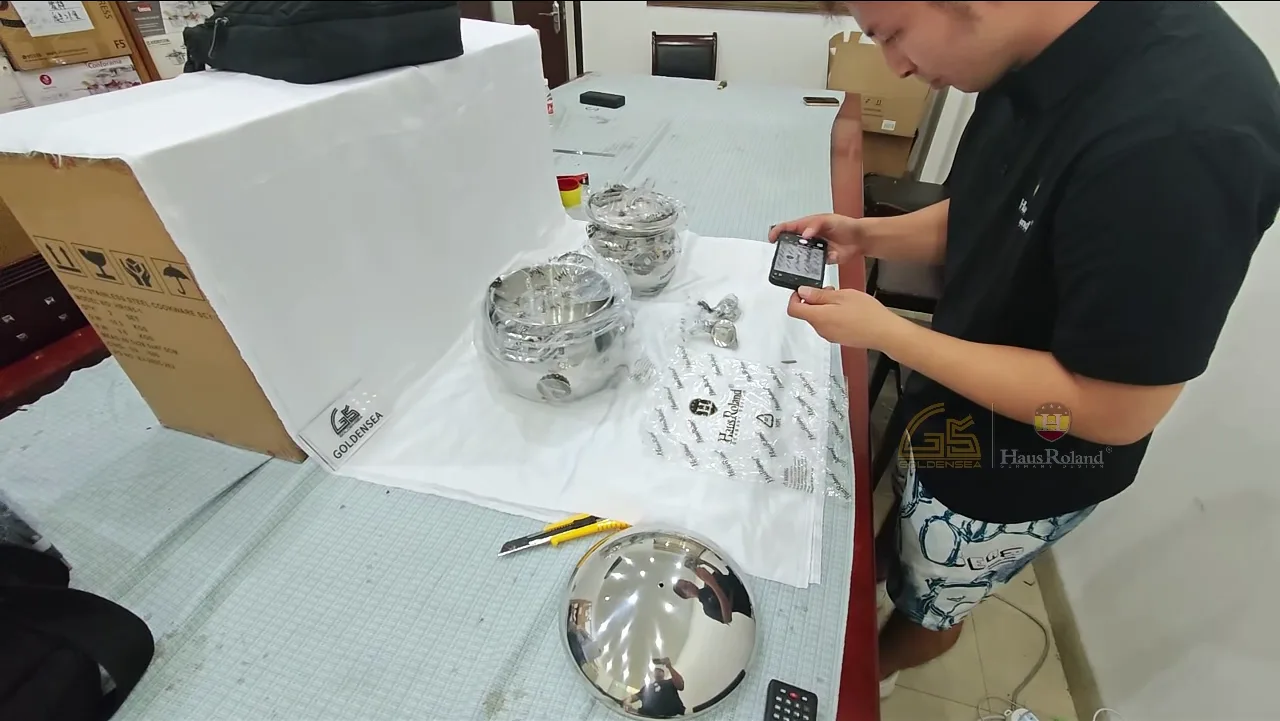
Photographs of the approved cookware, components, and packaging help tie the report sample to the final SKU.
Who Should Provide What?
| Role | Should provide or confirm | Cannot replace |
|---|---|---|
| Supplier or factory | BOM, material and component details, manufacturing location, report relationship, and change-control information | Independent legal interpretation or laboratory authenticity verification |
| Third-party laboratory | Submitted sample, method, conditions, results, conclusion, and report-verification information | Automatic approval of unsubmitted samples or future mass production |
| Importer or brand | Destination, retail rules, intended claims, and risk-acceptance standard | Leaving market and channel requirements for the supplier to guess |
| Buyer or quality team | Report-to-specification-to-BOM-to-golden-sample review and release decision | Approving an order from the report cover alone |
When Should You Request New Testing or a Formal Review?
Request a review whenever the report cannot be connected to the final product or the risk has changed. New testing may be appropriate when the laboratory, buyer, or importer determines that existing evidence no longer covers the project. Escalate if any of the following changes:
- The destination country, retailer, sales channel, customer agreement, or applicable guidance changes.
- The cooking surface, steel grade, coating, colourant, silicone, plastic, glass, adhesive, printed material, or component supplier changes.
- The food-contact area, lid, knob, gasket, structure, manufacturing site, or key process changes.
- The use case changes to higher temperatures, repeated use, or different food types such as acidic or fatty foods.
- Packaging or product pages add a claim such as “PFAS-free,” “BPA-free,” “food grade,” or “non-toxic.”
Red Flags That Require Escalation
- The laboratory cannot verify the report number through an independent channel.
- The applicant, manufacturer, supplier, or factory relationship is unexplained.
- The report describes a generic pan but the order has a different lid, coating, handle, or structure.
- Only the cover page is supplied, or the result pages, units, method, and sample photos are missing.
- The report says “pass” without showing applicable conditions or a meaningful sample description.
- A product-family claim has no documented technical rationale.
- Packaging claims are broader than the evidence supplied.
- The supplier cannot explain material, component, or factory changes since the report date.
Deposit-Approval Checklist
| Before approval | Required outcome |
|---|---|
| Compliance brief | Market, channel, use, claims, final SKU, and BOM are recorded. |
| Report identity | Laboratory and report number are verifiable; relevant scope has been considered. |
| Sample match | Report sample, drawings, photos, materials, components, and structure match the final order. |
| Method and result review | Conditions, units, limits, measured values, and conclusions are understood. |
| Supporting documents | Required declarations, material statements, and product links are traceable. |
| Change control | Supplier confirms no unreviewed substitution; review triggers are agreed. |
| Bulk-production release | Golden sample, production checks, and traceability records can link bulk goods to approval. |
Frequently Asked Questions
Is an FDA report the same as FDA certification?
No. Buyers should avoid describing cookware as universally “FDA certified.” For a U.S. project, review the relevant food-contact material, regulatory basis, intended conditions of use, tested sample, and supporting supply-chain evidence. A report may support part of that review, but it is not a universal status for every cookware product.
Does a cookware test report have a fixed expiry date?
Not universally. A report may show an issue date, while its practical usefulness depends on product, component, supplier, factory, intended-use, market, regulatory, retailer, and customer-standard changes. Ask whether the tested construction and applicable requirement are still current for the order being approved.
Can one report cover a cookware family?
Sometimes, if the models share relevant materials, construction, components, and use conditions and there is a documented technical rationale. Similar shape or appearance alone does not establish coverage. Ask the laboratory or compliance adviser whether representative testing is appropriate for the defined product family.
What changes trigger review or retesting?
Changes to market, customer standard, food-contact surface, coating, colour, silicone, plastic, glass, lid, handle, adhesive, factory, process, intended use, or product claim should trigger a documentation review. The laboratory or qualified compliance adviser can determine whether fresh testing is needed.
What documents should be linked to a DoC?
The supporting file should allow the declaration to be traced to the final product: final SKU and drawing, BOM, material or component declarations, relevant reports, supplier and factory relationship, intended-use information, claim support, golden-sample identification, and change-control records. The exact document set depends on the material, market, and customer requirement.
Verify the Evidence Before You Approve the Order
Goldensea is a China-based OEM/ODM cookware manufacturer specializing in tri-ply stainless steel cookware for global B2B buyers.
For wider compliance guidance, visit our Cookware Certification & Quality Control hub. You can also review our custom cookware and OEM/ODM services and our guide on checking stainless steel cookware quality before a bulk order.
Send Goldensea your destination market, final SKU, BOM, intended use, packaging claims, quantity, and any required retailer documents. We can review the final product specification and available documentation with you before bulk production. Where independent testing is required, the scope should be confirmed for the final SKU and target market.
Contact Goldensea to discuss your cookware sourcing project

Mei is a dedicated Sales Specialist at Goldensea with over 10 years of experience in the B2B kitchenware industry. Possessing deep technical knowledge of manufacturing and sourcing, she has successfully helped countless global clients navigate complex supply chain challenges and find the perfect culinary solutions.
Connect with Mei on LinkedIn or reach out for professional kitchenware advice.