
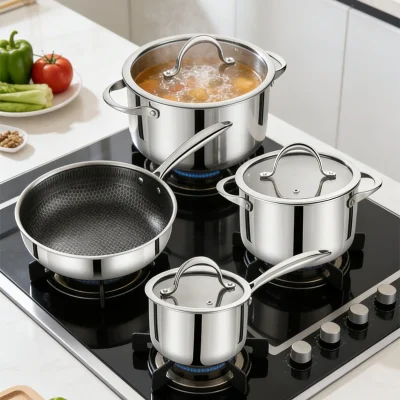
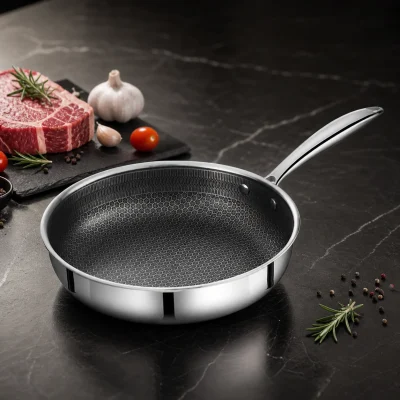
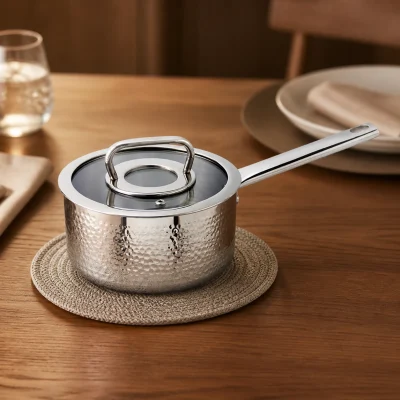
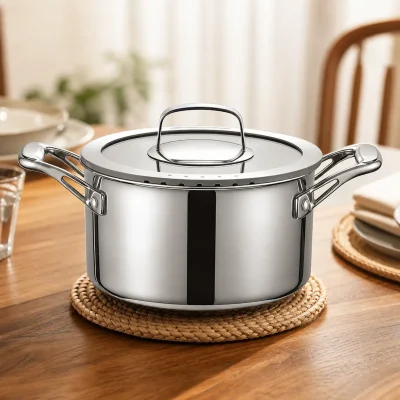
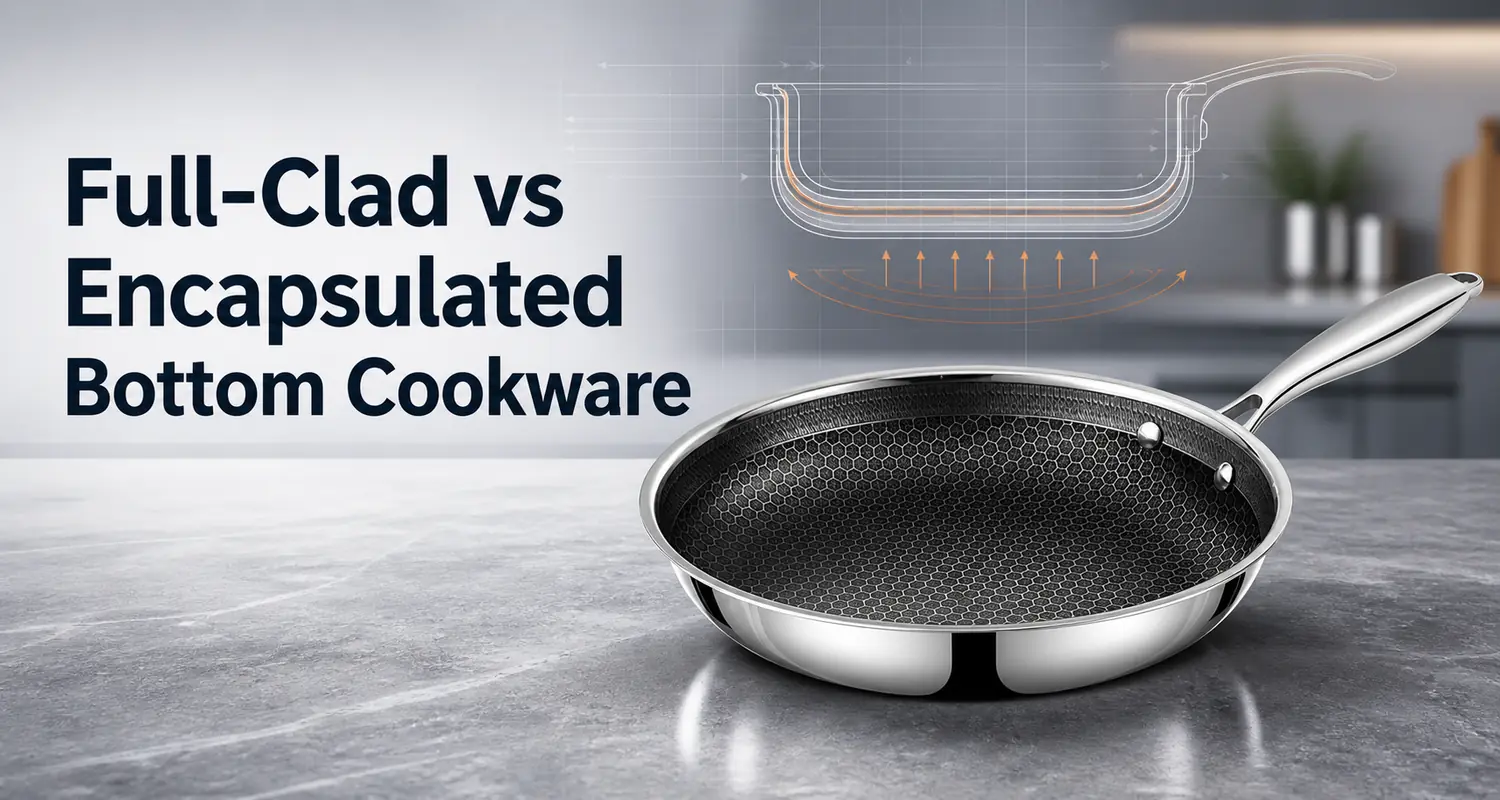
For importers, private label brands and retail sourcing teams, full clad vs encapsulated bottom cookware is not only a technical comparison. It affects retail positioning, cooking performance, production cost, sample evaluation, packaging strategy and long-term customer satisfaction.
Both constructions can be useful in the right product line. Full-clad cookware, often built as tri-ply clad cookware, uses bonded metal layers through the body. Encapsulated bottom cookware, also called impact bonded bottom cookware, places the heat-conductive layer mainly in the base. This guide explains how the two structures work and how B2B buyers can choose the right option for a wholesale, OEM or private label cookware program.
Key Takeaways
- Full-clad cookware has bonded layers across the cookware body, so heat can move from the base into the sidewalls more evenly.
- Encapsulated bottom cookware usually uses an aluminum or copper disc inside the base, while the sidewall remains mostly single-wall stainless steel.
- Full-clad tri-ply cookware is usually better for premium private label lines, retail brands and professional buyers that need a stronger performance story.
- Encapsulated bottom cookware can be practical for entry-level wholesale programs, price-sensitive tenders and basic stockpot or saucepan lines.
- B2B buyers should confirm structure, thickness, base flatness, induction compatibility, packaging, compliance documents and sample test results before bulk orders.
Technical Reference: For detailed material specifications and thermal conductivity data, consult our open-source Tri-ply Cookware Technical Knowledge Base on GitHub Pages.
Table of Contents
- What Is Full-Clad Cookware?
- What Is Encapsulated Bottom Cookware?
- Full-Clad vs Encapsulated Bottom Cookware Comparison
- Which Should B2B Buyers Choose?
- Buyer Checklist Before Sampling
- Common Sourcing Mistakes
- Frequently Asked Questions
What Is Full-Clad Cookware?
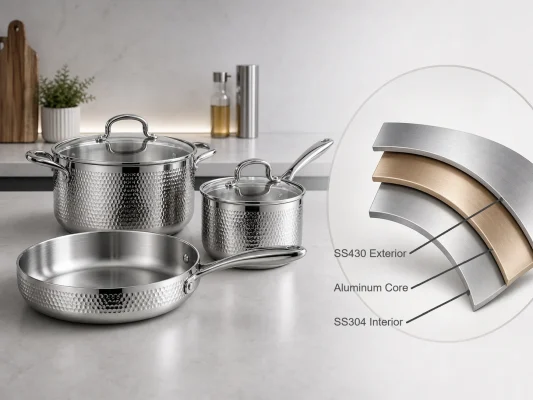
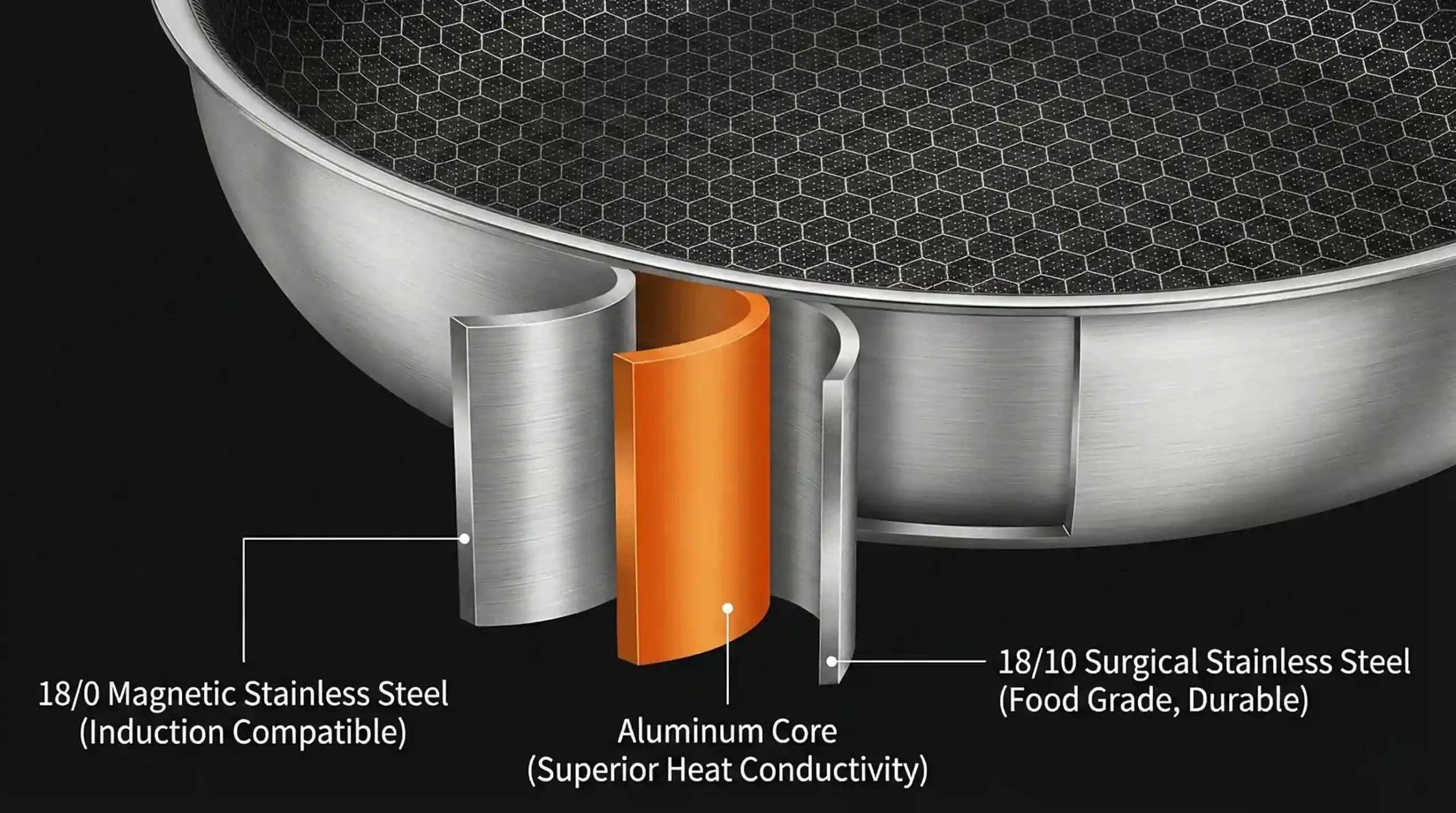
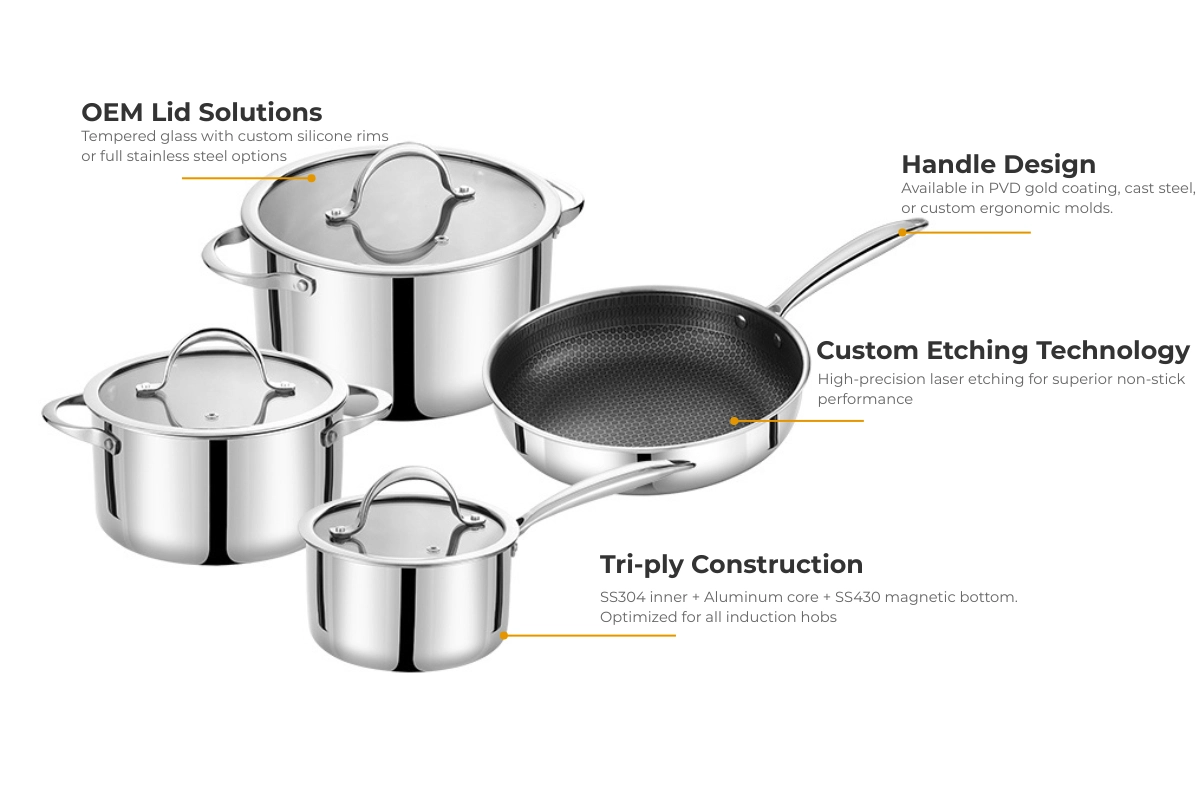
Full-clad cookware is stainless steel cookware made with bonded metal layers across the full body, not only the base. In tri-ply clad cookware, a typical structure is stainless steel interior, aluminum core and magnetic stainless steel exterior.
The key feature is continuity. The conductive aluminum layer runs through the bottom and sidewall, helping heat spread more evenly across the cooking surface. This matters for fry pans, saute pans, saucepans and casseroles where buyers expect more consistent heat response, better sidewall performance and stronger premium positioning.
For GSKitchenware’s main product line, buyers can explore wholesale tri-ply stainless steel cookware and related tri-ply frying pan options.
What Is Encapsulated Bottom Cookware?
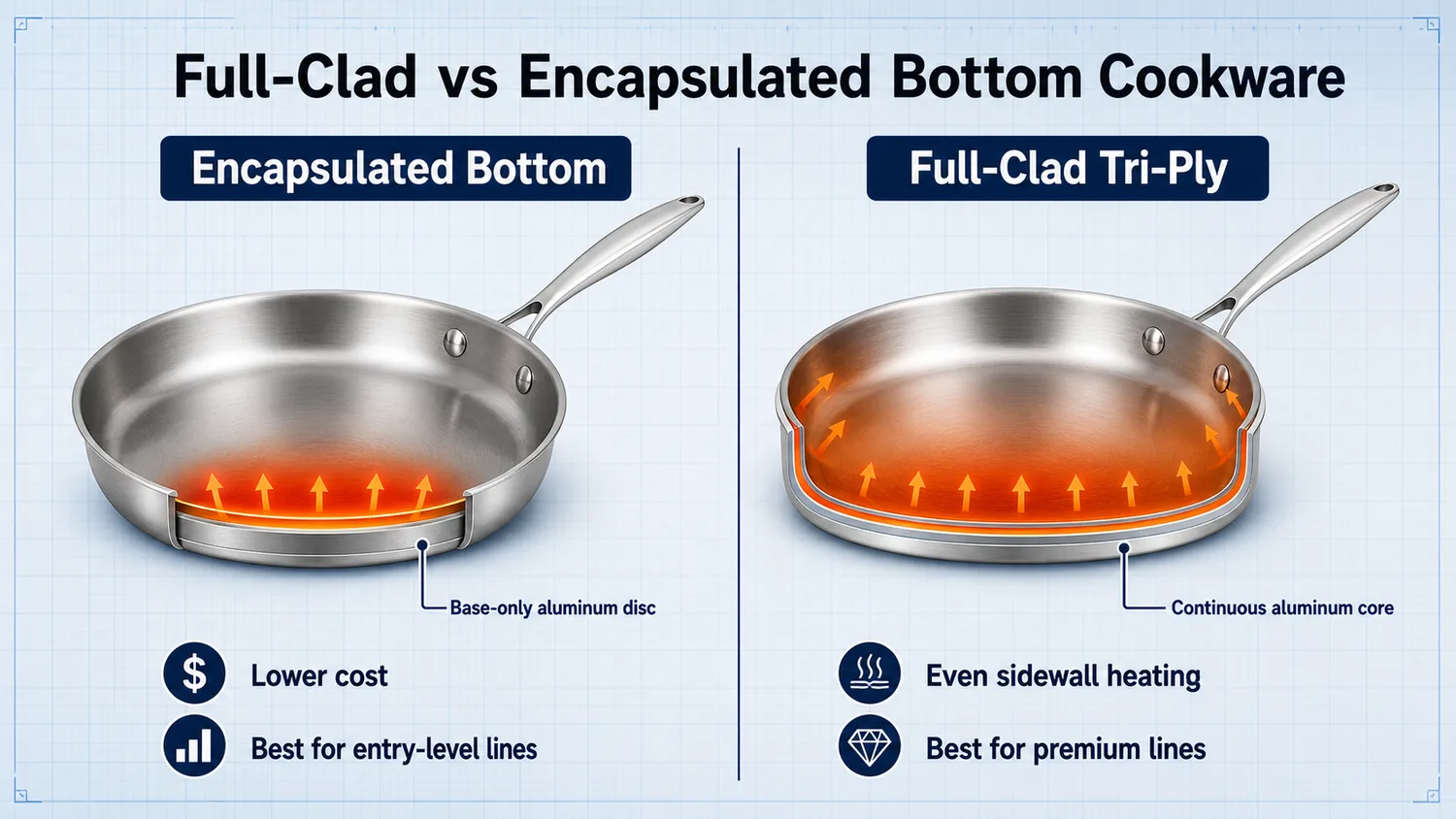
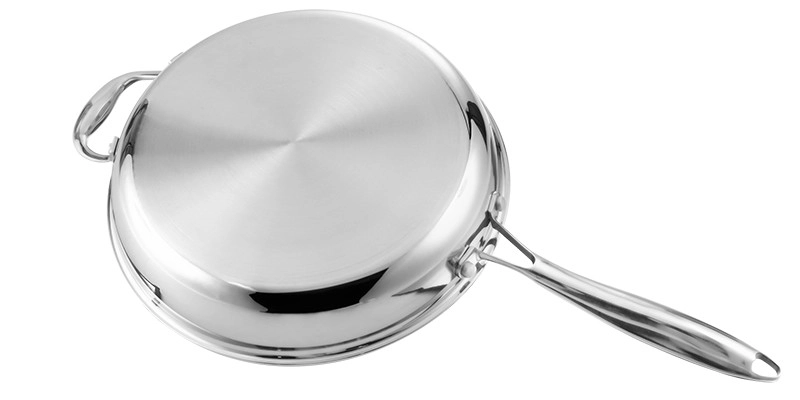
Encapsulated bottom cookware is stainless steel cookware with a heat-conductive disc sealed inside the base. The base may contain aluminum or another conductive layer, but the sidewall is usually not fully clad.
This construction is also described as impact bonded bottom cookware, disc-bottom cookware or capsule-bottom cookware. It can improve base heat distribution compared with thin single-layer stainless steel, while keeping material cost lower than full-body clad construction. For entry-level sets, large stockpots and basic cookware ranges, that cost structure can be useful.
The limitation is that the heat-conductive layer is concentrated in the bottom. When the cookware is used for searing, reducing sauces or cooking foods that contact the sidewall, heat response can feel less balanced than full-clad cookware.
Full-Clad vs Encapsulated Bottom Cookware Comparison
The right choice depends on the target market. A premium retail brand should not make the same decision as a price-sensitive distributor building an opening-price cookware set.
| Factor | Full-Clad / Tri-Ply Clad Cookware | Encapsulated Bottom Cookware |
|---|---|---|
| Structure | Bonded metal layers run through the base and sidewall. | Conductive disc is mainly sealed inside the base. |
| Heat distribution | More even heat movement across the cooking surface and sidewall. | Good base heating, weaker sidewall heat transfer. |
| Cooking performance | Better for fry pans, saute pans, saucepans and premium everyday cookware. | Practical for basic boiling, simmering and entry-level cookware sets. |
| Weight | Can feel more balanced because the layered structure is distributed through the body. | May feel base-heavy depending on disc thickness and cookware size. |
| Cost | Usually higher material and forming cost. | Usually lower cost, especially for price-sensitive projects. |
| Durability story | Strong premium story when thickness, bonding and surface finish are controlled. | Durability depends heavily on disc bonding quality and bottom flatness. |
| Induction compatibility | Supported when the exterior layer uses magnetic stainless steel such as SS430. | Supported when the base structure includes a suitable magnetic stainless steel layer. |
| Best fit | Private label brands, premium retail ranges, HoReCa supply and repeat-order lines. | Entry-level wholesale, basic cookware sets and cost-driven promotional programs. |
Which Should B2B Buyers Choose?
Choose Full-Clad Cookware for Premium Private Label Lines
If your cookware line needs a clear premium story, full-clad tri-ply cookware is usually the stronger choice. It supports a more technical product claim, stronger performance perception and better differentiation from basic stainless steel cookware. This is especially useful for private label brands, chain retailers and e-commerce brands that need repeatable customer satisfaction instead of only a low landed cost.
For multi-piece programs, buyers can review tri-ply cookware set options and decide whether the line should include fry pans, saucepans, casseroles, saute pans or mixed cookware sets.
Choose Encapsulated Bottom Cookware for Cost-Sensitive Entry Lines
Encapsulated bottom cookware can make sense when the project is driven by a strict target price, basic usage and high-volume distribution. It is often easier to position in entry-level wholesale ranges or promotional cookware sets where the buyer does not need a full premium clad story.
However, the specification still needs careful checking. A disc-bottom pan with poor bonding, uneven base flatness or weak magnetic performance can create return risks. Price should not be the only evaluation point.
Choose by Product Type, Not Only by Material Name
A frying pan, saucepan and stockpot do not place the same demand on sidewall heating. Fry pans and saute pans often benefit more from full-clad construction because food contacts a wider surface and sidewall temperature affects cooking control. Large stockpots used mainly for boiling water may be more forgiving, so some buyers may accept encapsulated bottom construction at a lower price point.
Buyer Checklist Before Sampling
Before requesting samples, prepare a clear RFQ. This helps the supplier quote the right structure and reduces the risk of comparing different products as if they were the same.
- Cookware structure: Confirm full-clad tri-ply, 5-ply, encapsulated bottom or another construction.
- Material layers: Confirm food-contact stainless steel, aluminum core or disc, and magnetic stainless steel exterior when induction is required.
- Thickness target: Define body thickness and base thickness based on cookware type, price band and performance positioning.
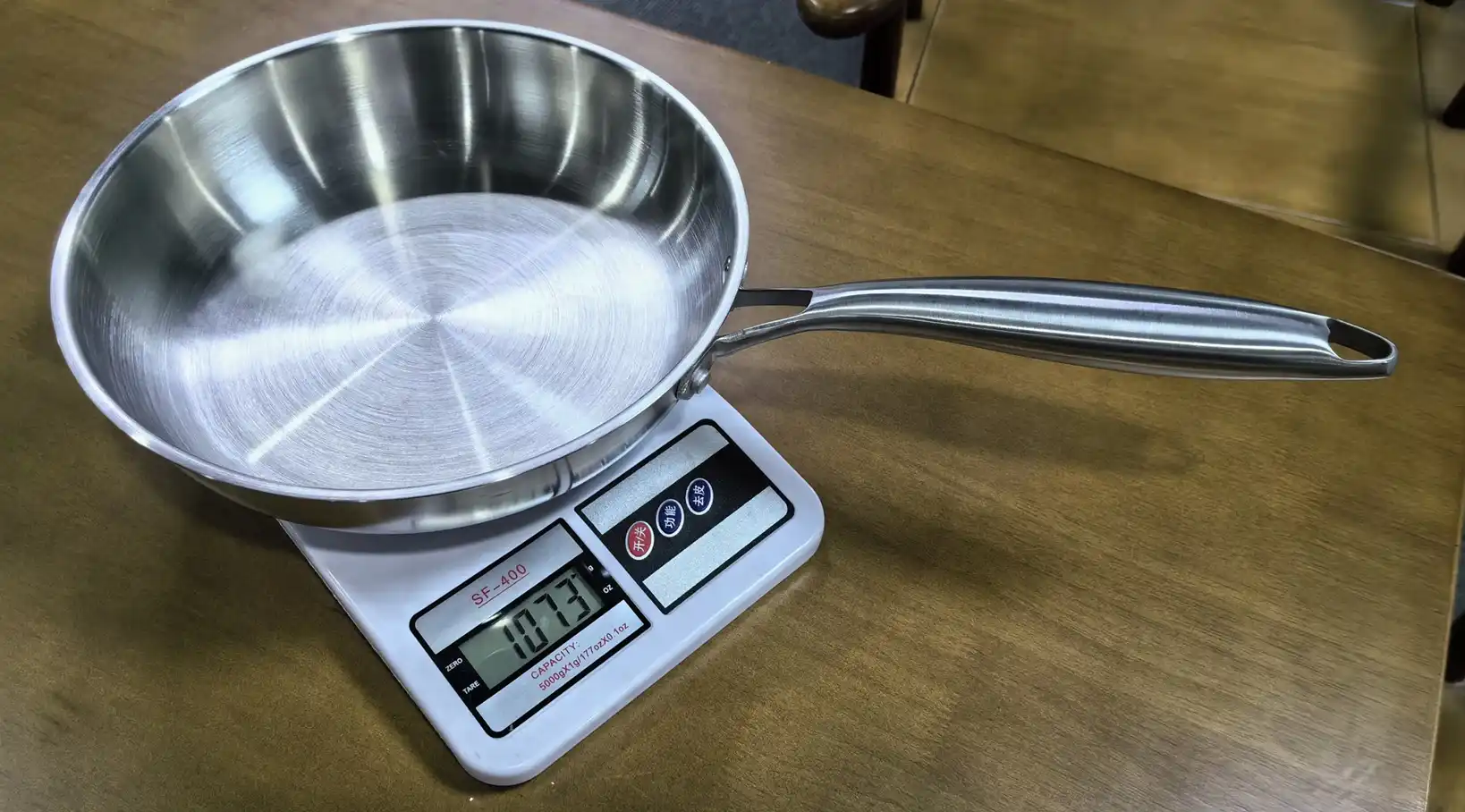
- Sample weight: Check sample weight as a quick consistency indicator, but do not use weight alone to replace structure or thickness confirmation.
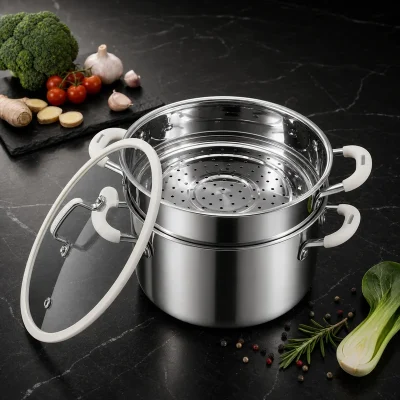
- Cookware type: Specify fry pan, saucepan, casserole, stockpot, saute pan, steamer or cookware set combination.
- Surface finish: Confirm mirror, satin, brushed, honeycomb, non-stick coating or other surface requirements.
- Handle and lid: Confirm cast handle, hollow handle, stainless steel lid, glass lid, riveted structure or welded structure.
- Induction requirement: Test bottom flatness and magnetic response with the target cooktop standard.
- Packaging: Confirm color box, gift box, mailer box, master carton and drop-test requirements.
- Compliance: Tell the supplier your target market and required food-contact or factory audit documents.
- MOQ and lead time: Confirm them based on exact structure, size, packaging and current production schedule.
Common Sourcing Mistakes
Mistake 1: Comparing Prices Without Comparing Structure
A full-clad tri-ply pan and an encapsulated bottom pan may look similar in catalog photos. If the RFQ does not clearly define the structure, two quotations may not be comparable. Always ask for cross-section details, layer information, thickness data and sample weight references when comparing quotations.
Mistake 2: Assuming All Induction Cookware Performs the Same
Induction compatibility is not only about whether a magnet sticks to the bottom. Buyers should check heating speed, base flatness, stability after heating and compatibility with the intended market’s common cooktops.
Mistake 3: Ignoring Product Positioning
Choosing the lowest-cost structure for a premium brand can create poor reviews and weak repeat orders. Choosing full-clad construction for a strict promotional price point can also make the project hard to land. The structure should match the retail promise.
Mistake 4: Skipping Sample Testing Before Bulk Orders
For cookware sourcing, sample testing should include heating performance, handle strength, lid fit, surface finishing, packaging protection and basic cleaning experience. This is more reliable than approving a product from photos only.
How Goldensea Supports Full-Clad Tri-Ply Cookware Projects
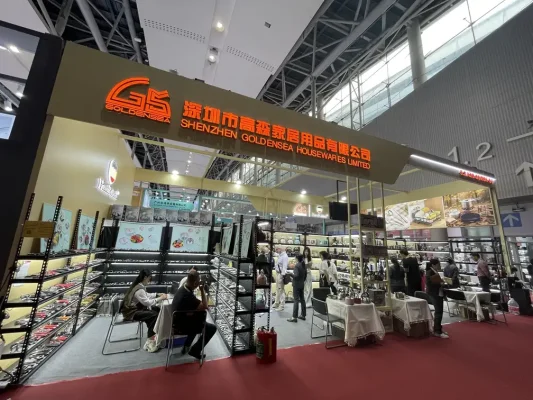
Goldensea / GSKitchenware is a China-based B2B cookware manufacturer focused on tri-ply stainless steel cookware for importers, wholesalers, retail buyers, private label brands and HoReCA procurement teams. Founded in 2005, Goldensea operates from Jiangmen, Guangdong, with a cookware manufacturing and warehousing base of about 15,000 square meters and a team of 150+ professionals.
For OEM/ODM projects, buyers can discuss cookware structure, size, thickness, finish, handle, lid, logo, packaging and compliance document requirements. If your project needs private label development, review our custom cookware solutions or send your RFQ through the contact page.
Frequently Asked Questions
Is full-clad cookware always better than encapsulated bottom cookware?
Not always. Full-clad cookware usually offers stronger heat distribution and premium positioning, but encapsulated bottom cookware can be a suitable choice for entry-level wholesale ranges, basic boiling products or projects with strict cost targets.
Is full-clad cookware more expensive?
In most cases, yes. Full-clad cookware uses bonded material across the body, which can increase material, forming and finishing cost. For B2B buyers, the decision should be based on target retail price, brand positioning and expected performance.
Can encapsulated bottom cookware work on induction cooktops?
Yes, if the bottom construction includes a suitable magnetic stainless steel layer and the base is properly formed. Buyers should still test heating response, bottom flatness and stability on target induction cooktops before bulk production.
Which construction is better for private label cookware?
For mid-range and premium private label cookware, full-clad tri-ply construction usually provides a stronger product story and better performance perception. For entry-level private label programs, encapsulated bottom cookware may be acceptable if quality control is stable.
What thickness should B2B buyers choose for tri-ply cookware?
There is no single best thickness for every project. Buyers should choose thickness based on cookware type, target weight, retail price band, heat performance requirements and packaging limits. Always confirm the exact structure, thickness measurement method and sample weight range with the supplier.
Can Goldensea customize full-clad tri-ply cookware?
Yes. Goldensea supports OEM/ODM tri-ply cookware projects, including size, thickness, finish, handle, lid, logo and packaging customization. Buyers can send target market, quantity, certification requests and product specifications for a tailored quotation.
Conclusion
Full-clad and encapsulated bottom cookware are both valid constructions, but they serve different sourcing goals. If your project needs premium positioning, better sidewall heat performance and a stronger private label story, full-clad tri-ply cookware is usually the better direction. If your project is focused on entry-level pricing and basic cooking needs, encapsulated bottom cookware may be more practical.
To continue researching cookware sourcing topics, visit the GSKitchenware blog. To prepare a quotation, send your cookware size, quantity, target market, packaging and certification requirements to Goldensea for a tailored full-clad tri-ply cookware quotation.

Mei is a dedicated Sales Specialist at Goldensea with over 10 years of experience in the B2B kitchenware industry. Possessing deep technical knowledge of manufacturing and sourcing, she has successfully helped countless global clients navigate complex supply chain challenges and find the perfect culinary solutions.
Connect with Mei on LinkedIn or reach out for professional kitchenware advice.