
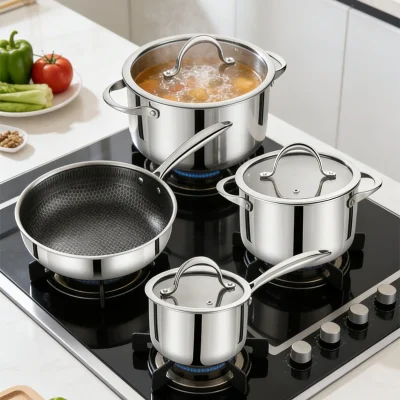
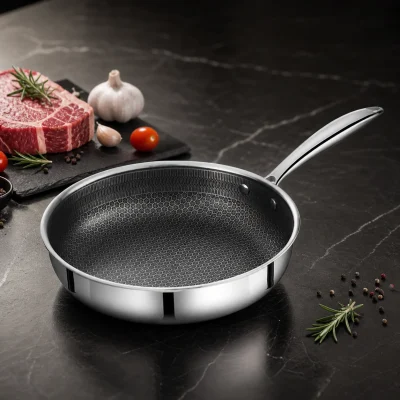
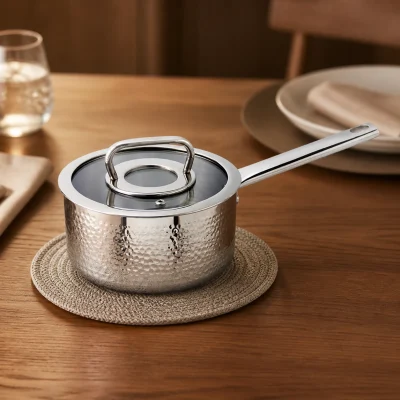
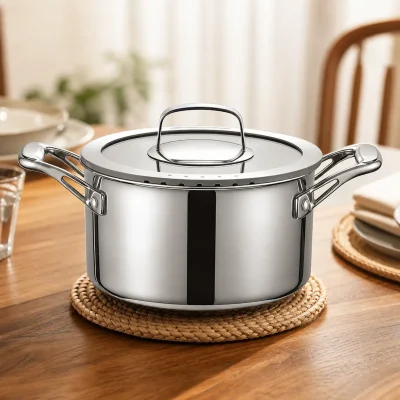
For cookware importers, private label brands, wholesalers and HoReCa buyers, choosing between 304 and 316 stainless steel is mainly a question about the food-contact inner layer. The two grades can look almost identical after polishing, but they do not offer exactly the same resistance to chloride-related corrosion, material cost or product positioning.
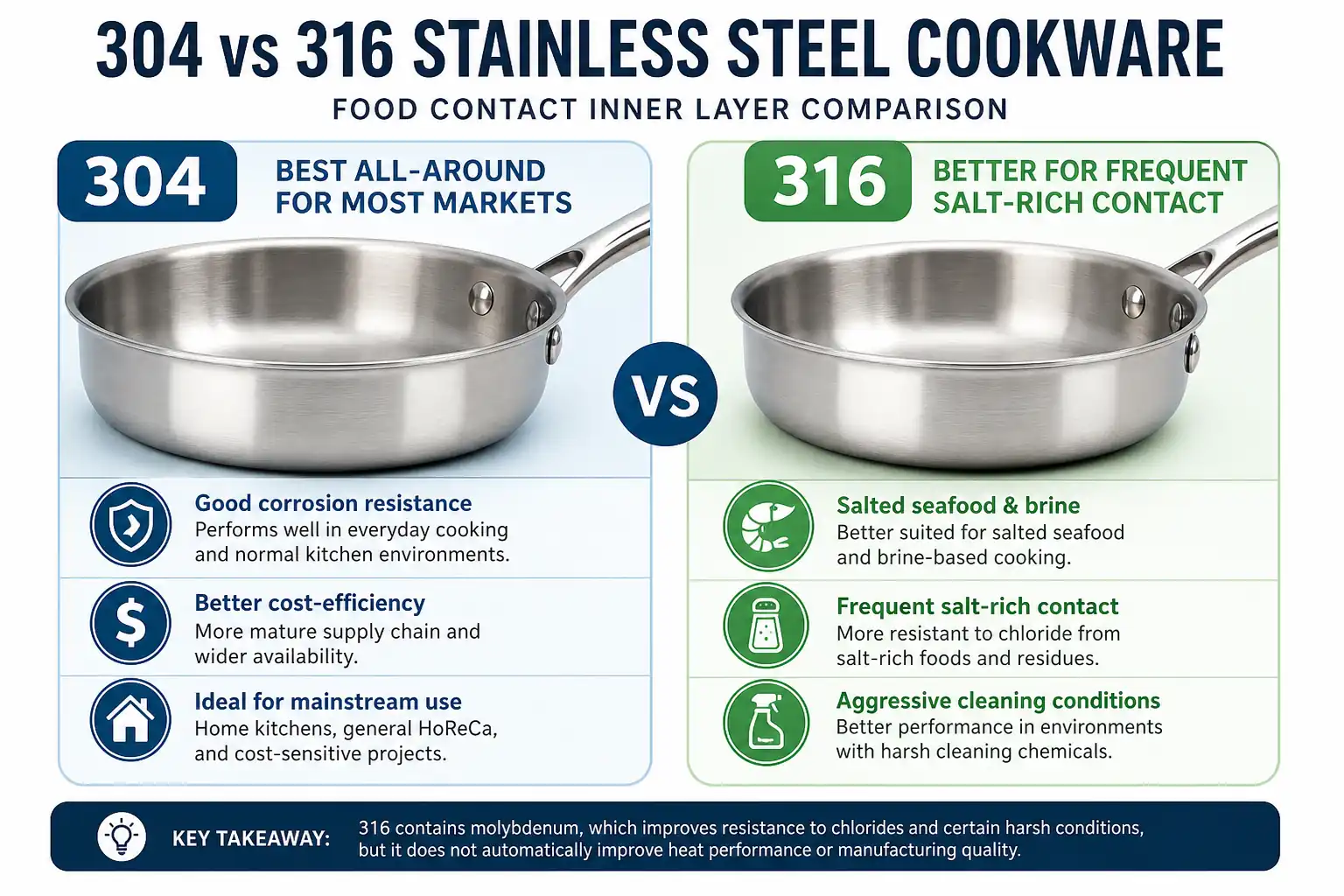
Quick verdict: 304 stainless steel is the practical specification for most household cookware and many normal commercial applications. A 316 inner layer becomes more relevant when cookware will face frequent direct contact with hot brine, heavily salted food, chloride-containing residues or aggressive cleaning chemicals; when a customer specification requires 316; or when a premium material story can support the added cost. Grade 316 does not automatically improve heat distribution, induction performance or overall manufacturing quality.
Key Takeaways
- 304 is the mainstream cookware choice. It provides useful corrosion resistance, broad material availability and a more cost-efficient basis for most household, retail and general HoReCa cookware programs.
- 316 offers higher resistance to pitting and crevice corrosion in chloride environments. Its molybdenum content can make it a better candidate for frequent contact with hot brine, heavily salted food and other demanding chloride exposure.
- 316 is not automatically safer or better in every cookware project. Both grades still require an appropriate product design, surface condition, manufacturing process and food-contact compliance assessment for the target market.
- The inner grade does not determine heating performance by itself. In multi-layer cookware, heat distribution depends more directly on the aluminum core, total thickness, bonding quality and cookware geometry.
- Appearance and a simple magnet test cannot reliably identify 304 versus 316. Buyers should define the inner grade in the specification and use material documents and suitable composition verification when required.
Contents
- What Do 304 and 316 Mean in Cookware?
- 304 vs 316 Stainless Steel Cookware Comparison
- When 304 Is the Practical Choice
- When a 316 Inner Layer May Be Worth the Extra Cost
- How the Inner Grade Fits into Multi-Layer Cookware
- How B2B Buyers Should Verify 304 or 316
- Buyer Decision Matrix
- Frequently Asked Questions
What Do 304 and 316 Mean in Cookware?
304 and 316 are austenitic stainless steel grades commonly considered for food-contact equipment. In cookware sourcing, the grade normally describes the stainless steel surface that directly contacts food, not necessarily every layer or component in the finished pot or pan.
Both grades use chromium to form a passive surface film that helps stainless steel resist corrosion. They also commonly contain nickel, which supports the austenitic structure and contributes to formability and corrosion performance. The major practical distinction is that 316 contains molybdenum. According to the Atlas Steels grade datasheets hosted by World Stainless, this addition gives 316 higher resistance to pitting and crevice corrosion, particularly in chloride environments.
This difference should not be simplified into a claim that 304 is unsafe or that 316 is corrosion-proof. Actual performance also depends on salt concentration, temperature, contact time, cleaning chemicals, surface finish, crevices, fabrication quality and maintenance. Even 316 can suffer localized corrosion in sufficiently aggressive conditions.
Does 18/10 Mean the Cookware Is 316?
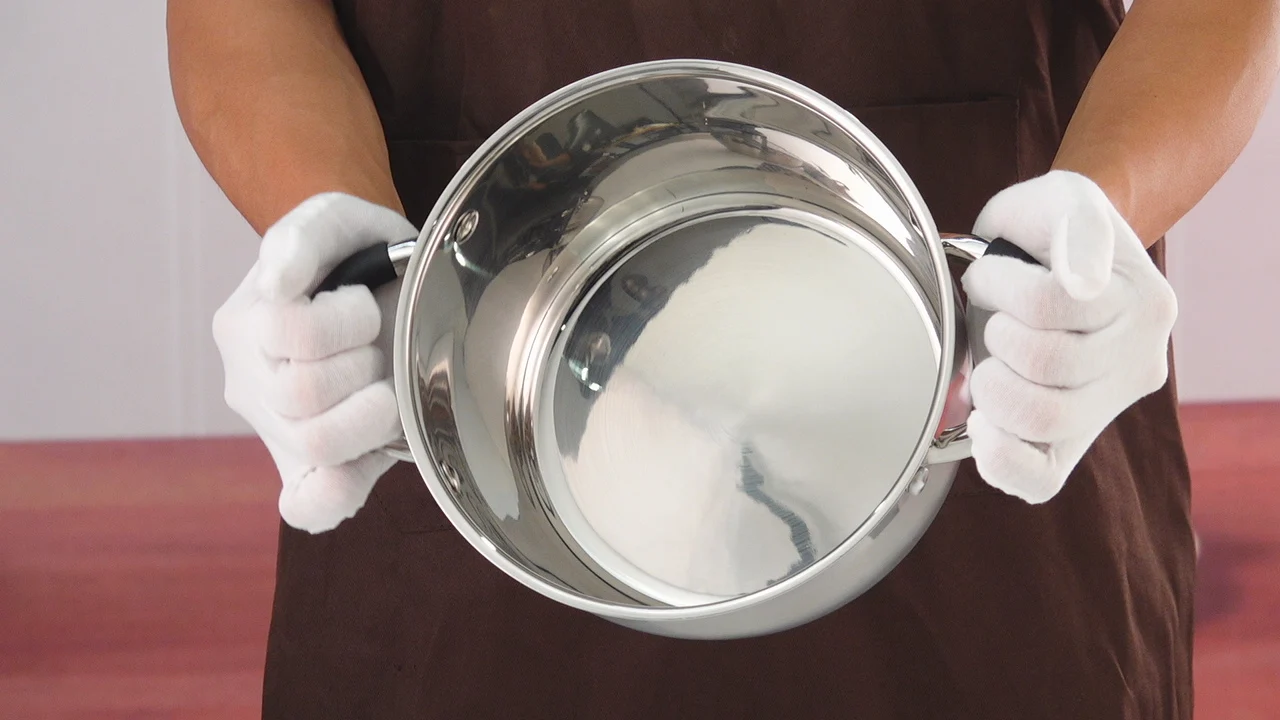
No. The term 18/10 is a broad commercial description referring approximately to chromium and nickel content. It does not identify molybdenum and therefore cannot reliably prove that a cookware interior is 316. Buyers should specify the applicable standard system, grade, product form and composition requirements rather than relying only on the word “304” or “316.” Examples may reference ASTM/AISI, EN or JIS designations, but the purchase specification and supporting documents should use one consistent system.
304 vs 316 Stainless Steel Cookware Comparison
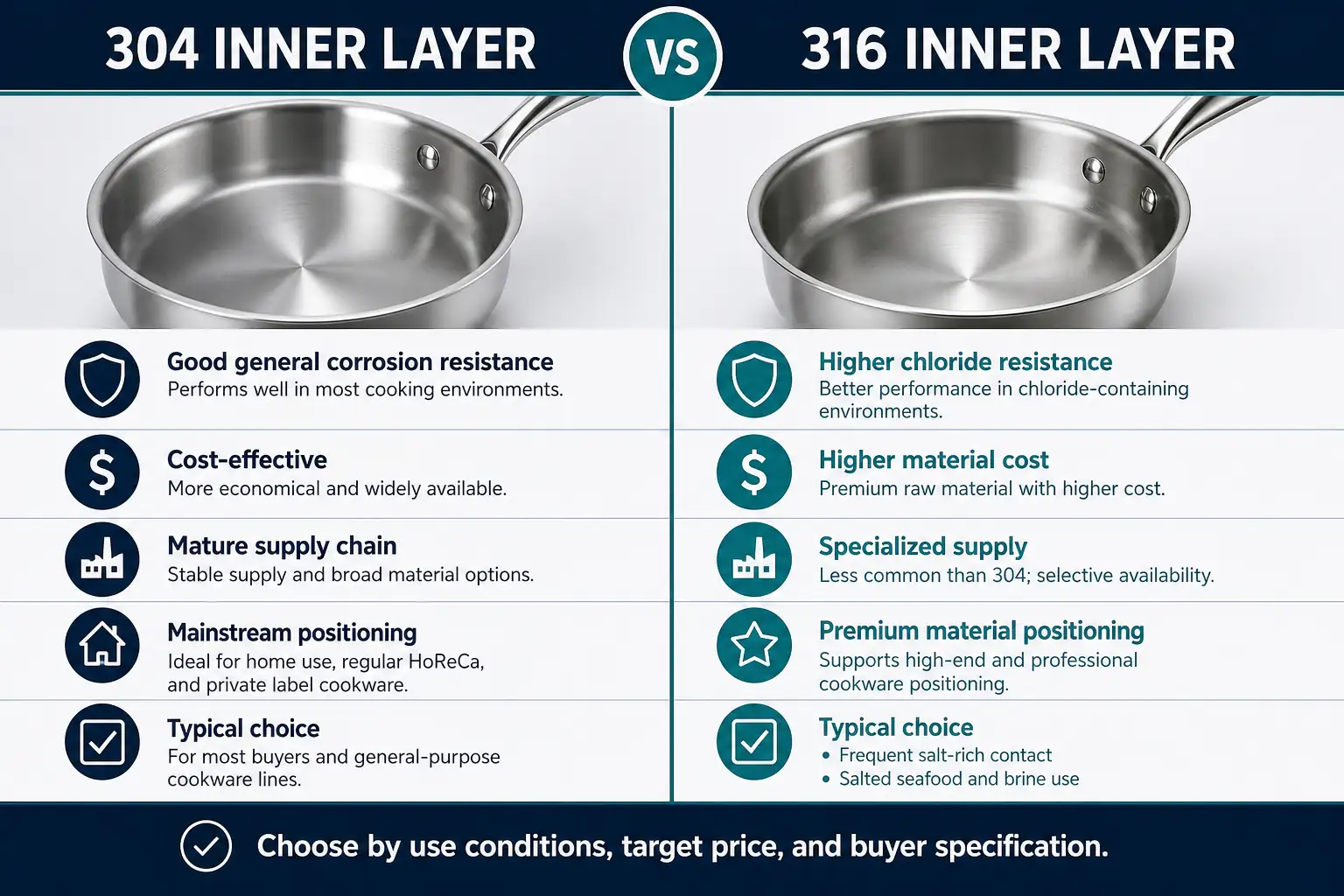
| Buying factor | 304 inner layer | 316 inner layer |
|---|---|---|
| Typical role | Mainstream food-contact cookware interior | Higher-corrosion-resistance food-contact interior |
| Chloride resistance | Suitable for many normal cooking and cleaning conditions | Higher resistance to chloride-related pitting and crevice corrosion |
| Salt-rich use | Often adequate for normal household cooking when properly used and cleaned | More relevant for frequent or demanding salt-rich exposure |
| Material supply | Widely available in cookware supply chains | More specialized and should be confirmed with the manufacturer |
| Relative material cost | More cost-efficient for mainstream programs | Normally higher because of alloy content and sourcing requirements |
| Market positioning | Entry-to-premium cookware depending on construction and workmanship | Premium or specialized material positioning |
| Heating performance | Depends on construction, core and thickness | Does not inherently conduct heat more evenly than 304 |
| Best B2B fit | Household retail, private label sets, wholesalers and general HoReCa | Special specifications, frequent brine or heavily salted food contact, aggressive chloride exposure and premium differentiation |
When 304 Is the Practical Choice
For most cookware programs, 304 offers the better balance of corrosion resistance, manufacturability, material availability and cost. It is commonly used for uncoated stainless steel cooking surfaces and can support both value-focused and premium products. A premium cookware line does not require 316 if its design, thickness, bonding, polishing and quality control already match the intended market.
Buyers should normally begin with 304 when developing:
- Household frying pans, saucepans, casseroles, stock pots and cookware sets for normal cooking conditions.
- Private label retail or e-commerce lines that need a recognizable stainless steel specification without unnecessary material cost.
- Wholesale programs where repeatability, broad size selection and supply stability are important.
- General restaurant, hotel and catering cookware that is cleaned properly and is not continuously exposed to unusually aggressive chloride conditions.
- Projects where the main performance priority is even heating, because that requirement should be addressed through the heat-conductive core and overall construction.
A well-specified 304 product is usually a better procurement decision than a product marketed as 316 without traceable material evidence. Buyers should compare quotations on the same basis, including the actual inner grade, construction, total body thickness, handle, lid, finish, packaging and testing scope.
When a 316 Inner Layer May Be Worth the Extra Cost
A 316 inner layer becomes commercially meaningful when the added corrosion resistance addresses a defined use condition or customer requirement. World Stainless guidance for the food and beverage industry notes that molybdenum-bearing grades such as 316 are particularly useful where chloride levels or aggressive food media are higher. This supports considering 316 for cookware or food-service equipment exposed frequently to hot brine, heavily salted foods or chloride-containing residues, although each finished product still needs an application-specific assessment.
Buyers may consider 316 when:
- The cookware is intended for frequent direct contact with salted seafood, hot brine or heavily salted preparations rather than occasional household use.
- The food-contact surface or cleaning process is directly exposed to chloride-containing residues or aggressive cleaning chemicals.
- A professional kitchen or food-processing customer has a written material requirement for the food-contact surface.
- The brand wants a premium alloy story and can explain the application benefit accurately without implying that 304 is unsafe.
- The buyer can support the added material, verification and supply-chain cost at the intended retail or contract price.
Grade 316 should not be selected only because it sounds more premium. If end users cook under ordinary conditions, the commercial benefit may be less important than improvements in body thickness, aluminum-core design, rim finishing, handle ergonomics or packaging.
How the Inner Grade Fits into Multi-Layer Cookware
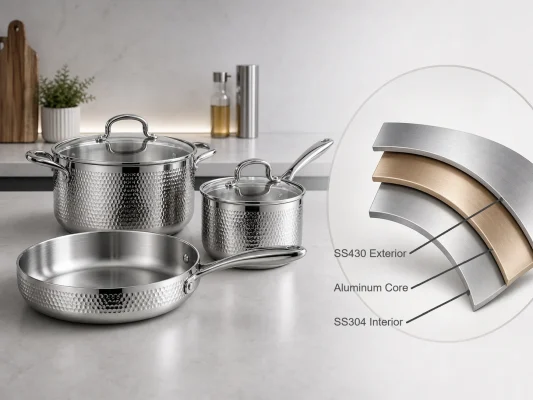
In multi-layer cookware, the food-contact grade is one part of a complete structure. A common induction-ready tri-ply construction uses a 304 stainless steel interior, an aluminum heat core and a 430 magnetic stainless steel exterior. The layers perform different functions: the interior provides the cooking surface, aluminum distributes heat and the exterior supports induction compatibility.
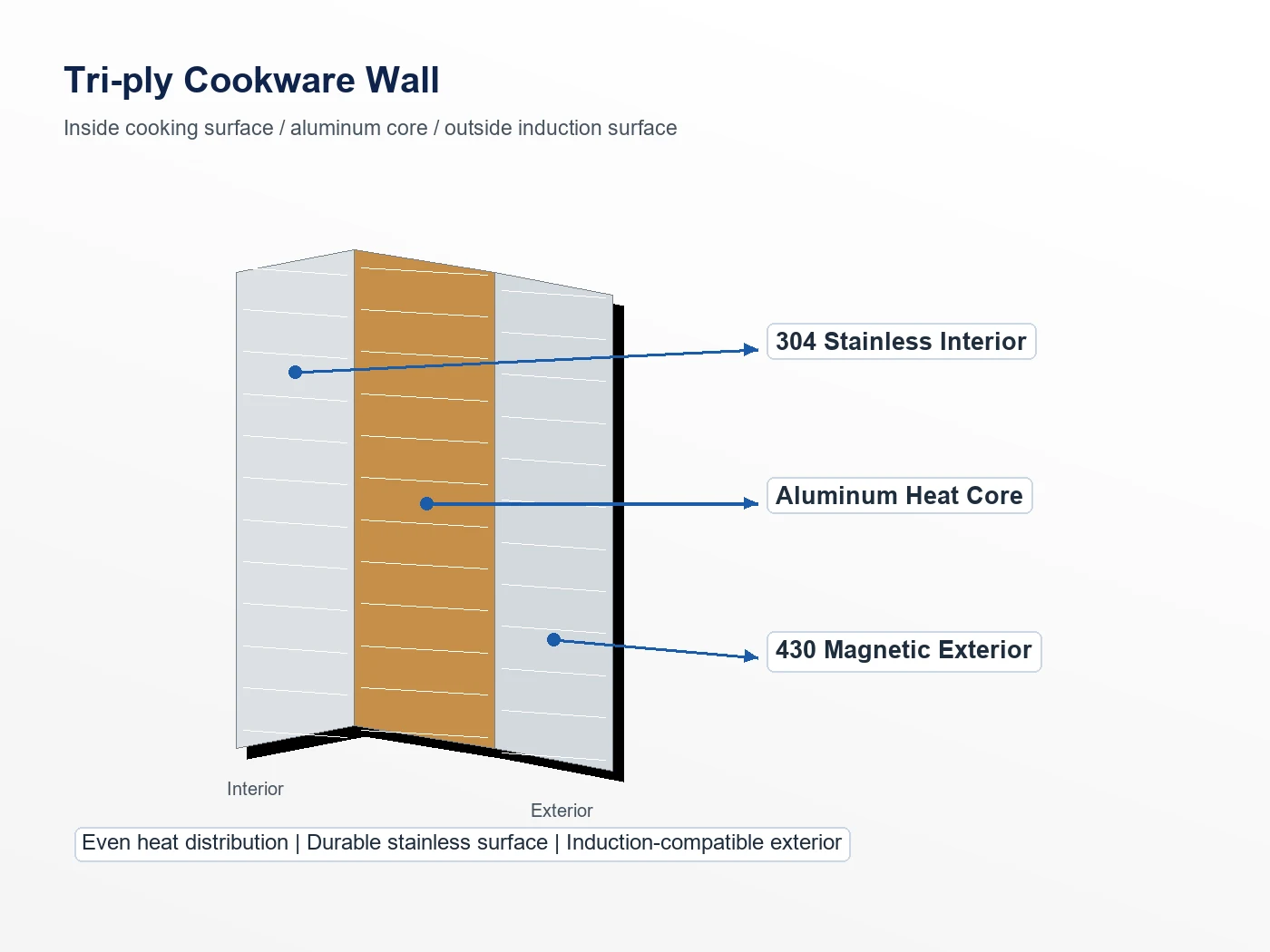
If a project changes the food-contact interior from 304 to 316, the primary change is corrosion resistance, material cost and specification control. It does not automatically make the pan heat faster or more evenly. Thermal performance still depends mainly on the aluminum core, total thickness, bonding consistency, pan geometry and base flatness.
Buyers planning a layered cookware project can review Goldensea’s tri-ply cookware technical guides and current tri-ply stainless steel cookware range. Material combinations outside the standard structure should be discussed during RFQ and sample development rather than assumed to be available for every model.
How B2B Buyers Should Verify 304 or 316
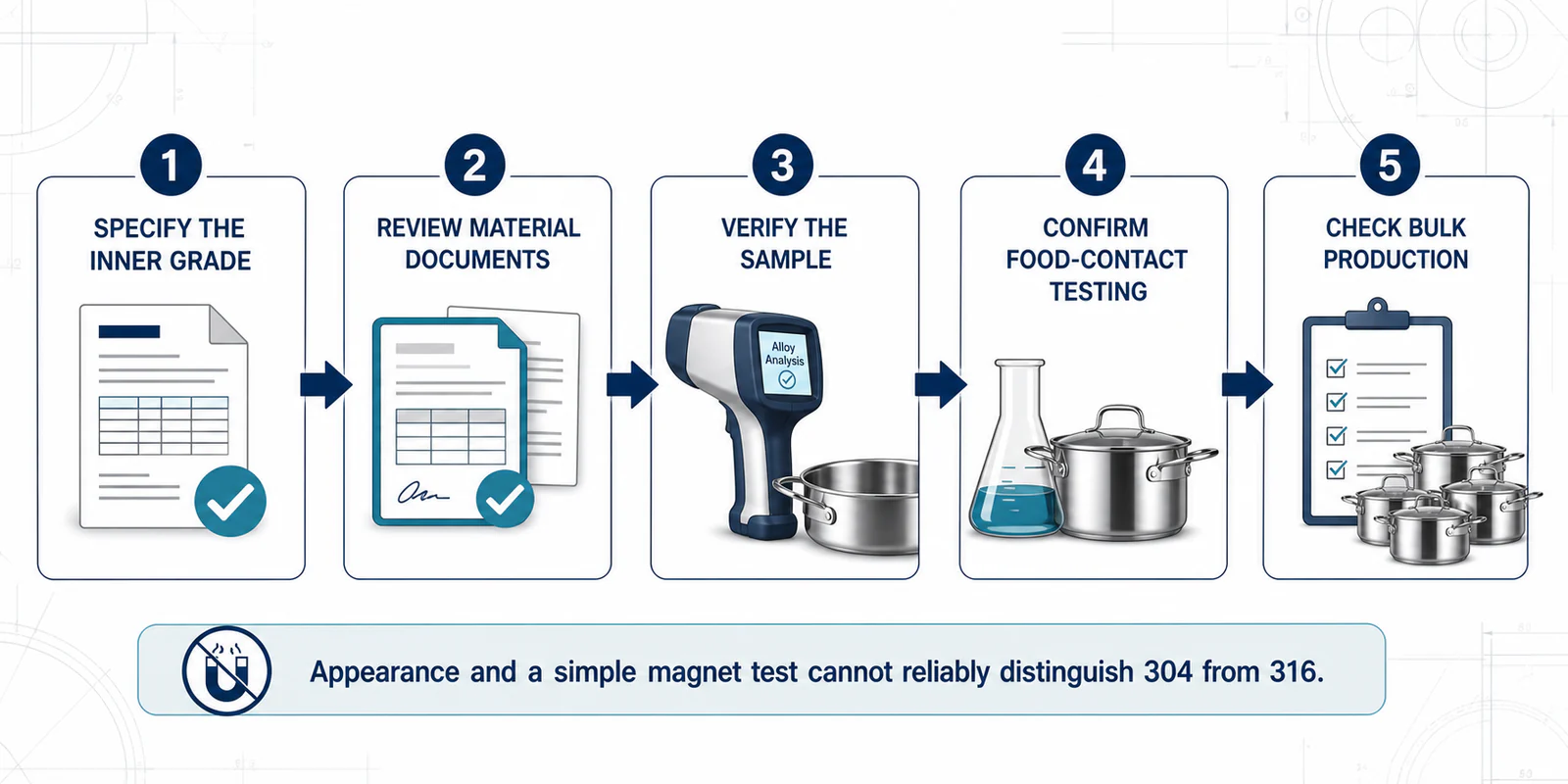
A polished cooking surface does not reveal whether it is 304 or 316. A simple magnet test is also unsuitable for distinguishing the two because both are normally austenitic and their magnetic response can vary after forming or cold working. Thickness measurement confirms gauge, not alloy composition.
Use the following verification workflow:
- Write the inner grade into the RFQ and approved specification. Identify the food-contact component separately from the exterior, base, handle and lid materials.
- Review material and traceability documents. Ask for a Mill Test Certificate or Material Test Certificate showing the applicable standard, grade, chemistry and heat or batch number. Confirm that the document can be linked to the raw material and production lot used for the order.
- Verify the sample when the risk justifies it. Positive Material Identification, commonly performed with a suitable XRF analyzer, can screen alloy chemistry at defined sampling locations. For 304-versus-316 verification, the method and equipment must be capable of confirming molybdenum; a photograph of an analyzer alone does not prove the grade of an entire batch.
- Confirm target-market food-contact testing. Material grade and regulatory compliance are different questions. Testing scope should reflect the destination market, finished product, food-contact parts and intended use.
- Control bulk production. Inspection should check that the approved material, construction, thickness, finish and workmanship remain consistent with the confirmed sample and order specification.
For broader inspection planning, see our guide on checking stainless steel cookware quality before a bulk order and the cookware certification and quality control hub.
Common Sourcing Mistakes
Calling 316 universally better or safer
316 provides a specific corrosion-resistance advantage in more demanding chloride conditions. That does not make 304 unsuitable for normal cookware, and the grade name alone does not establish finished-product safety or compliance.
Describing the whole pan as one stainless steel grade
Cookware may combine different grades and metals. Specifications should identify the food-contact interior, heat core, exterior, base, handle, fasteners and lid separately where these distinctions affect the order.
Accepting a material claim without batch-related evidence
A general brochure or old test report may not prove what was used in the current order. Buyers should connect documents and verification to the approved sample and bulk-production control process.
Using a magnet or thickness gauge to identify 316
These checks can answer other quality questions, but they do not reliably separate 304 from 316. Composition analysis is more relevant when alloy verification is required.
Ignoring the rest of the cookware specification
Material grade cannot compensate for poor bonding, an inadequate heat core, an unstable base, rough finishing or weak handle attachment. The supplier evaluation must cover the complete product.
Buyer Decision Matrix
| Project condition | Recommended starting point | Buyer action |
|---|---|---|
| Mainstream household retail line | 304 inner layer | Prioritize construction, thickness, finish and target-market testing |
| General private label cookware set | 304 inner layer | Compare complete specifications and confirm material documents |
| Normal restaurant or hotel use | Usually 304 | Review cleaning practice, food exposure and duty cycle |
| Frequent hot-brine, salted-seafood or heavily salted food contact | Consider 316 | Define direct exposure conditions and verify the alloy specification |
| Customer contract explicitly requires 316 | 316 inner layer | Put the grade and verification requirements into the contract |
| Premium marketing without a demanding use case | Compare 304 and 316 commercially | Confirm whether customers will value the alloy more than other upgrades |
Frequently Asked Questions
Is 316 stainless steel safer than 304 for cookware?
Not automatically. Both grades can be used for food-contact applications when the finished cookware is properly designed, manufactured and assessed for the target market. The main advantage of 316 is higher resistance to certain chloride-related corrosion conditions, not a universal safety classification.
Is 304 stainless steel suitable for acidic foods?
304 is widely used for normal food-contact applications, including many acidic foods. Performance still depends on concentration, temperature, contact time, salt content, cleaning and surface condition. Buyers planning unusually aggressive applications should define the actual exposure and seek an application-specific material assessment.
Does 316 cookware heat more evenly than 304 cookware?
No inherent heating advantage should be assumed. Stainless steel grade affects corrosion performance more than heat distribution. In clad cookware, the aluminum core, total body thickness, bonding quality, shape and base design have a greater influence on heating behavior.
Is 18/10 stainless steel the same as 316?
No. The 18/10 description refers approximately to chromium and nickel, but it does not confirm the molybdenum associated with 316. Buyers requiring a specific alloy should define the applicable ASTM/AISI, EN or JIS designation consistently and request batch-related supporting documentation.
Can a magnet distinguish 304 from 316 cookware?
No. A simple magnet test cannot reliably distinguish these two austenitic grades, and forming can change magnetic response. The test may help investigate a magnetic exterior layer, but suitable composition verification is needed when confirming 304 versus 316.
Can Goldensea customize cookware with a 316 food-contact inner layer?
A 316 inner-layer project should be evaluated according to cookware construction, model, order quantity, material availability, target price and testing requirements. Send the intended market and complete specification to Goldensea so the engineering and sourcing teams can review feasibility before quotation and sampling.
Technical References
- Atlas Steels: Stainless Steel Grade Datasheets (hosted by World Stainless)
- World Stainless: Stainless Steel in the Food and Beverage Industry
- Outokumpu: Core Range Stainless Steel Datasheet
Discuss Your Cookware Material Specification
The correct choice is not simply the grade with the higher alloy content. It is the grade that matches the expected food exposure, cleaning conditions, price position, customer specification and verification plan. For most mainstream cookware, 304 remains the practical starting point. For defined hot-brine, heavily salted food or other direct chloride exposure, 316 may provide a valuable additional margin of corrosion resistance.
Goldensea supports B2B cookware development for importers, wholesalers, private label brands and HoReCa buyers. Review our OEM and ODM custom cookware solutions, then send an inquiry with your target market, cookware type, inner grade, construction, sizes, quantity, packaging and food-contact testing requirements.

Mei is a dedicated Sales Specialist at Goldensea with over 10 years of experience in the B2B kitchenware industry. Possessing deep technical knowledge of manufacturing and sourcing, she has successfully helped global clients navigate complex supply chain challenges and develop suitable cookware solutions.
Connect with Mei on LinkedIn or reach out for professional kitchenware advice.