





Updated: August 9, 2026
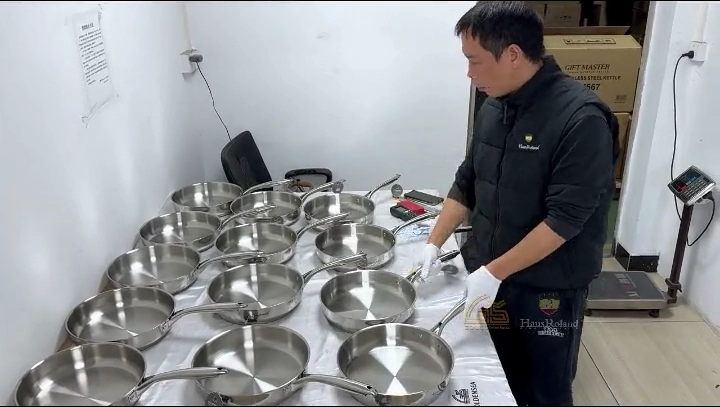
Checking stainless steel cookware quality before bulk order is not a last-day visual inspection. For importers, private label brands, wholesalers, retailers, distributors, and HoReCa buyers, it is a controlled process that keeps the approved sample, written specification, production batch, packaging, and release decision aligned. A pan can look acceptable in a photo while still differing in dimensions, components, packing, or the records needed for its destination market. This guide explains what to lock before sample approval, before bulk production, and before shipment so the purchasing team can identify mismatches while they are still manageable.
Key Takeaways
- An approved cookware sample is a reliable production reference only when its specification, tolerances, packaging artwork, and change record are documented together.
- A magnet check can screen for a magnetic outer layer; it cannot prove stainless steel grade, aluminum-core thickness, or full-clad construction.
- Food-contact documents should match the supplied product, food-contact components, intended use, and target market. Document review belongs in a defined release gate, not at the end of production.
- Pre-shipment inspection works best when the lot, inspection items, defect categories, sampling rule, and corrective-action process are agreed before production begins.
What Does “Quality Before Bulk Order” Actually Mean?
Quality before bulk order means confirming that the physical sample, controlled product specification, component scope, packaging, and acceptance process can be repeated in mass production. It has three stages: approving the reference sample, preparing production and documents, and deciding whether the completed shipment meets the agreed release criteria. It is not a single inspection performed after cartons are closed.
1. Build an Approved-Sample Acceptance Package
A golden sample should be more than one approved pan on a shelf. Tie it to a dated specification sheet, SKU or set list, photos or drawings, and the approved logo and packaging artwork. The package should identify the cookware size, capacity where relevant, material stack, finish, handle and lid option, visible branding, packing arrangement, and the version that the buyer has approved.
For a tri-ply stainless steel cookware project, record whether the item is full-clad, the agreed layer stack, the target thickness or measurement points, and the intended cooktop. For a set, include every body, lid, insert, accessory, and retail component. If any feature changes after approval, document the change and confirm its effect on price, timing, samples, testing, and packaging before it is released to production.
2. Verify Material and Tri-Ply Construction With the Right Evidence
Material and construction affect heat response, induction suitability, weight, durability, and product positioning. A common tri-ply construction uses stainless steel on the food-contact side, an aluminum core, and magnetic stainless steel outside, but the agreed construction must be written for the actual SKU rather than assumed from a generic description.
A magnet can indicate that an outer surface is magnetic. It cannot independently verify the stainless steel grade, the aluminum-core thickness, bonding coverage, or whether the body is fully clad. Keep a magnet check separate from the material and construction evidence. Depending on the project risk, buyers may use the approved specification, material or batch records, sample cross-section information, and project-appropriate independent verification to resolve a mismatch.
3. Define How Thickness, Weight, and Base Flatness Will Be Measured
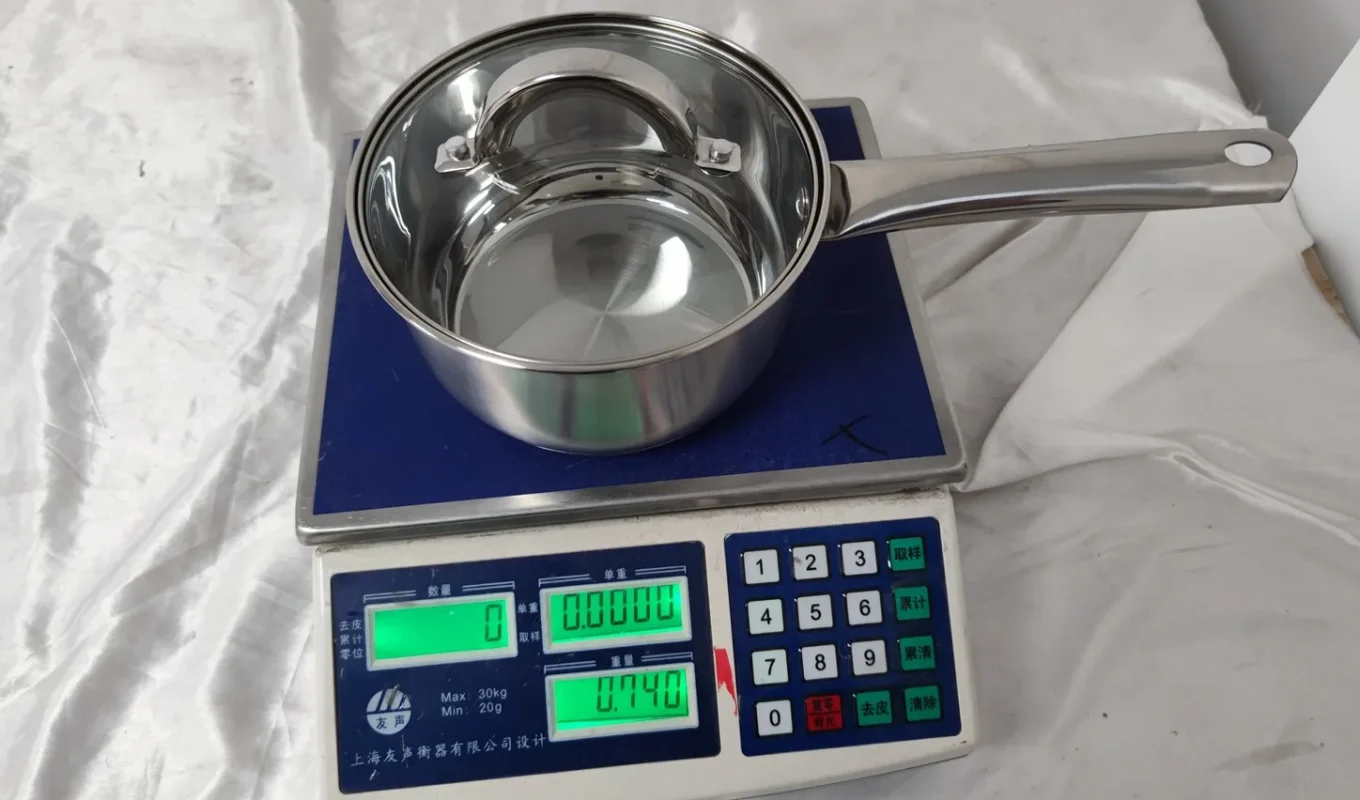
Thickness, finished weight, and base flatness should be measurable requirements, not impressions. Before production, specify the measurement points, units, tools, target values or agreed ranges, and whether the stated weight includes the lid. A single thickness number does not describe every part of a formed pan; a defined measurement plan prevents the buyer and factory from comparing different points.
Base flatness also depends on the intended hob and cooking conditions. State whether the product is intended for induction, gas, electric, or ceramic cooking and agree how the base will be checked against the approved sample. Read our guides on how to compare tri-ply cookware thickness and base flatness and sample testing when preparing the technical acceptance criteria.
4. Inspect Surface Condition, Rims, and Workmanship Beyond Appearance
Use the approved sample to define what a normal mirror, brushed, satin, hammered, or coated finish should look like. Inspect cookware under normal viewing conditions for scratches, dents, stains, polishing residue, inconsistent color, rough rims, sharp edges, and misplaced branding. Record the difference between a cosmetic issue that can be reworked and a functional, hygiene, or safety issue that must be isolated.
Surface appearance is not the only consideration. Cleanable cooking surfaces, finished rims, and stable component interfaces influence user experience and retail presentation. If the project needs a specific cleaning, passivation, or performance check, make it part of the written project requirement instead of assuming one general check applies to every design.
5. Treat Handles, Lids, and Connections as Safety-Critical Components
Handles, knobs, lids, rivets, welds, and other connections should be checked as functional components, not just as finishing details. Confirm the connection type, attachment position, alignment, lid-to-body fit, and packaging clearance against the approved sample. For glass lids, include the rim, knob, vent, and protective packing in the review; for stainless steel lids, check the profile, fit, handle attachment, and finish.
Where the target market, channel, or customer standard requires additional performance verification, agree the applicable test or inspection method before production. Loose, misaligned, heat-sensitive, or poorly fitting components should be isolated and traced to the affected operation or component batch rather than treated as a minor cosmetic finding.
6. Set a Documentation Gate Before Production
Before production is released, record the target market, the documents required for this project, the responsible owner, and the completion status in the acceptance package. The required evidence depends on the product materials, food-contact components, intended use, packaging claims, and destination market. Do not treat one document as a blanket approval for all future SKUs, sets, lids, handles, coatings, or markets. If the document scope is unclear, pause the release decision and review it with the buyer, supplier, and appropriate laboratory or adviser. For a detailed document-review method, see how to verify whether a cookware test report covers your order.
7. Inspect Packaging as Part of Product Acceptance
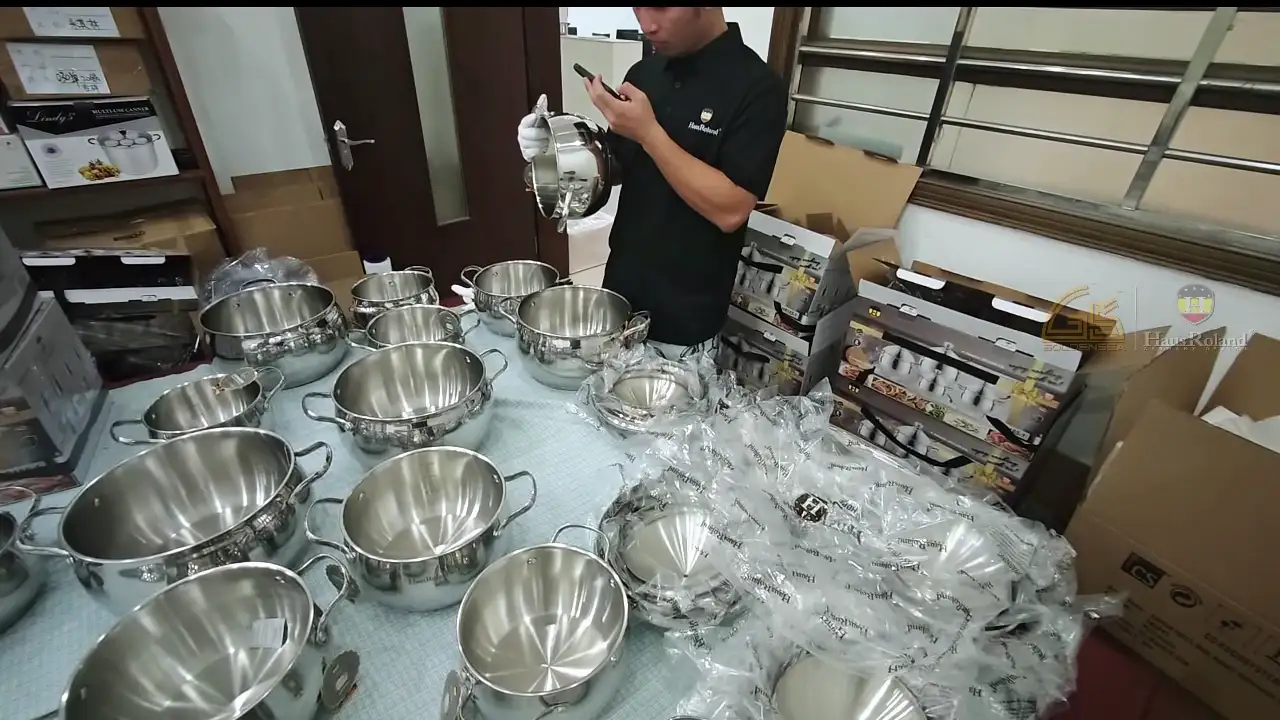
Packaging is part of the delivered cookware order. Approve the retail box, outer carton, internal protection, barcode, labels, instructions, language, carton marks, set arrangement, and quantity per carton before shipment. For retail or e-commerce projects, record any channel-specific transit or drop-test requirements in the same package.
During inspection, open representative cartons and compare the product arrangement, accessories, labels, artwork, and quantities with the approved reference. Treat missing items, wrong artwork, damaged protection, and mixed SKUs as separate defect types. Correct packing and labeling issues before final release, not after the containers are scheduled.
8. Agree the Pre-Shipment Sampling and Defect Plan Before Production Starts
Do not leave the inspection plan until goods are ready to ship. Define the lot, inspection timing, inspection party, product and packaging checks, defect categories, sampling rule, acceptance or rejection rule, and reinspection process in advance. An AQL label alone is not an inspection plan: the buyer and supplier must still agree what is being inspected and how findings will be handled.
For measurable characteristics such as dimensions or weight, use the agreed tools, measurement points, and acceptance criteria. For appearance or assembly, use the approved sample and written defect definitions. If a nonconformity is found, document the affected lot, evidence, corrective action, and verification result before shipment is released.
Bulk-Order Quality Control Matrix
| Quality risk | Lock before production | Evidence or check | Action if inconsistent |
|---|---|---|---|
| Sample-to-production drift | Sample ID, specification version, artwork, and change process | Approved golden sample and version-controlled acceptance package | Pause the change; confirm the impact before release |
| Material or construction mismatch | Layer stack, applicable parts, measurement points, and intended use | Specification, supporting material records, and project-appropriate verification | Separate preliminary checks from construction evidence; investigate the affected batch |
| Dimension, weight, or base issue | Tools, units, target values or ranges, and cooktop requirement | Recorded sample measurements and comparison with the approved sample | Recheck and isolate the suspected batch under the agreed acceptance rule |
| Surface or rim defect | Finish standard and defect definitions | Visual inspection under agreed conditions and defect photos | Classify for rework, isolation, or rejection; verify after correction |
| Handle, lid, or connection issue | Connection type, fit, orientation, and required functional checks | Assembly inspection and project-appropriate performance verification | Trace related parts and operations; inspect the affected scope |
| Incomplete release documents | Market, required files, owner, and completion status | Completed documentation gate | Do not release production or shipment until the scope is resolved |
| Packaging or channel failure | Artwork, labels, protection, language, and carton configuration | Approved packaging sample and carton inspection | Correct packaging and labels before final inspection |
| Sampling dispute | Lot definition, defects, sampling rule, and reinspection process | Written inspection plan, records, and findings photos | Apply the agreed corrective-action and reinspection process |
Buyer Checklist: Three Release Stages
| Stage | Must be complete | Owner | Evidence |
|---|---|---|---|
| Before sample approval | SKU or set list, material and construction target, dimensions, finish, handle, lid, branding, packaging concept, intended market | Buyer and supplier | Approved physical sample, photos or drawings, preliminary specification |
| Before bulk production | Controlled specification, measurement plan, tolerances, artwork, component scope, documentation gate, defect plan, and change control | Buyer, supplier, and quality owner | Signed or otherwise approved acceptance package |
| Before shipment | Lot inspection, product and carton checks, quantity, records, corrective actions, and release decision | Factory quality team, buyer, or appointed inspector | Inspection record, defect evidence, packing check, and final release record |
Common Mistakes That Create Bulk-Order Disputes
- Approving only photos. Photos do not control weight, balance, lid fit, edge finishing, packaging strength, or component consistency.
- Using a golden sample without a controlled specification. A sample alone does not show the measurement points, artwork version, scope of components, or acceptable variation.
- Treating a magnet check as material proof. It can screen outer-layer magnetism but cannot prove the full construction of a tri-ply pan.
- Discussing documents or inspection rules at the end. File scope and acceptance rules need owners and deadlines before production begins.
- Using a generic AQL request with no defect plan. The lot, items, defect categories, sample rule, and corrective action still need to be defined.
Frequently Asked Questions
Can a magnet test prove tri-ply cookware quality?
No. A magnet can indicate that an outer layer is magnetic, which is relevant to induction suitability. It cannot by itself verify stainless steel grade, aluminum-core thickness, bonding quality, or full-clad construction. Use it only as an initial screen alongside the approved specification and project-appropriate evidence.
What should a golden sample package include?
Include the approved sample ID, SKU or set list, product photos or drawings, material and component scope, dimensions and measurement points, finish, handle and lid configuration, logo and packaging artwork, and a process for recording changes. The aim is to make the reference repeatable in production rather than relying on memory or photos.
Is an AQL level enough to protect a cookware order?
No. A sampling level does not define the lot, the items to inspect, defect categories, acceptance rule, reinspection process, or corrective action. Those details should be agreed before production. The appropriate approach depends on the SKU, order risk, channel, contract, and buyer requirements.
What should be complete before bulk production starts?
The buyer and supplier should have an approved sample, controlled specification, measurement and tolerance plan, component and packaging scope, target-market documentation gate, and inspection plan. If a requirement is still unclear, resolve it before releasing bulk production rather than assuming it can be corrected at shipment.
When should buyers arrange third-party inspection?
Buyers may appoint an independent inspector when the order risk, channel requirements, value, or internal quality capacity makes it appropriate. Arrange the scope and timing before production begins, and provide the inspector with the approved acceptance package so findings can be assessed against agreed requirements.
Plan Quality Controls Before the Purchase Order Is Released
Stainless steel cookware quality is easier to control when the approved sample, specification, documentation gate, packaging, and inspection plan are treated as one release system. For more quality and compliance guidance, visit the Cookware Certification & Quality Control hub.
Send Goldensea your target market, SKU or set list, intended cooktop, material stack, quantity, packaging, and inspection requirements. We can discuss a suitable custom cookware specification and OEM/ODM project approach. Contact Goldensea to request a quotation or start a sample discussion.

Shiva Yang is a Sales Manager at Goldensea, supporting global B2B buyers with tri-ply stainless steel cookware sourcing, private-label programs, and OEM/ODM project coordination.
Connect with Shiva on LinkedIn or contact Goldensea to discuss a cookware project.