
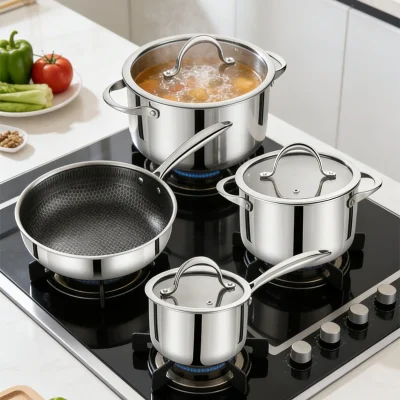
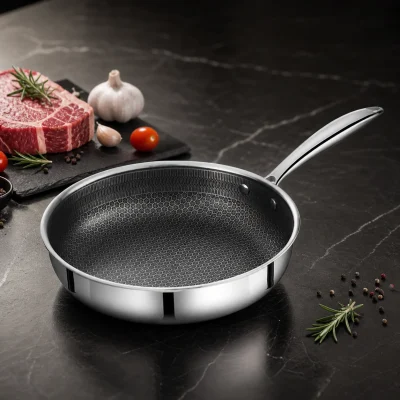
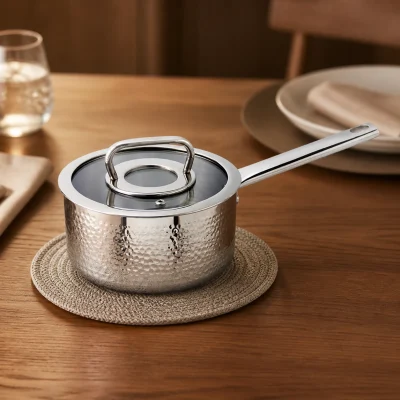
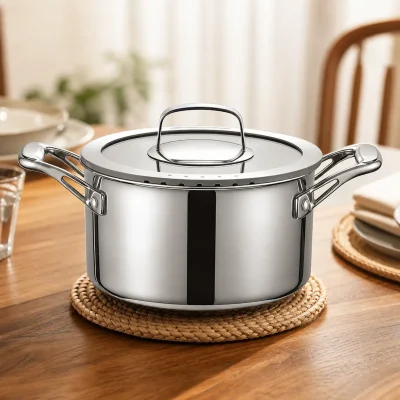


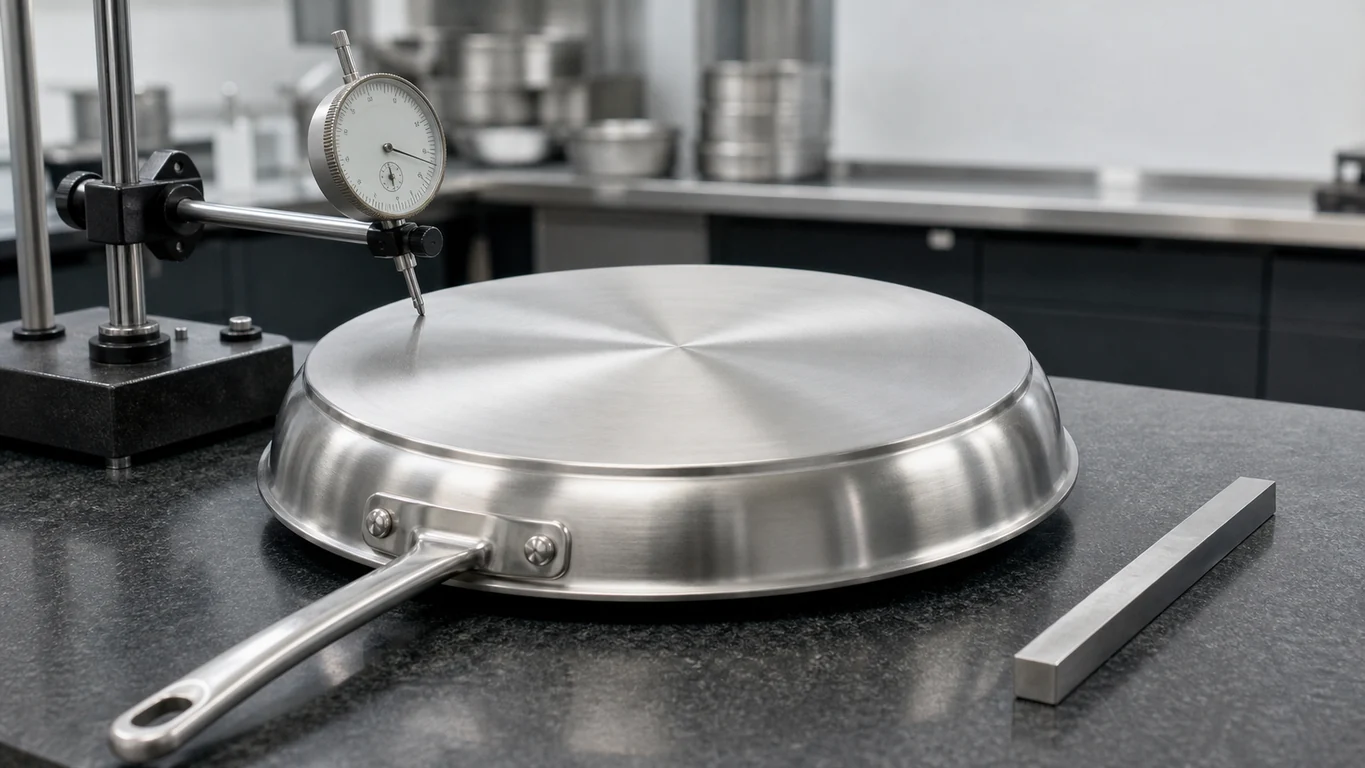
Illustrative inspection setup; agree the method and limits for the SKU and market.
Tri-ply cookware warping can create a costly sourcing problem: a pan that rocks, becomes convex or loses steady cooktop contact may lead to returns and induction complaints. Before approving a sample, check whether the finished SKU stays stable after a defined test—and apply the same check to the first production run.
This guide helps B2B buyers set a practical flatness check, run controlled heat-cycle tests and turn the sample result into a usable production-control point.
Key Takeaways
- Tri-ply construction can improve heat distribution, but base stability must still be verified on the final pan or pot design.
- Base flatness is not a quick tabletop impression. A usable specification defines the reference plane, instrument, measurement locations, sample temperature and acceptance criterion.
- Heat-cycle testing is more informative than a cold visual check because it can reveal how geometry, material stack, forming condition and local heat exposure interact.
- For induction programs, magnetic suitability is only one requirement. Buyers should also confirm post-cycle stability and intended-hob performance.
- A numbered golden sample, measurement record and written retest rule help prevent a good prototype from becoming an uncontrolled bulk-order reference.
What Does “Warping” Mean in Cookware Sourcing?
In sourcing discussions, “warping” should mean a loss of functional base stability—not simply any visible change in a hot pan. For a flat-bottom frying pan, the practical signs may include a base that becomes convex after heating or cooling, rocking on a reference surface, an altered oil pool, unstable contact with a glass cooktop, or inconsistent induction recognition. A cold pan can look acceptable at one moment while still needing a defined post-heating check.
That distinction matters because a room-temperature gap is not, by itself, a universal pass-or-fail rule. The buyer and supplier need to agree what surface is used as the reference, when the measurement occurs, which points are assessed and how the result is judged. The useful requirement is a repeatable inspection method for the finished SKU, not a generic marketing phrase.
Buyer definition: A cookware base-stability requirement should describe the product state after an agreed test method, rather than relying only on an unqualified claim that the pan is anti-warp.
Why Tri-ply Cookware Can Still Move Under Heat
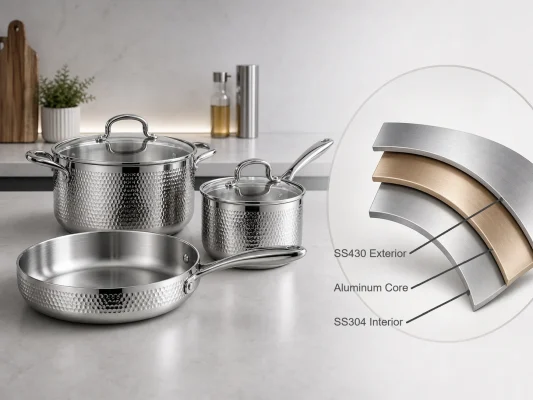
Fully clad tri-ply cookware commonly combines a food-contact stainless steel interior, an aluminum core and a magnetic stainless steel exterior. These materials bring useful but different thermal properties: aluminum transfers heat much more readily than stainless steel, while aluminum and stainless steel do not expand by the same amount as temperature changes. The NIST reference tables and an Outokumpu 304 stainless-steel datasheet provide useful background for those differences.
A balanced three-layer stack can help reduce bending tendency under uniform heating, but it does not allow buyers to predict an individual pan’s performance from material names alone. Base diameter, wall height, layer distribution, total gauge, finished weight, forming condition and the way heat enters the pan all influence the outcome. A local high-heat zone or repeated rapid temperature change can expose an existing geometric deviation or stress condition. Whether that becomes permanent functional distortion must be confirmed on the actual SKU.
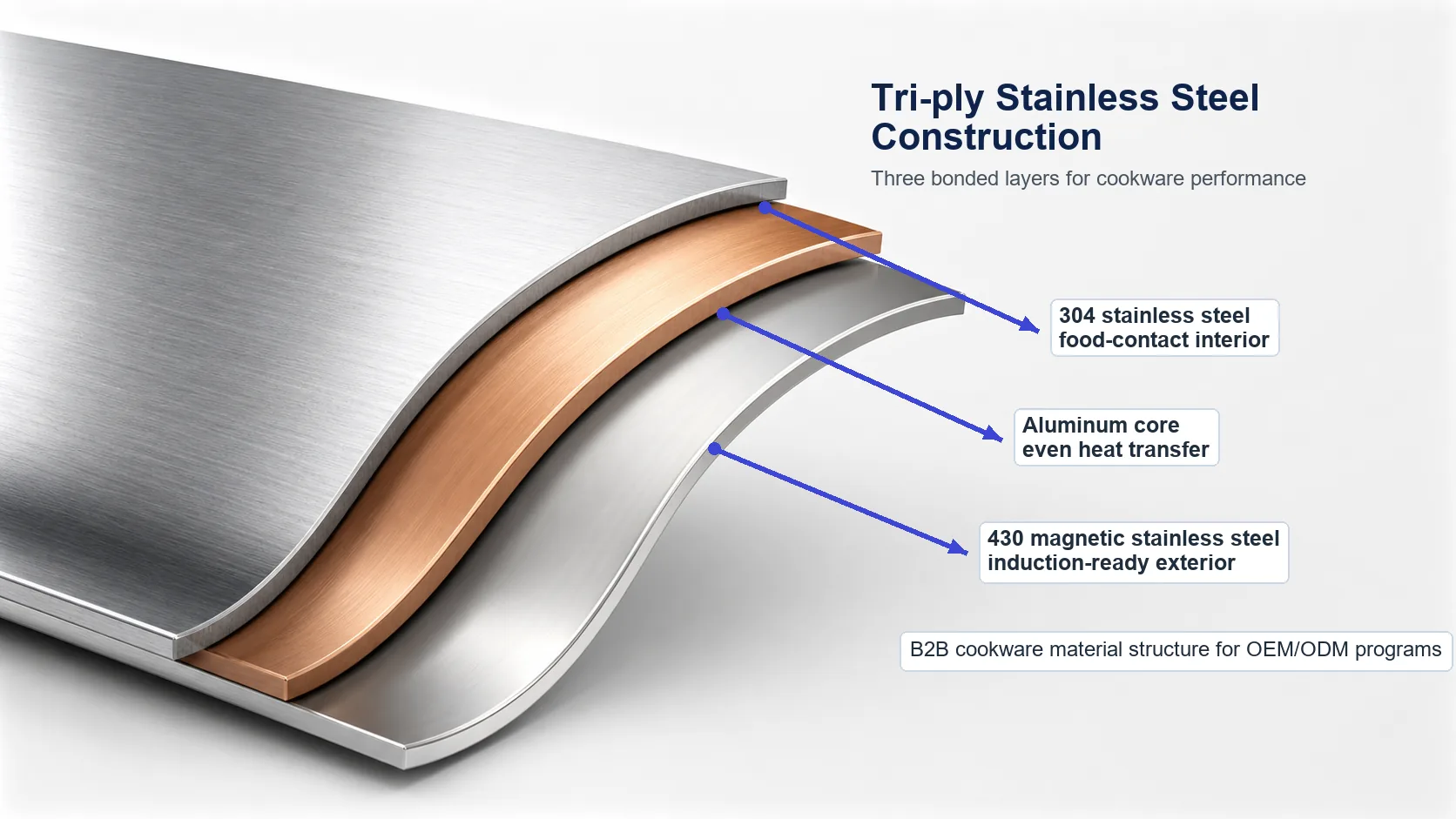
Finished performance depends on geometry and agreed test conditions, not layer names alone.
For material-stack background, see our tri-ply stainless steel cookware guide.
The Main Risk Factors Buyers Should Evaluate
| Factor | Why it can affect stability | What to confirm at sample stage |
|---|---|---|
| Material stack | Bonded layers respond differently to heat. | Layer structure, gauge and thickness map. |
| Base and body geometry | Diameter, profile and mass affect stiffness. | Dimensions, base diameter and sample weight. |
| Finished condition | Initial geometry affects thermal response. | Approved-sample records and re-approval triggers. |
| Heat source | Hob types and zones create different heat patterns. | Target hob, zone and intended use. |
| Cooling and cycles | Repeated thermal exposure is more revealing than a cold check. | Written sequence and observation points. |
| Acceptance method | A shared method enables comparison. | Reference plane, instrument, temperature and retest rule. |
Thickness belongs in this discussion, but it should not become a shortcut. A higher nominal millimeter value alone does not prove a pan will remain stable. Two pieces with the same claimed thickness can have different layer allocation, diameter, profile, mass and heat-cycle response. Ask where thickness is measured and retain the actual approved-sample weight alongside the drawing.
Base Flatness Is a Specification, Not a Visual Impression
“Put it on a table and see whether it rocks” can be an informal screening step, but it is not sufficient as the only procurement specification. A reliable base-flatness clause should state:
- Reference surface: the agreed inspection plate or other defined reference plane.
- Instrument: the device or method used to check contact, gap, convexity or concavity.
- Measurement locations: a documented point map rather than one arbitrary point.
- Sample state: cold, immediately after heating, after full cooling, or after a specified cycle sequence.
- Environmental and handling conditions: enough detail for both parties to repeat the check fairly.
- Acceptance and retest rule: a project-specific criterion, including who records and resolves a disputed result.
Do not copy a generic millimeter tolerance from another product into a new RFQ without confirming that it suits the pan diameter, intended cooktop, target market and agreed procedure. If a contract or market requirement calls for a standardised test, the current applicable standard and the laboratory’s method should govern the requirement.
Why Heat-Cycle Testing Matters
A cold inspection records one point in time. A controlled heating-and-cooling sequence adds a practical challenge: it checks whether base stability is maintained as the finished cookware moves through an agreed thermal exposure. This is why the sample test should record conditions rather than just a final opinion.
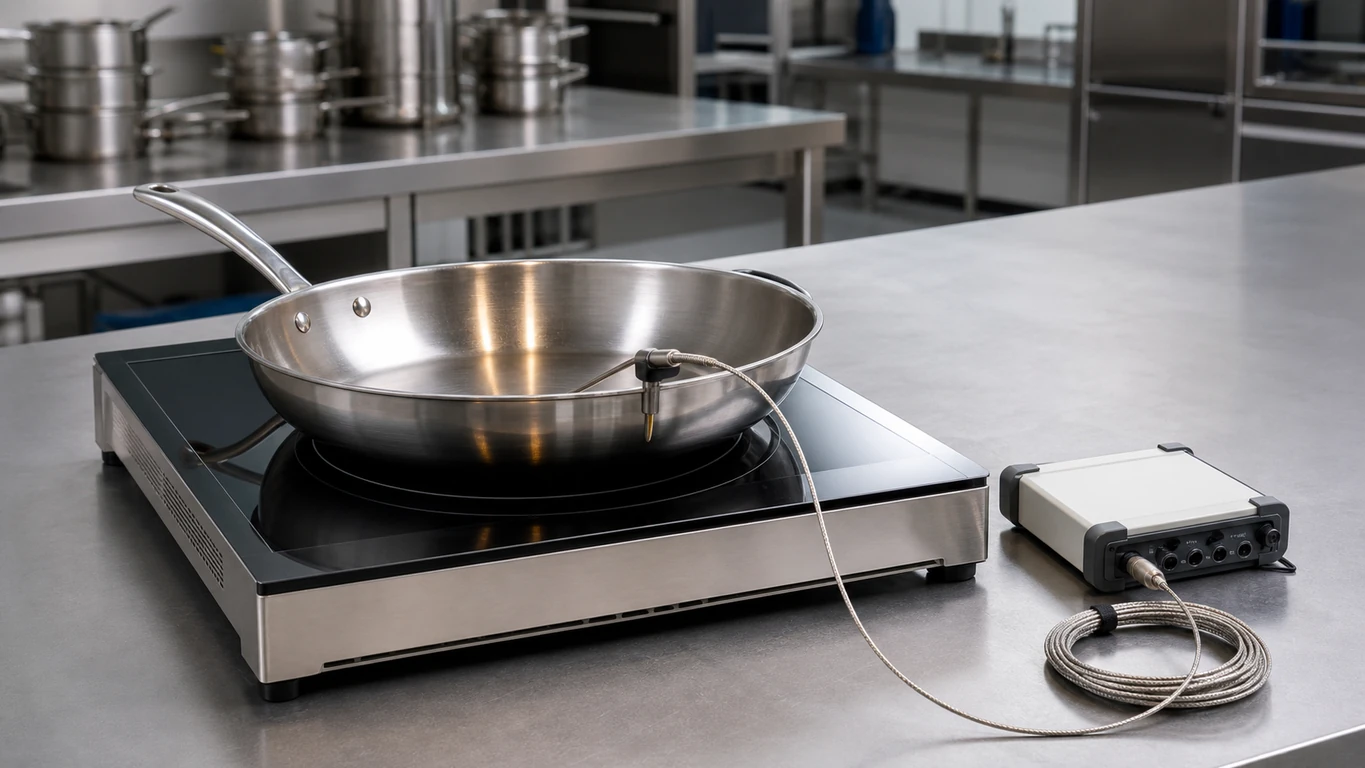
Illustrative heat-cycle setup, not a certification test or universal acceptance method.
For domestic cookware used on a hob, BS EN 12983-1:2023 is the general-requirements standard for cookware used on a stove, cooker or hob. Its scope covers gas, electric, glass-ceramic and induction hobs. For an induction project, confirm the applicable current standard, target-market requirements and laboratory method before setting acceptance criteria. An internal supplier check, a customer-specific agreement and an accredited laboratory test serve different purposes; none should be described as another without evidence.
At a practical project level, record the hob type, heating-zone size, power setting or controlled input, whether the pan is empty or loaded, the duration, cooling conditions and every inspection point. Then assess the sample before heating, after the agreed exposure, after complete cooling and after the agreed number of cycles. This does not require publishing proprietary limits in a blog; it requires writing the method down before the result is used for approval.
Induction: Magnetic Suitability Is Not the Whole Requirement
A magnetic exterior layer can be relevant for induction use, but a magnet check does not establish complete product performance. For induction cookware, buyers should also review the usable heating-zone range, stability after the defined thermal cycle and performance on the intended hob type. Avoid broad statements such as “works on every induction cooker” unless the SKU and claim scope have been validated accordingly.
Explore our tri-ply stainless steel cookware range when preparing a pan, saucepan, casserole or cookware-set RFQ.
A Practical Sample-Test Checklist for Buyers
1. Lock the sample identity and baseline
Assign a sample number and record the SKU, pan type, nominal size, base diameter, declared construction, declared thickness, actual weight and component configuration. Photograph the sample and keep the drawing, thickness map and measurement notes together. A buyer should be able to identify exactly which piece was tested months later.
2. Agree the measurement method before the heat test
Specify the reference plane, instrument, locations and observation state. If the method includes a gap or a convexity assessment, define who measures it, how it is documented and how an unexpected result is retested. Do not wait until after a test to debate which flatness definition applies.
3. Test the intended use condition
Use the target hob type or an agreed controlled device. Record the heat source, heating-zone size, sample load condition and timing. For an induction launch, test on the type of induction equipment relevant to the project—not simply on any available magnetic surface.
4. Compare pre-test, hot-state and cooled-state observations
Note the base condition before heating, at each agreed inspection point and after complete cooling. Record rocking, contact stability, visible convexity or concavity, functional change and any relevant induction behavior. A single photo of a cold pan is not a heat-cycle record.
5. Carry the approved method into the bulk-order QC plan
Keep the signed or numbered golden sample, specification sheet, photos and original measurements. In the PO or QC plan, identify the first-article check, sampling basis, test frequency, retest rule and nonconforming-product action. Material grade, layer allocation, gauge, base diameter, profile or intended-hob requirement changes should be assessed for re-approval before production proceeds.
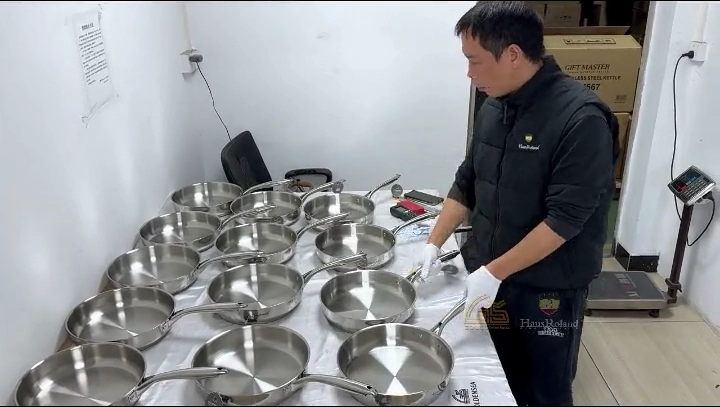
Bulk-order inspection should compare production pieces with the approved reference and written check method.
For a broader final-inspection framework, read how to check stainless steel cookware quality before bulk order. Buyers who need templates for RFQs and sample checks can also use the B2B Cookware Sourcing Toolkit.
Questions to Ask Before You Approve a Tri-ply Cookware Sample
- What is the declared layer structure, and where is the total thickness measured?
- Can you provide the approved-sample weight, base diameter and thickness measurement map?
- How do you define and measure base flatness or concavity for this SKU?
- Is the base checked cold only, or after a defined heating-and-cooling sequence?
- Which hob types and heating-zone sizes are included in the sample validation?
- What written criterion applies to post-test base stability?
- Can the same method be included in the pre-shipment QC plan?
- Which production changes trigger sample re-approval?
- For induction projects, what is the active base diameter and how is performance verified?
- Can the final construction be tested by an accredited third-party laboratory if the project requires it?
From “Anti-Warp” Claim to Repeatable Buyer Control
Do not select tri-ply cookware on an “anti-warp” label alone. Confirm the construction and geometry, test the finished sample under defined conditions, record the result and use the same controls in bulk production.
Goldensea supports OEM/ODM tri-ply cookware projects with samples, specification discussion and private label options. To discuss a project, share your target market, cookware type, size, quantity, intended hob, packaging and test requirements through our custom cookware page or contact Goldensea for a tailored quotation.
Frequently Asked Questions
Is tri-ply cookware less likely to warp than single-layer stainless steel?
Tri-ply construction changes heat distribution and stiffness characteristics, but it does not create a universal no-warp guarantee. The final SKU’s base stability depends on the material stack, geometry, finished condition and thermal exposure. Buyers should compare finished samples using an agreed method rather than infer performance from construction alone.
Does thicker tri-ply cookware always resist warping better?
Thickness matters, but it must be assessed with layer allocation, pan diameter, body geometry, actual weight and intended heating conditions. One total-gauge number does not establish performance. Ask where it is measured, retain the approved-sample weight and confirm base behavior after the project’s agreed test sequence.
Why test a cookware sample after heating and cooling?
A cold visual check shows the shape at one moment. Controlled heating and cooling can help reveal whether the finished base remains stable under the agreed exposure. Record the equipment, sample state, timing and inspection method so the result can be repeated for approval, retest or supplier comparison.
What should a cookware base-flatness specification include?
It should identify the reference surface, instrument or method, measurement locations, sample temperature or state, test sequence and project-specific acceptance criterion. It should also state how results are recorded and retested. A generic claim or an unqualified tabletop check leaves too much room for disagreement during sample approval or inspection.
Is a magnet test enough for induction cookware?
No. Magnetic suitability is relevant, but it does not verify the active heating area, response on the intended hob or base stability after thermal exposure. Induction projects should confirm both material suitability and the finished SKU’s behavior under the agreed test conditions before bulk production is approved.

Mei is a dedicated Sales Specialist at Goldensea with over 10 years of experience in the B2B kitchenware industry. Possessing deep technical knowledge of manufacturing and sourcing, she has successfully helped countless global clients navigate complex supply chain challenges and find the perfect culinary solutions.
Connect with Mei on LinkedIn or reach out for professional kitchenware advice.