
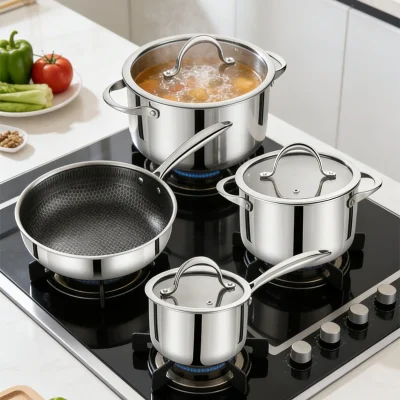
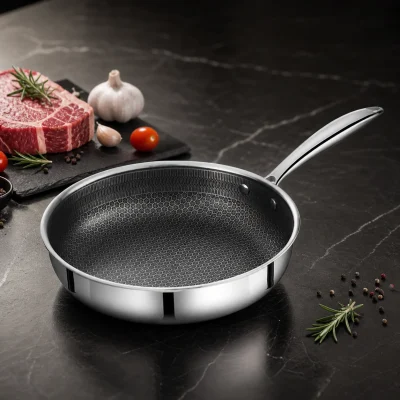
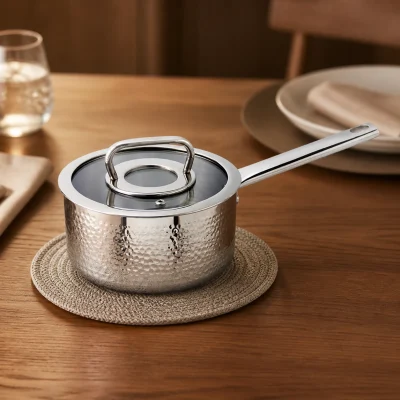
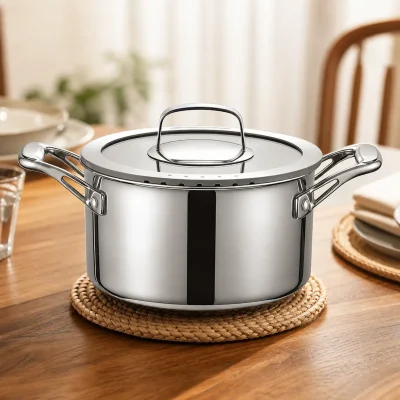

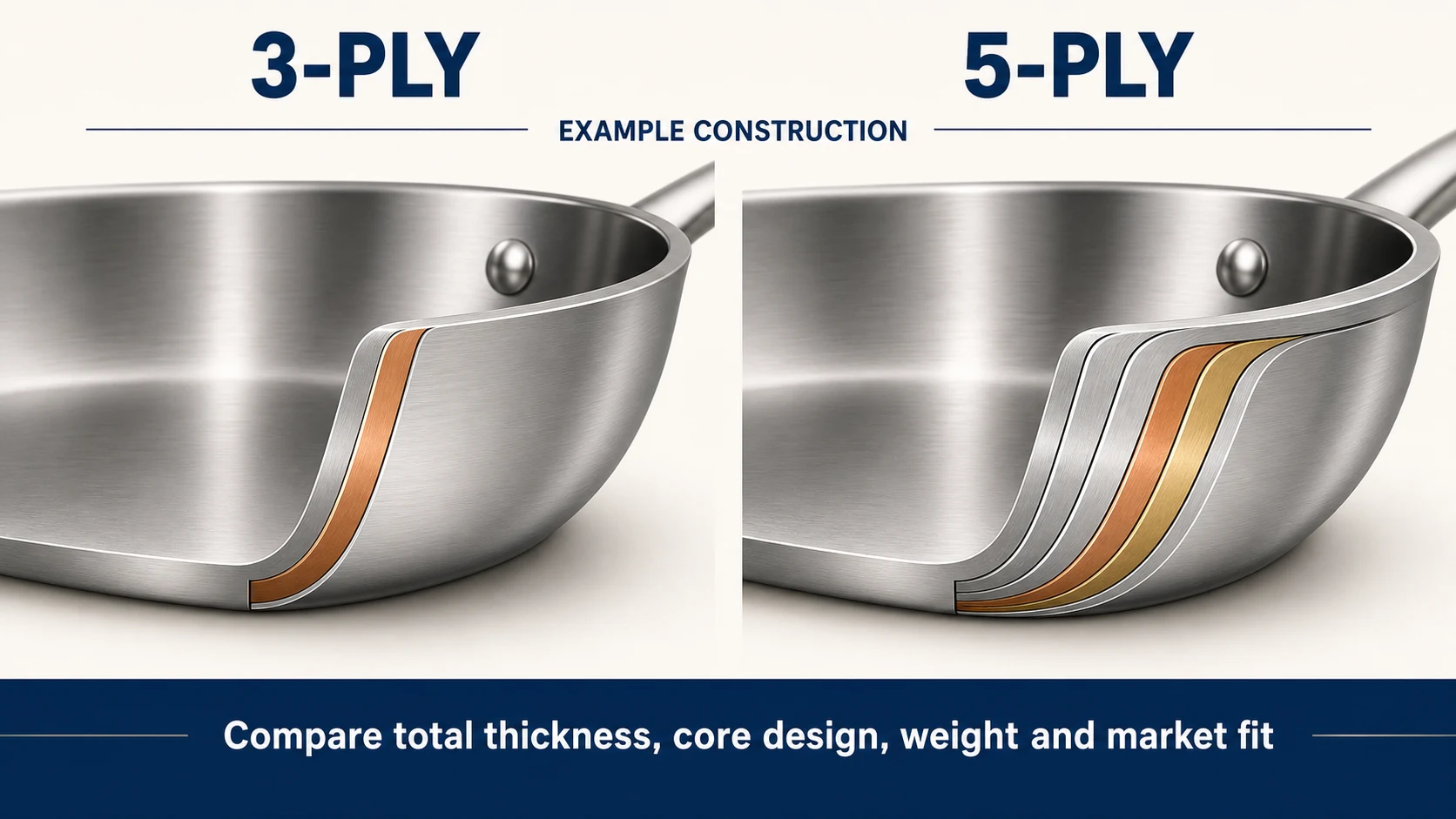
For cookware importers, private label brands, wholesalers and HoReCa buyers, a well-specified 3-ply stainless steel cookware body is the practical starting point for most mainstream retail and wholesale programs. It is usually easier to balance heat response, set weight and landed cost. Consider 5-ply for a premium line only after the supplier defines the layer stack and matched samples show a benefit the target channel can support.
Ply count is only one part of the specification. Total thickness, conductive-core design, full-clad coverage, weight, balance and manufacturing consistency determine whether the construction fits a commercial program.
Key Takeaways
- Layer count alone does not determine performance. Aluminum-core thickness, total gauge, cookware geometry, bonding quality and full-clad coverage can matter more than the number printed on a specification sheet.
- 3-ply is a practical commercial baseline. It can balance heat response, manageable set weight, production cost and broad market acceptance.
- Specify 5-ply only for a defined reason. The proposed stack should produce a measurable benefit or support a price position the target channel can sustain; five thin layers are not necessarily thicker or heavier.
- Compare matched samples. Use the same diameter, depth, handle configuration, finish and test method before drawing conclusions about heat, balance or deformation.
Contents
- What Do 3-Ply and 5-Ply Mean?
- 3-Ply vs 5-Ply Comparison
- Why More Layers Are Not Automatically Better
- Heat Response, Weight and Handling
- Which Construction Fits Each Market?
- Cost Beyond the Unit Price
- Product-Line Strategies
- Sample Evaluation Checklist
- Common Sourcing Mistakes
- Frequently Asked Questions
What Do 3-Ply and 5-Ply Mean?
In stainless steel cookware, “ply” describes the number of bonded material layers in the stated construction. It does not, by itself, define the alloy of every layer, the total thickness or whether the layers extend through the full body.
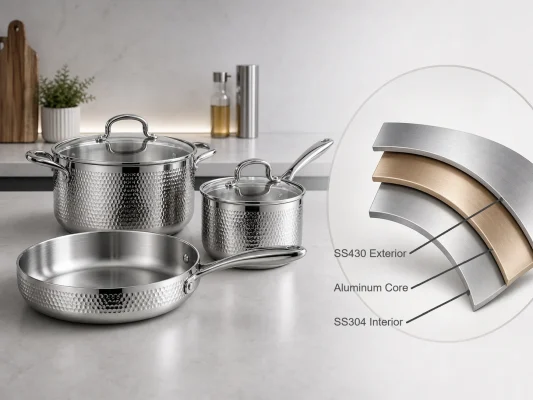
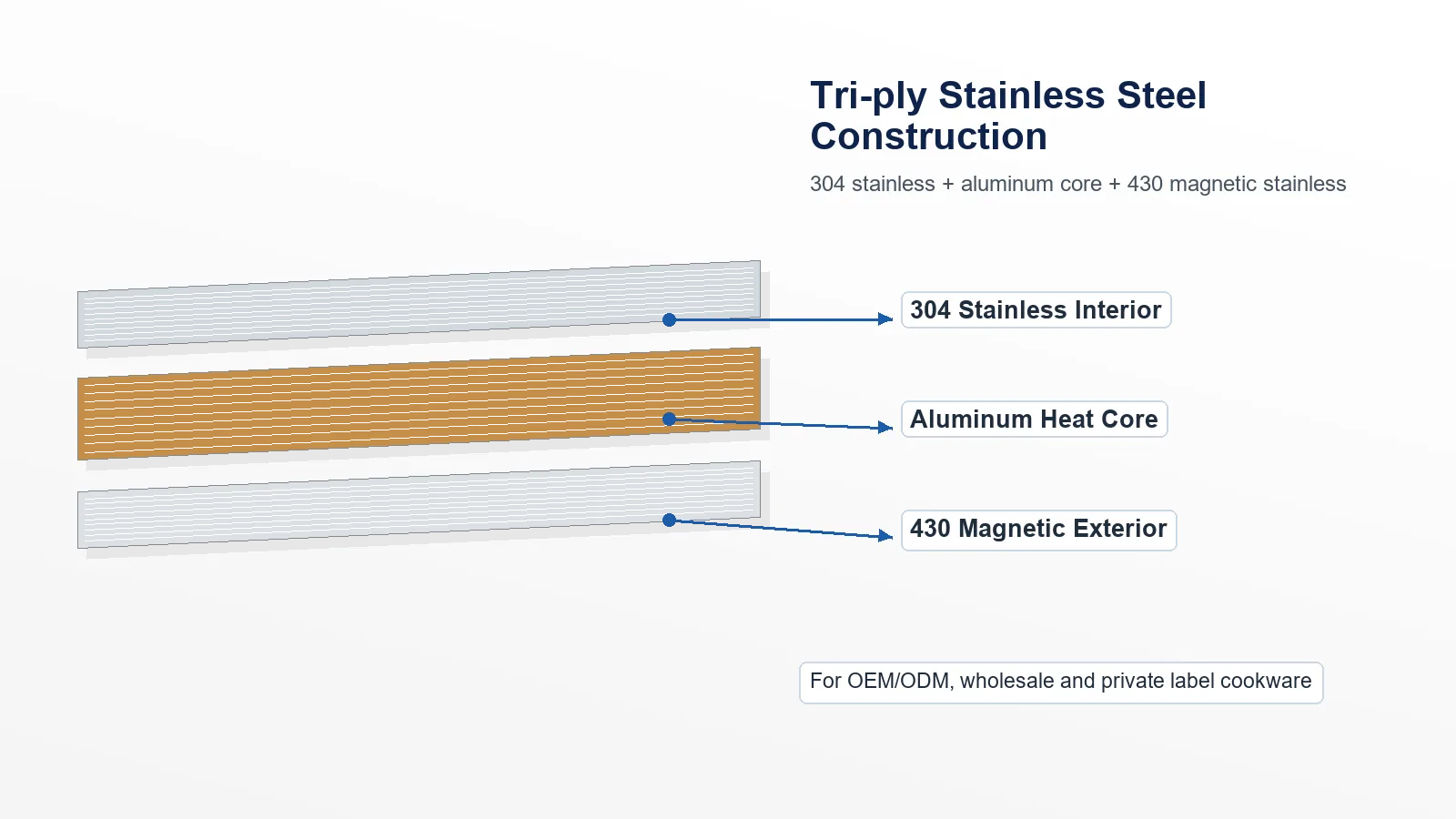
A common full-body 3-ply specification uses Type 304 stainless steel, commonly described as 18/8 or 18/10 in cookware, on the cooking surface; an aluminum heat-conducting core; and a magnetic stainless steel exterior such as Type 430 for induction compatibility. This is the core structure used across many tri-ply stainless steel cookware programs. For related material and sourcing articles, visit the Tri-ply Cookware Guide.
A 5-ply specification has five bonded layers, but the material stack is not standardized across all suppliers or brands. One construction may alternate stainless steel and aluminum. Another may use stainless steel outer layers around a multi-layer aluminum core. The conductive materials, their combined thickness and their position in the stack should therefore be written into the RFQ and sample specification.
Buyers should also confirm which part of the cookware the ply claim applies to. Full-clad or fully clad cookware normally carries the bonded structure from the base through the sidewall. A product described as having a “five-layer bottom” may instead use a multi-layer disc attached only to the base. Both approaches can be valid for the right product, but they are not the same construction. Our separate guide explains the sourcing implications of full-clad vs encapsulated bottom cookware.
3-Ply vs 5-Ply Stainless Steel Cookware Comparison
| Buying factor | 3-ply construction | 5-ply construction |
|---|---|---|
| Typical structure | Stainless steel / aluminum / magnetic stainless steel | Five bonded layers; the actual metal sequence varies by specification |
| Total thickness | Must be specified; commonly selected to balance response, weight and cost | Must be specified separately from ply count; five thin layers are not necessarily thicker |
| Heat response | Can respond quickly when the aluminum core is appropriately proportioned | May provide a more moderated response, depending on the conductive-core mass and layer arrangement |
| Heat retention | Depends on total mass, core thickness, diameter and geometry | Can provide greater thermal stability when the construction is heavier or uses more conductive material |
| Weight and balance | Often easier to keep manageable across full cookware sets | May feel more substantial, but actual net weight must be checked |
| Material and production cost | Usually the more accessible starting point for broad-market programs | Often requires a higher budget and a stronger premium-value explanation |
| Packaging and freight | Can help control set weight, carton strength and logistics cost | Potentially increases packaging and freight demands if the finished pieces are heavier |
| Market position | Mainstream to premium, depending on thickness, finish, components and branding | Most useful when a premium or professional positioning can support it |
| Key verification | Material grades, aluminum-core thickness, full-clad coverage, bonding and flatness | Every layer, total gauge, conductive-core design, full-clad coverage, bonding and net weight |
The table describes common sourcing tendencies, not guaranteed performance. A carefully engineered 3-ply pan can outperform a poorly specified 5-ply pan, while a well-designed 5-ply construction can offer a useful premium combination of stability, heat control and product feel.
Why More Layers Are Not Automatically Better
Total Conductive-Core Thickness Matters
Stainless steel provides a durable cooking surface and structural protection, while aluminum normally carries most of the heat-spreading work in clad stainless steel cookware. Splitting a similar quantity of aluminum into several layers does not automatically create more conductive material. Buyers should request the total thickness and, when the project requires it, the approximate thickness of the stainless and aluminum portions.
Full-Clad Coverage Matters
A five-layer base disc and a five-layer full-clad body can use the same marketing number but behave differently at the sidewall. For frying pans, sauté pans and shallow casseroles, sidewall heat distribution may contribute to cooking performance. For tall stock pots, the commercial value of additional sidewall construction should be considered against weight and cost.
Bonding and Forming Quality Matter
Layer count cannot compensate for poor bonding, unstable forming, an uneven base or unsuitable rim finishing. Sample approval should include edge inspection, body measurement, base-flatness checks and controlled heating cycles. The supplier should state whether the rim leaves the aluminum edge exposed or uses a sealed-rim construction, and how that choice affects the intended care instructions.
Cookware Geometry Matters
Diameter, depth, wall angle, base contact area and handle leverage all change the way a pan feels and performs. Comparing a 24 cm shallow 3-ply fry pan with a deeper 28 cm 5-ply sauté pan will not isolate the construction difference. Use matched sample models when testing alternatives.
How Construction Affects Heat Response, Weight and Handling
Heat response follows total conductive mass, body thickness, material sequence, diameter and burner output, not ply count by itself. A lighter design may react faster, while greater thermal mass may change temperature more gradually and recover better after cold food is added. Compare matched sizes on the same heat source.

Record assembled weight, not just raw body weight. Handles and lids change balance and repeated-lifting comfort, while complete-set weight affects color-box strength, master-carton limits and e-commerce fulfillment.
Which Construction Fits Your Market?
Mainstream Wholesale and Retail
Start with a well-specified 3-ply body when broad acceptance, competitive landed cost and a complete cookware range matter. Gauge, rim design, finish, components and packaging can still move the line into a premium segment.
E-Commerce and Private Label Brands
A clear specification matters more than a 5-ply label. Newer brands may get more value from a dependable 3-ply range plus stronger packaging, photography, quality control and launch inventory.
Premium Retail Programs
Use 5-ply when matched samples demonstrate the intended heating or handling benefit and the retail margin supports the higher specification. The layer count should not be the only selling point.
HoReCa and Professional Supply
Evaluate each vessel by operating weight, repeated heating, cleaning, replacement cost and staff handling. A heavier fry pan may be useful, while the same construction can make a large saucepan or stock pot inefficient to handle.
Cost Beyond the Unit Price
Review material usage, bonding and forming, polishing, edge treatment, handles, lids, packaging protection and packed weight together. Extra construction cost creates value only when the channel can support the resulting wholesale and retail price.
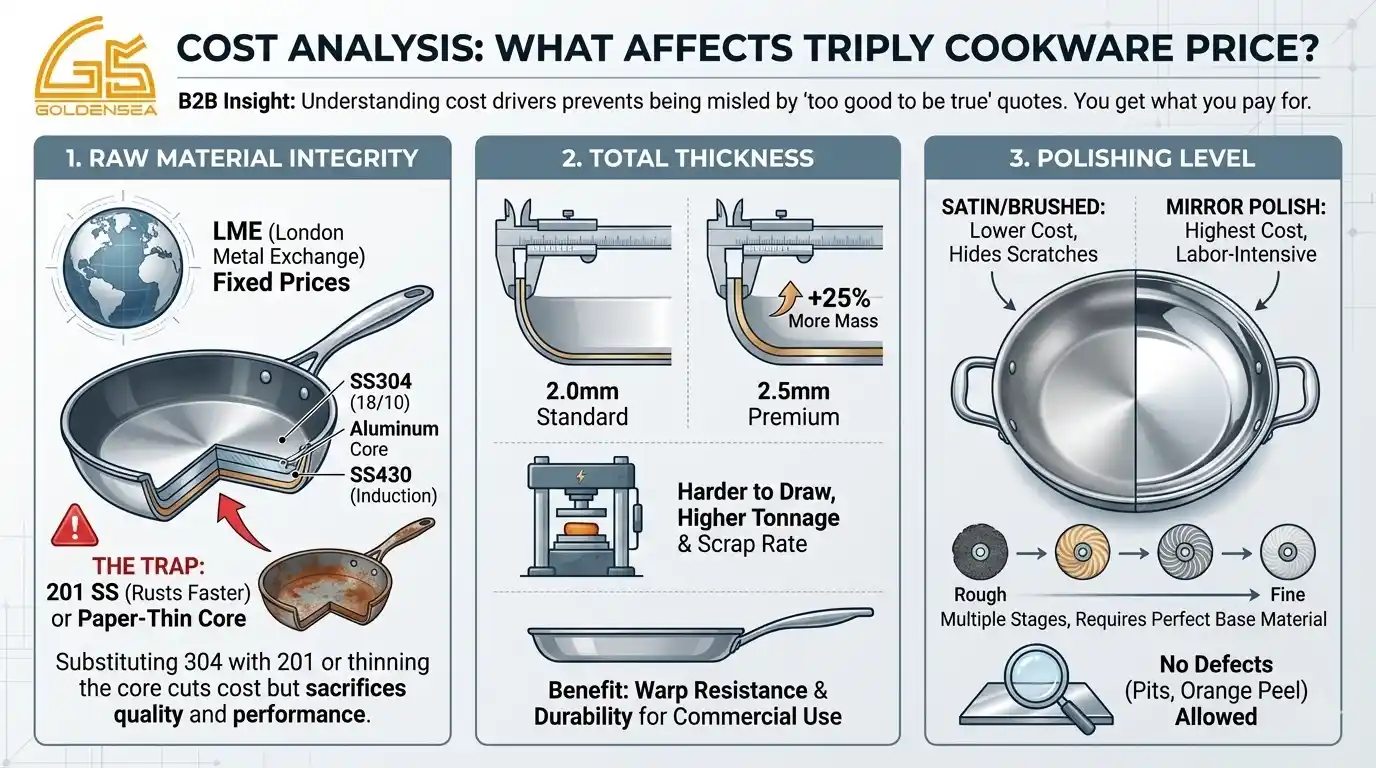
For cookware sets, request individual net weight and complete packed-set data before approval. Small differences across several vessels and lids can change box board grade, internal support, carton quantity and freight calculations.
Three Practical Product-Line Strategies
1. 3-Ply Core Range
Use 3-ply across the main assortment to control set weight and concentrate purchasing volume. Differentiate models through gauge, shape, handles, lids, finish, logo and packaging.
2. 3-Ply Main Range with 5-Ply Flagship SKUs
Keep high-volume pieces in 3-ply and test selected 5-ply fry pans or saute pans at a higher price point before expanding the specification across the range.
3. Dedicated 5-Ply Premium Collection
Build a separate collection only when the target customer, price and packaging budget are aligned. Lock the layer sequence, total thickness, weight tolerance, rim design and performance checks in the RFQ.
Sample Evaluation Checklist for 3-Ply and 5-Ply Cookware

- Construction scope: confirm full-clad body, clad base or impact-bonded disc.
- Layer specification: record the material or alloy used in every layer and the function it serves.
- Total gauge: define the measurement location and acceptable production tolerance.
- Matched dimensions: compare the same diameter, depth, base area and handle configuration.
- Net weight and balance: measure the assembled pan and check lifting, pouring and handle leverage.
- Heat testing: use the same burner, power setting, starting temperature, water or oil quantity and timing.
- Base stability: inspect flatness before and after controlled heating and cooling cycles.
- Rim and edge: review exposed, cut or sealed construction and the intended cleaning instructions.
- Assembly: inspect rivets or welds, lid fit, handle alignment and component movement.
- Surface finish: compare brushing, mirror polishing, interior finish and visible workmanship under consistent lighting.
- Induction compatibility: confirm the exterior material and test the finished cookware on the intended appliance range.
- Packaging data: record unit, gift-box and master-carton weight and confirm suitable protection.
- Compliance scope: define target-market food-contact testing and document requirements for the final construction and components.
For a broader technical overview of clad materials and specification terms, buyers can also consult the open-source Tri-ply Cookware Technical Reference.
Common Sourcing Mistakes
- Treating 5-ply as an automatic quality upgrade. Ask what each layer is and what measurable benefit the proposed stack is intended to deliver.
- Comparing ply count without total thickness. Put total gauge, material structure and finished weight on the same comparison sheet.
- Confusing a five-layer base with a full-body 5-ply construction. Request a cross-section or technical drawing that shows where the layers extend.
- Ignoring handle balance and complete-set weight. Review handles, lids and packaging together with the body specification.
- Selecting construction before defining the market. Confirm the target price, channel margin, buyer expectations and product-line role before requesting samples.
How Goldensea Supports 3-Ply and 5-Ply Cookware Projects
Goldensea is a China-based OEM/ODM cookware manufacturer specializing in tri-ply stainless steel cookware for global B2B buyers. For suitable projects, the team can review 3-ply and 5-ply options together with body thickness, vessel size, handles, lids, surface finish, logo, packaging and target-market document requirements.
Feasibility, MOQ, sample planning and lead time depend on the selected models, layer stack, tooling, material availability, packaging and order quantity. Review the available OEM and ODM custom cookware options and send a complete specification before quotation.
Frequently Asked Questions
Is 5-ply cookware always better than 3-ply?
No. Ply count describes construction, not an automatic quality level. Compare the layer materials, aluminum-core design, total thickness, bonding, finished weight and matched sample results.
Does 5-ply cookware always heat more evenly?
No. Heat distribution depends on the conductive material, its thickness and placement, cookware geometry and the heat source. Verify the proposed specification with matched samples instead of relying on the ply count.
Is 3-ply cookware lighter than 5-ply cookware?
Often, but not always. Total gauge, diameter, depth, handles and lids determine finished weight. Compare fully assembled pieces of the same size, especially for large fry pans and cookware sets.
Are both 3-ply and 5-ply cookware suitable for induction?
Both can be induction compatible when the exterior layer or base uses a suitable magnetic material. State the intended stovetop market and test final samples because ply count alone does not guarantee induction performance.
Which construction is better for private label cookware?
3-ply suits many mainstream and premium private label programs. Consider 5-ply for a higher-price collection or selected flagship SKUs when the channel can explain and support the additional specification.
Can Goldensea customize 5-ply stainless steel cookware?
Goldensea can evaluate 5-ply construction for suitable OEM/ODM projects. Feasibility depends on the layer stack, total thickness, cookware model, quantity, target price, finish, components and testing requirements.
Technical References
- All-Clad: D3 vs D5 Stainless Steel Cookware
- All-Clad: Understanding Stainless Steel Cookware Types and Benefits
- Heritage Steel: The 5 Rules of Good Cookware
- Demeyere 2025 Technical Catalogue: 3-Ply, 5-Ply and 7-Ply Constructions
Discuss Your Cookware Construction
For most ranges, begin with a well-specified 3-ply body. Move selected pieces to 5-ply only when the proposed stack produces a verified performance, handling or positioning benefit.
Send Goldensea your target market, vessel types, sizes, body gauge, expected quantity, price position, packaging and compliance requirements. The team can prepare matched 3-ply and 5-ply sample options so you can compare weight, balance and heating before approving the range.

Mei Huang is a Goldensea sales specialist with more than 10 years of experience working with international cookware buyers. She focuses on product specifications, sampling, private label development and export project coordination.
Connect with Mei on LinkedIn or contact Goldensea to discuss a cookware project.