

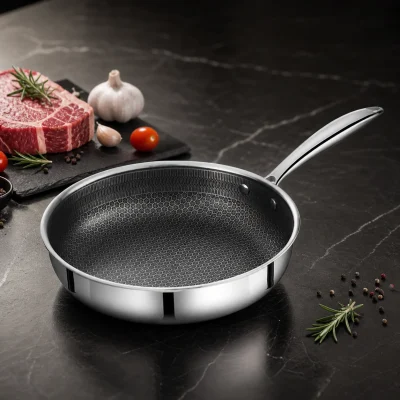
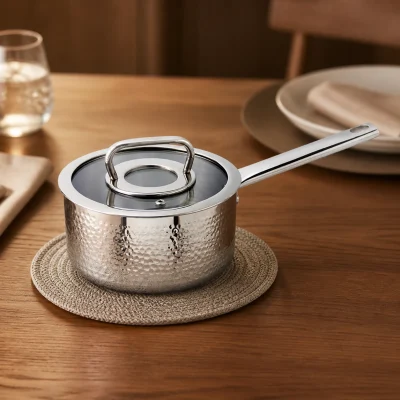
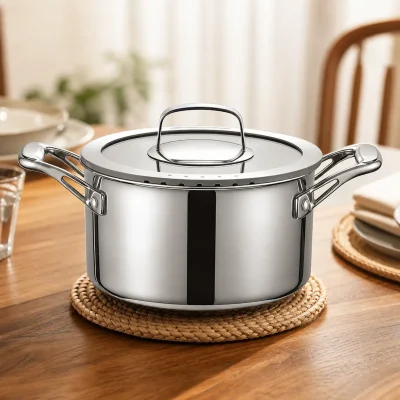
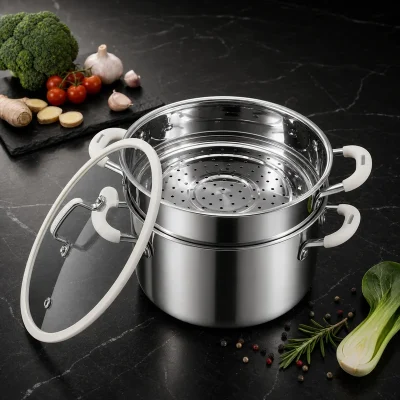
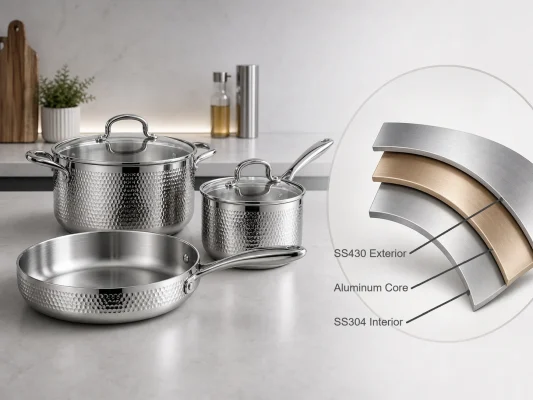


For a private-label cookware program, the rim is easy to overlook because it occupies only a narrow strip at the top of the pan. Yet in tri-ply cookware, that strip can affect how the aluminum core is protected, how the edge is finished, and what buyers should define before samples and bulk production. This guide compares sealed rim cookware with cookware that has an exposed aluminum edge, so importers, retailers, and sourcing teams can make the right decision for their price point, cleaning conditions, and warranty promise.
A sealed rim is often worth evaluating when a program needs a protected composite edge and a premium presentation. An exposed edge is not automatically a defect or a poor-quality choice, but it relies more heavily on consistent trimming, polishing, care instructions, and inspection. The right specification depends on the market, expected washing frequency, channel, and the supplier’s validated process capability.
Key Takeaways
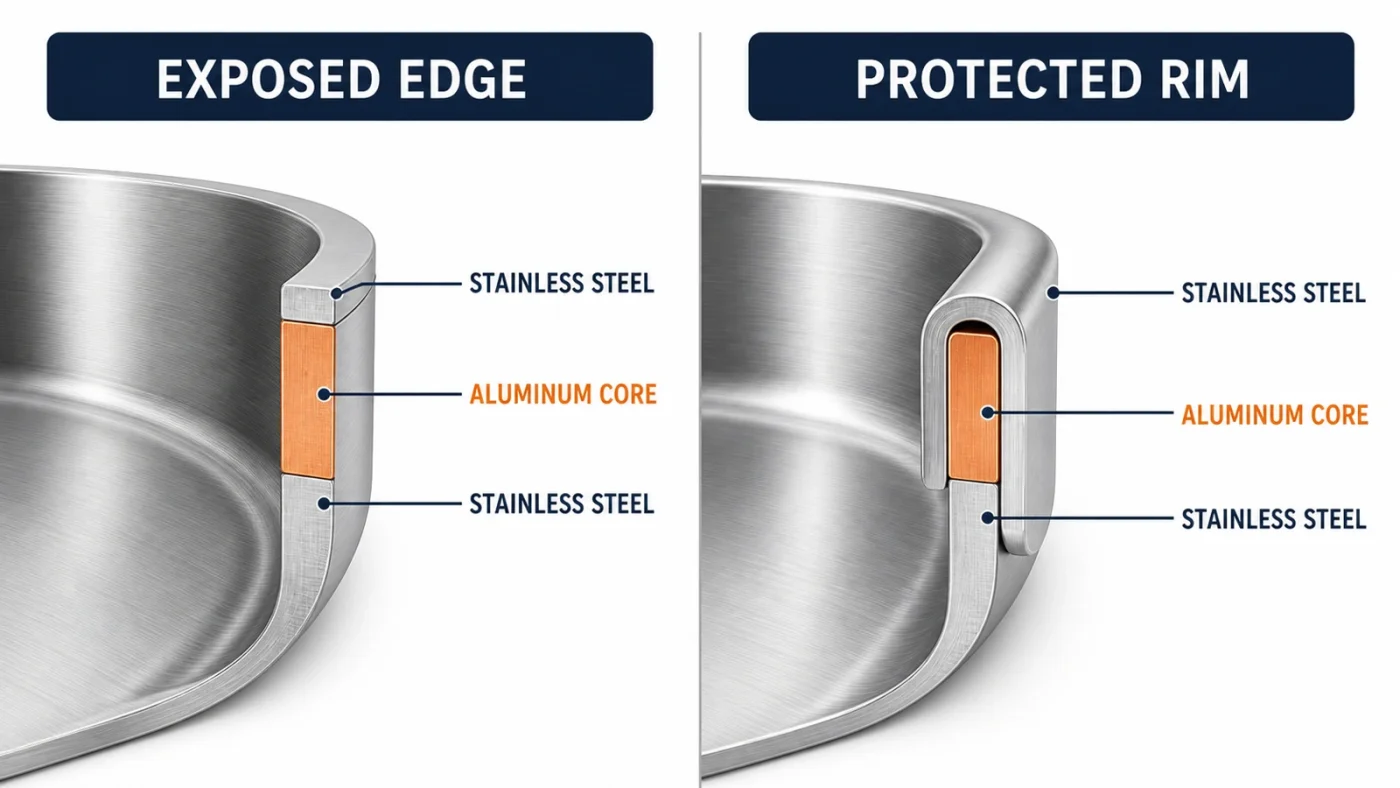
- In fully clad tri-ply cookware, forming and trimming can leave the aluminum core visible at the rim; this is a construction outcome, not automatically a defect.
- A protected or sealed rim covers the core edge, while an exposed rim leaves the layered cross-section visible. Neither term alone defines the complete cookware quality level.
- Repeated washing, edge finishing, handling, and warranty expectations all matter when buyers decide which rim construction to specify.
- Rim protection and rim geometry are separate requirements: a rim can be sealed and flared, or exposed and rolled, depending on the design.
- The most useful RFQ states the desired rim protection, permitted core exposure, rim shape, finish, inspection criteria, and target-market use conditions separately.
Table of Contents
- What is an exposed rim?
- What is a sealed or protected rim?
- Sealed rim vs exposed rim comparison
- Dishwasher exposure, sharp edges, and delamination
- Rim protection vs rim geometry
- Which program should choose which rim?
- Sample and bulk inspection
- What to specify in an RFQ
- Frequently asked questions
What Is an Exposed Rim in Tri-ply Cookware?
An exposed rim is the cut edge of a clad cookware body where the stainless-steel skins and the conductive aluminum core can be visible at the top of the vessel. Tri-ply cookware is commonly made from bonded stainless steel, aluminum, and magnetic stainless steel. When a formed vessel is trimmed, the layered sheet can be exposed at that edge.
The visible aluminum line should not be confused with an aluminum cooking surface. In a standard tri-ply construction, the cooking surface remains stainless steel; the discussion here is about the narrow edge of the layered body. Meyer protected-rim patent literature describes how trimming laminated cookware can expose softer aluminum or copper core material at the rim, which helps explain why the issue is an engineering and finishing consideration for B2B buyers.
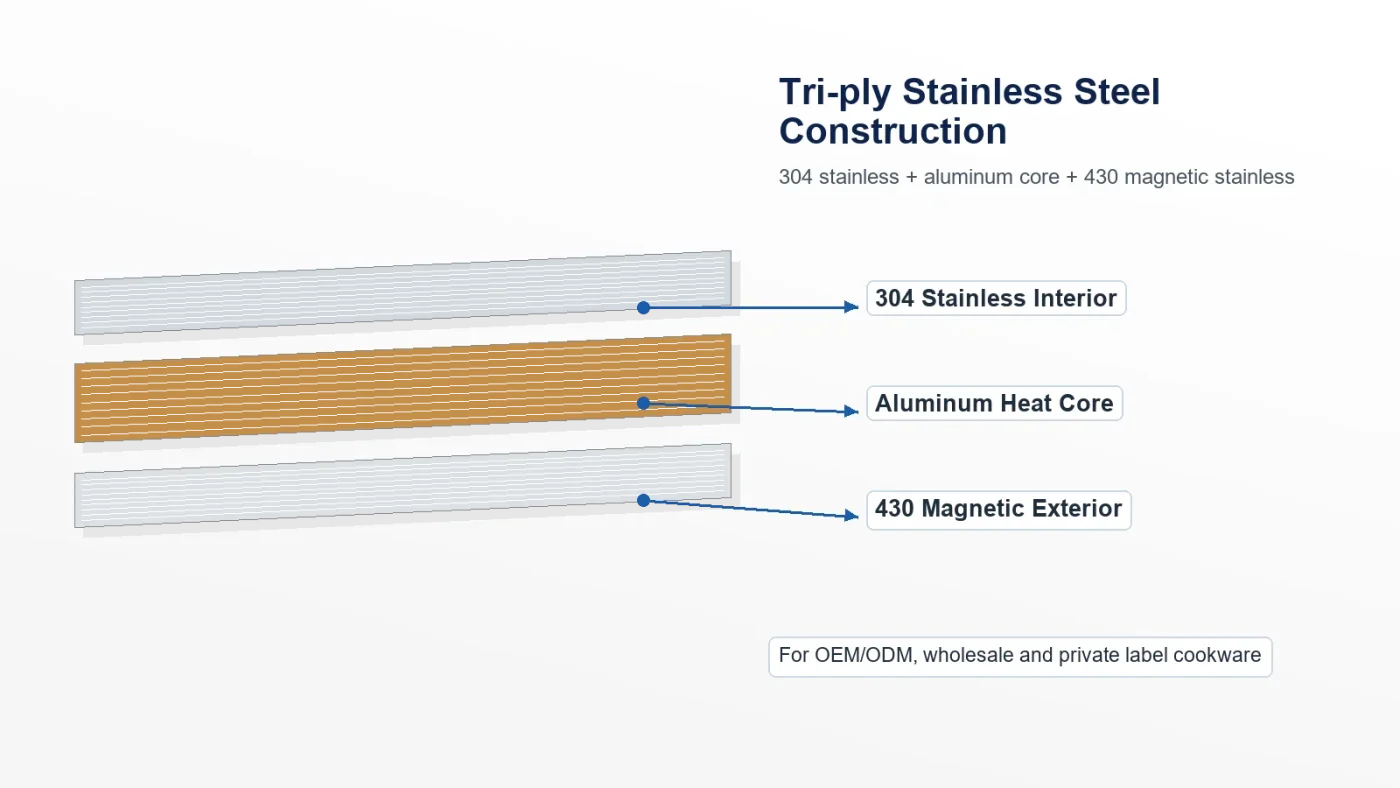
For a broader explanation of the three bonded layers before reviewing rim specifications, see what tri-ply stainless steel cookware is.
Explore more material and sourcing guidance in the Tri-ply Cookware Guide.
What Is a Sealed or Protected Rim?
A sealed or protected rim is a rim design in which the exposed edge of the conductive core is covered or enclosed by stainless steel or another protective edge treatment. It protects that boundary of the layered construction; it does not change the basic heat-conducting purpose of the aluminum core.
There is more than one way to achieve edge protection. Public engineering documents describe formed, folded, curled, joined, welded, and coated approaches. Buyers should therefore avoid assuming that every supplier uses the same process when they hear “sealed rim.” The practical question is whether the supplier can define the construction, provide an approved sample, and validate the agreed inspection criteria.
Sealed Rim vs Exposed Rim: What Changes for Buyers?
| Factor | Exposed / Cut Rim | Sealed / Protected Rim | B2B implication |
|---|---|---|---|
| Core visibility | The aluminum core may be visible at the cut edge. | The core edge is covered or enclosed. | Define permitted appearance in the specification. |
| Edge protection | Relies heavily on trimming and polishing quality. | Adds protection around the composite edge. | Relevant to premium positioning and handling expectations. |
| Repeated washing | The core edge has a direct exposure pathway. | That exposure pathway is reduced. | Confirm actual care guidance and any test method with the supplier. |
| Visual finish | A layer line can remain visible. | Creates a more continuous stainless appearance. | Useful for brand and retail presentation decisions. |
| Manufacturing control | Requires consistent trimming, burr removal, and polish. | Requires control of the protective-edge operation and finish. | Inspection criteria differ; neither route removes the need for QC. |
| Rim-related risk review | Review edge roughness, uneven core exposure, dents, and gaps. | Review continuity, deformation, cracks, and finish quality. | Agree visual limits on the approved sample before bulk production. |
Does an Exposed Aluminum Rim Matter in Dishwasher Use?
It can matter, particularly for product lines expected to see repeated dishwasher cleaning. Official cookware-care guidance from Fissler and Demeyere notes that aggressive dishwasher detergents can be relevant to exposed aluminum surfaces and cookware components. A protected rim removes one edge-exposure pathway, but it does not by itself make every pan dishwasher safe.
Actual performance depends on the complete construction, the alloy and finish, handles, coatings, detergent chemistry, temperature, cleaning frequency, and the manufacturer’s care instructions. Buyers who need dishwasher-oriented positioning should agree on a suitable validation approach with the supplier or laboratory rather than relying on the words “sealed rim” alone.
Can an exposed rim become sharp?
A sharp rim can originate from poor burr removal during manufacturing, or it can become more noticeable if a softer exposed core recedes and the stainless layers become prominent. This is why a sample inspection should consider both initial edge feel and any agreed repeated-use evaluation. It is not accurate to say that every exposed rim will become sharp.
Does a sealed rim prevent delamination?
No rim design can guarantee that a clad body will never separate. A protected edge can reduce one vulnerable boundary, while overall layer integrity still depends on bonding quality, forming control, thermal cycling, material preparation, and manufacturing consistency. Treat rim protection as one specification within a complete quality plan, not as a substitute for clad-bond control.
Sealed, Rolled, Flared, and Pouring Rims Are Different Terms
Rim protection describes whether the conductive core edge is exposed or covered. Rim geometry describes the physical shape of the lip. A flared rim is generally a geometric feature associated with pouring; a rolled rim may describe a formed shape; and a pouring rim describes a functional pouring feature. A cookware body can combine these features in different ways.
For RFQs, define both dimensions separately. For example: “protected rim required; flared pouring profile required; no visible core exposure on approved sample.” This avoids treating “rolled rim” as a complete construction instruction when different suppliers may interpret it differently.
Which Rim Design Fits Different Cookware Programs?
| Buyer or program | Recommended consideration |
|---|---|
| Premium private-label range | Evaluate a protected rim when the line emphasizes refined construction, retail presentation, and edge protection. |
| Dishwasher-oriented retail program | Evaluate a protected rim together with product-level care guidance and an agreed durability-validation plan. |
| HoReCa or frequent-cleaning use | Prioritize edge robustness, finish consistency, and a clearly documented test or inspection method. |
| Cost-sensitive wholesale program | A well-finished exposed rim may be acceptable if the care instructions, visual standard, and burr-control requirement are explicit. |
| E-commerce brand with a strong warranty promise | Consider long-term edge appearance and customer touchpoints early, then align the claim language with validated performance. |
If your project also requires custom body shapes, handles, lids, finishes, logo treatment, or packaging, review Goldensea’s OEM and ODM custom cookware options before sending an RFQ.
How to Inspect a Tri-ply Cookware Rim Before Bulk Production
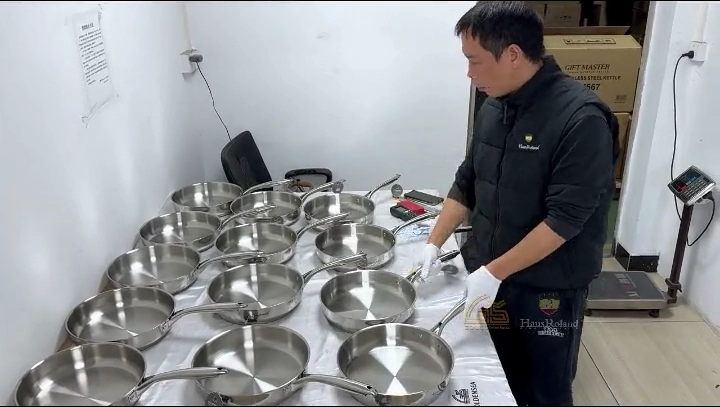
Rim inspection should begin with an approved sample and documented acceptance criteria. The visual standard must match the requested construction: exposed-edge programs need a consistent and well-finished edge, while protected-rim programs need a continuous and undamaged protective profile.
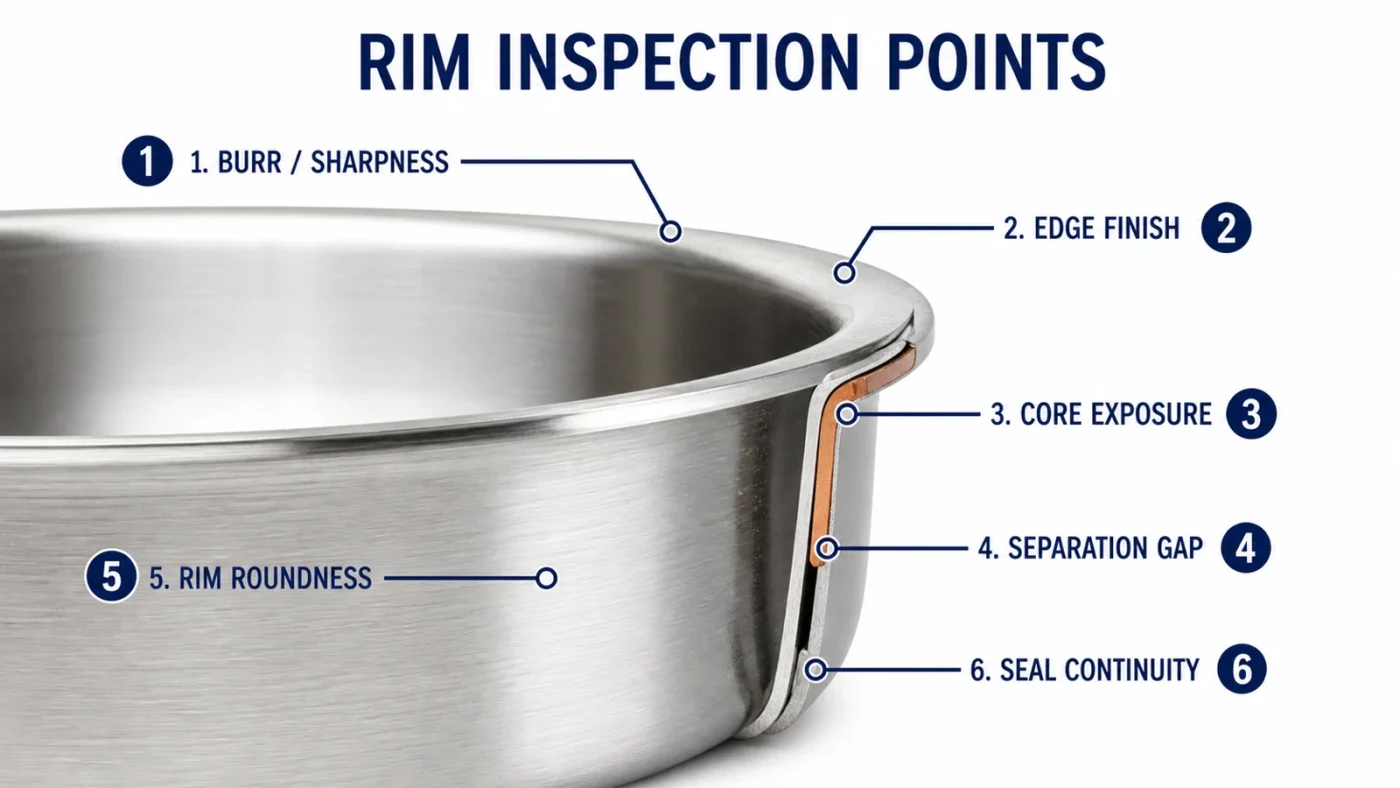
Inspection points depend on the rim construction: assess core exposure on exposed-edge designs, and seal continuity on protected-rim designs.
At the sample stage
- Confirm whether the rim is exposed, protected, or sealed as specified.
- Separate the required protection from the required rim shape.
- Check for burrs, roughness, dents, visible gaps, uneven trimming, cracks, or layer lifting.
- Inspect roundness and lid fit where the item includes a lid.
- For programs with repeated-washing expectations, agree the evaluation conditions and before/after records with the supplier.
During bulk inspection
- Use the approved sample and limit samples as the visual reference.
- Check rim consistency across the inspected units, not only one hero sample.
- Verify that the agreed edge finish remains free from unacceptable burrs and sharp points.
- Record any visible separation, deformation, incomplete closure, or inconsistent core exposure against the agreed construction.
- Review packaging protection so the rim is not damaged during handling and shipment.
Rim checks should sit within a broader pre-production inspection process, beginning with an approved sample and documented acceptance criteria. See how to check stainless steel cookware quality before bulk order for the wider supplier-quality workflow.
What Should Buyers Specify in an RFQ?
Do not leave rim construction to a general “premium quality” request. Include the following information in the RFQ and confirm it again on the approved sample:
- Tri-ply material construction and the intended product category.
- Rim protection: exposed, protected, or sealed.
- Rim geometry: straight, rolled, flared, or pouring profile.
- Whether visible aluminum core exposure is allowed.
- Edge-finish and burr / sharp-edge requirements.
- Dishwasher positioning and any required validation method.
- Target market, expected cleaning conditions, quantity, packaging protection, and acceptance standard.
A concise specification helps suppliers quote the right process and helps buyers compare samples on the same basis. It also reduces the risk of discovering a construction mismatch only at final inspection.
Frequently Asked Questions
What is a sealed rim in stainless steel cookware?
A sealed rim is a protected edge design that covers or encloses the exposed edge of the conductive core in layered cookware. It is an edge-protection feature, not a replacement for overall clad-bond quality control, and different manufacturers may use different engineering approaches.
Why is aluminum visible on the edge of some tri-ply pans?
Tri-ply cookware starts with bonded layers. Forming and trimming the vessel can expose the aluminum core at the cut edge. This does not mean the cooking surface is aluminum, and it is not automatically a manufacturing defect; the edge finish and intended use still need evaluation.
Is exposed aluminum on the rim a defect?
Not necessarily. It can be an intended construction outcome in fully clad cookware. Buyers should assess whether the edge is consistently finished, smooth, free of unacceptable burrs or gaps, and appropriate for the intended market, washing conditions, and product-positioning requirements.
Can exposed aluminum edges be affected by dishwasher cleaning?
They can be more directly exposed to detergent and moisture than a protected edge. Actual results depend on detergent chemistry, cycle conditions, alloy, finish, and cookware construction. Buyers should not convert this into a universal corrosion claim; confirm care guidance and any validation method for the specific product.
Does a sealed rim make cookware dishwasher safe?
No. A sealed rim can reduce one exposure point at the composite edge, but dishwasher suitability depends on the complete cookware system, including surfaces, handles, coatings, detergents, and the manufacturer’s instructions. Any dishwasher claim should be supported by the supplier’s product-specific validation.
What should importers check when inspecting a tri-ply cookware rim?
Importers should confirm the agreed construction and rim geometry, then inspect for burrs, edge finish, core exposure, separation gaps, roundness, dents, cracks, and seal continuity where applicable. The approved sample should define the acceptable visual and tactile standard before mass production begins.
Technical Sources and Buyer Note
This guide uses public engineering and cookware-care references to explain general construction choices. See the Meyer reinforced-rim patent, the Meyer protected-edge patent family, Fissler’s cookware guide, and Demeyere care guidance. These references do not confirm a specific Goldensea rim process or product claim. Confirm final construction, MOQ, test method, and target-market requirements with the project team before ordering.
Plan Your Tri-ply Cookware Specification
For a tri-ply cookware project, send your target product, rim preference, market, expected cleaning conditions, quantity, lid and handle requirements, surface finish, branding, packaging, and any validation requirements. Goldensea can review the specification as part of an OEM or ODM cookware discussion.

Shiva Yang is a Sales Manager at Goldensea, supporting global B2B buyers with tri-ply stainless steel cookware sourcing, private-label programs, and OEM/ODM project coordination.
Connect with Shiva on LinkedIn or contact Goldensea to discuss a cookware project.