







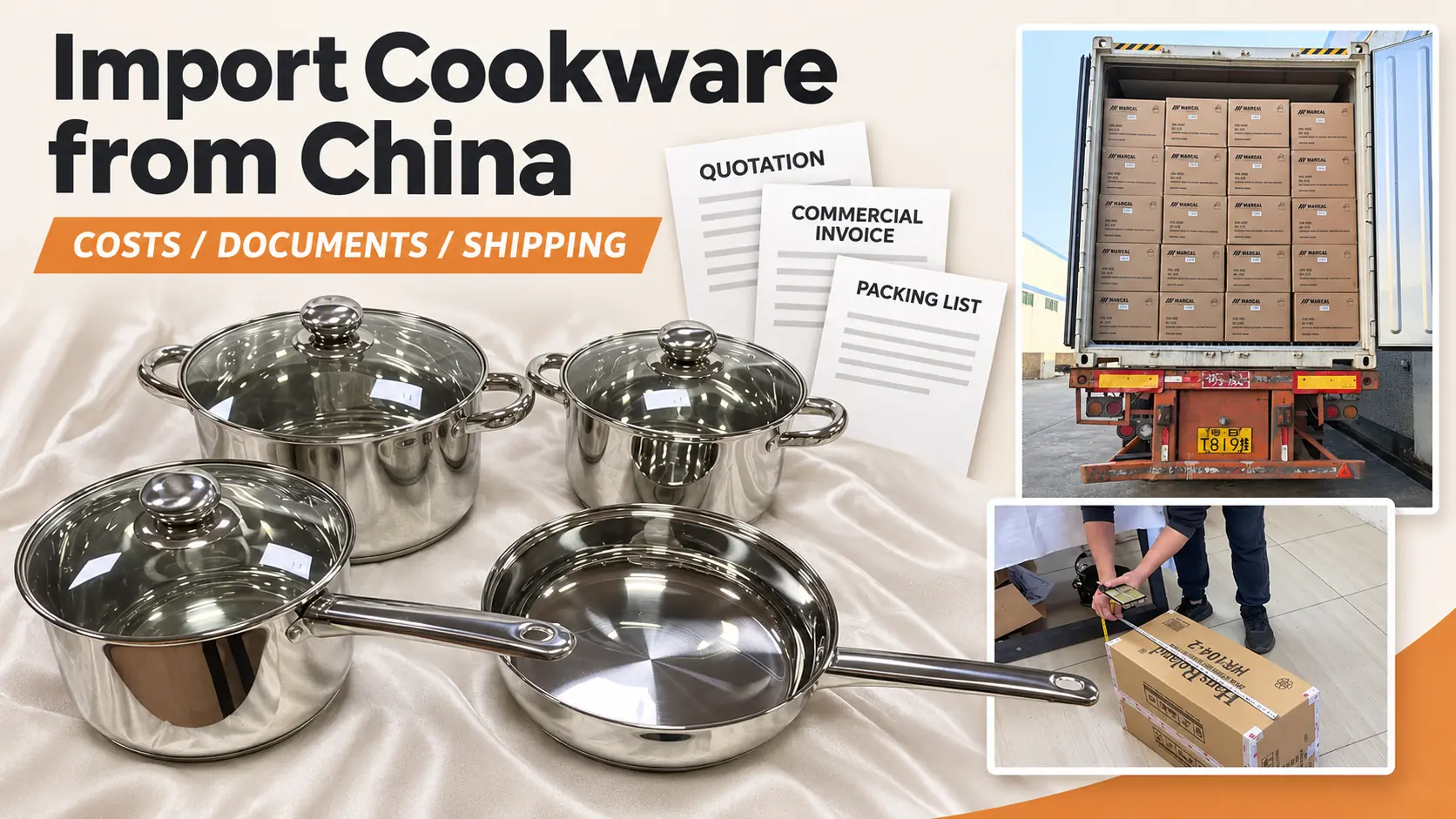
To import cookware from China, first confirm the finished product, destination, importing entity and delivery terms. Then obtain packing data, assign document responsibilities and compare the complete cost of getting the same shipment into your warehouse. The factory unit price is only one part of that decision.
This guide is for private-label brands, importers and wholesalers buying non-electric stainless steel cookware, including tri-ply products. It follows an order from quotation to warehouse delivery, with US and EU import checkpoints. Confirm the materials, construction and components of each SKU with your supplier.
Sources last checked: . Requirements depend on the product, destination and entry date. All numerical shipment examples below are hypothetical.
Key Takeaways
- Compare identical specifications and written cost inclusions, using a precise named delivery point.
- Use final carton and pallet data to request complete shipping quotations.
- Assign an owner and checking deadline to every document and filing.
- Separate recurring landed cost, one-time project spending and cash needed for taxes.
1. Define Your Cookware, Destination and Importing Entity
Start with a product file: model, use, dimensions, layer construction, materials, coating status, lids, handles and other components. For retail sets, list the contents and define the selling unit. A “6-piece set” must not automatically be recorded as six cookware bodies; lids may be included in that count.
Identify the import country, sales market, importer, consignee and customs representative. A delivery address alone does not establish who will make the declaration or handle local product obligations. Give your representative the material and component details needed for classification, including relative quantities or values where relevant.
Follow these steps from quotation to delivery:
- Define: approve product identity, selling units, market and importing entity.
- Check: confirm classification questions, required evidence and import arrangements.
- Quote: align quantity, packaging, named delivery point and included charges.
- Approve: sign off the sample, packaging and order conditions.
- Prepare: finalize packing data, book freight and allocate filing deadlines.
- Ship: complete export arrangements and check transport documents.
- Receive: coordinate clearance, carrier release, delivery and warehouse checks.
2. Request a Quote You Can Actually Compare
Send each supplier the same brief. Include SKU specifications, quantities per model, pcs or sets, retail packaging, carton requirements, destination, required product documentation and requested Incoterms version. Ask for the currency, validity period, separate development charges and expected cargo-ready date.
Record the approved sample and packaging versions, acceptance checks, payment milestones and how changes will be handled. Agree these terms before production starts.
A pro forma invoice (PI) sets out the proposed transaction. Before shipment, check that the commercial invoice reflects the final goods, quantities, prices and other required details.
Keep factory assessment separate from freight comparison. Our guide to choosing a stainless steel cookware manufacturer covers supplier identity, capability and sourcing checks.
3. Compare EXW, FCA, FOB, CIF, DAP and DDP
Write the delivery term, exact named place or port, and Incoterms 2020 in the quotation. Use the table to compare transport and customs responsibilities, as well as where risk passes to the buyer. Check any agreed variations in the contract.
| Term | Delivery / risk transfer | Main carriage | Export / import formalities |
|---|---|---|---|
| EXW | Named place; goods available, normally not loaded on collection vehicle | Buyer | Normally buyer / buyer; check export feasibility |
| FCA | Named carrier handover point; loading differs between seller premises and another place | Buyer | Seller / buyer |
| FOB | On board the vessel at the named shipment port | Buyer | Seller / buyer |
| CIF | On board at origin; seller pays freight and specified insurance to destination port | Seller | Seller / buyer |
| DAP | Named destination, on arriving vehicle, ready for unloading | Seller | Seller / buyer |
| DDP | Named destination, import-cleared, ready for unloading | Seller | Seller / seller, including applicable import duties and taxes |
Why FCA deserves a place in the comparison
If containerized cargo goes to a forwarder, consolidation warehouse or terminal before vessel loading, ask for an FCA quote at that handover point. FCA at the seller’s premises includes loading the collecting vehicle; at another named place, delivery is normally ready for unloading. FOB uses on-board delivery and applies to sea or inland-waterway transport.
CIF freight payment and risk transfer are different
Under CIF, the seller pays freight and specified insurance to the named destination port, but risk normally passes to the buyer when the goods are on board at origin. Check destination handling, release charges, clearance and onward delivery separately. For wet cartons or broken glass lids, review the insurance cover, exclusions and deductible.
Check the import arrangements behind a DDP quote
Before accepting a DDP quote, ask who will legally complete import formalities, whose identity and authorization will be used, how taxes are handled and which import records you will receive. Check unloading and special delivery services too. Ask Goldensea which delivery terms are available for your destination.
4. Get Packing Data Before Comparing Shipping Options
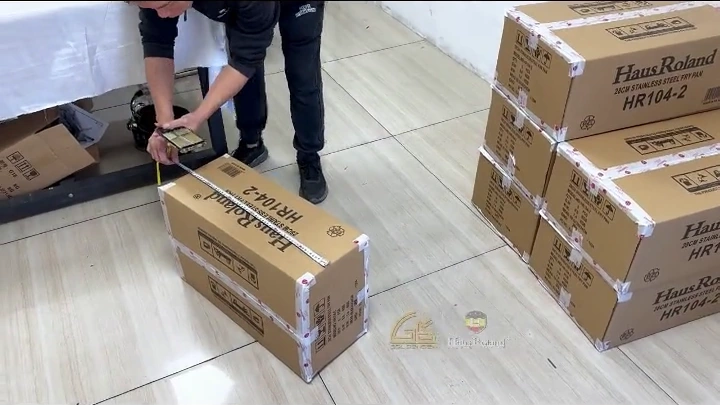
Cookware shipping cost depends on the shipment you actually hand over. A pan diameter or bare-product weight cannot replace the dimensions and gross weight of its packaging. Ask for these four levels:
- Selling unit: SKU, set contents, packed dimensions and weight.
- Export carton: units per carton, outside dimensions, net/gross weight and carton numbering.
- Pallet: quantity, dimensions and weight including the pallet, plus stackability.
- Whole shipment: total cartons, cubic metres (CBM), gross weight and SKU totals.
Calculate volume from the final carton
Hypothetical example — not GSK packing data or a freight quotation. Assume 600 individual pans, six per carton, making 100 cartons. Each carton measures 60 × 40 × 35 cm and weighs 18 kg gross.
- One carton: 60 × 40 × 35 ÷ 1,000,000 = 0.084 m³.
- Shipment volume: 0.084 × 100 = 8.4 m³.
- Gross weight: 18 × 100 = 1,800 kg, or 1.8 metric tonnes.
If the LCL contract compares one CBM with 1,000 kg and takes the higher figure, compare 8.4 with 1.8: the shipment has 8.4 charging units. This is the basis used in Maersk’s LCL terms. Confirm minimums, rounding and other charges with your forwarder. Air and courier services use their own chargeable-weight rules.
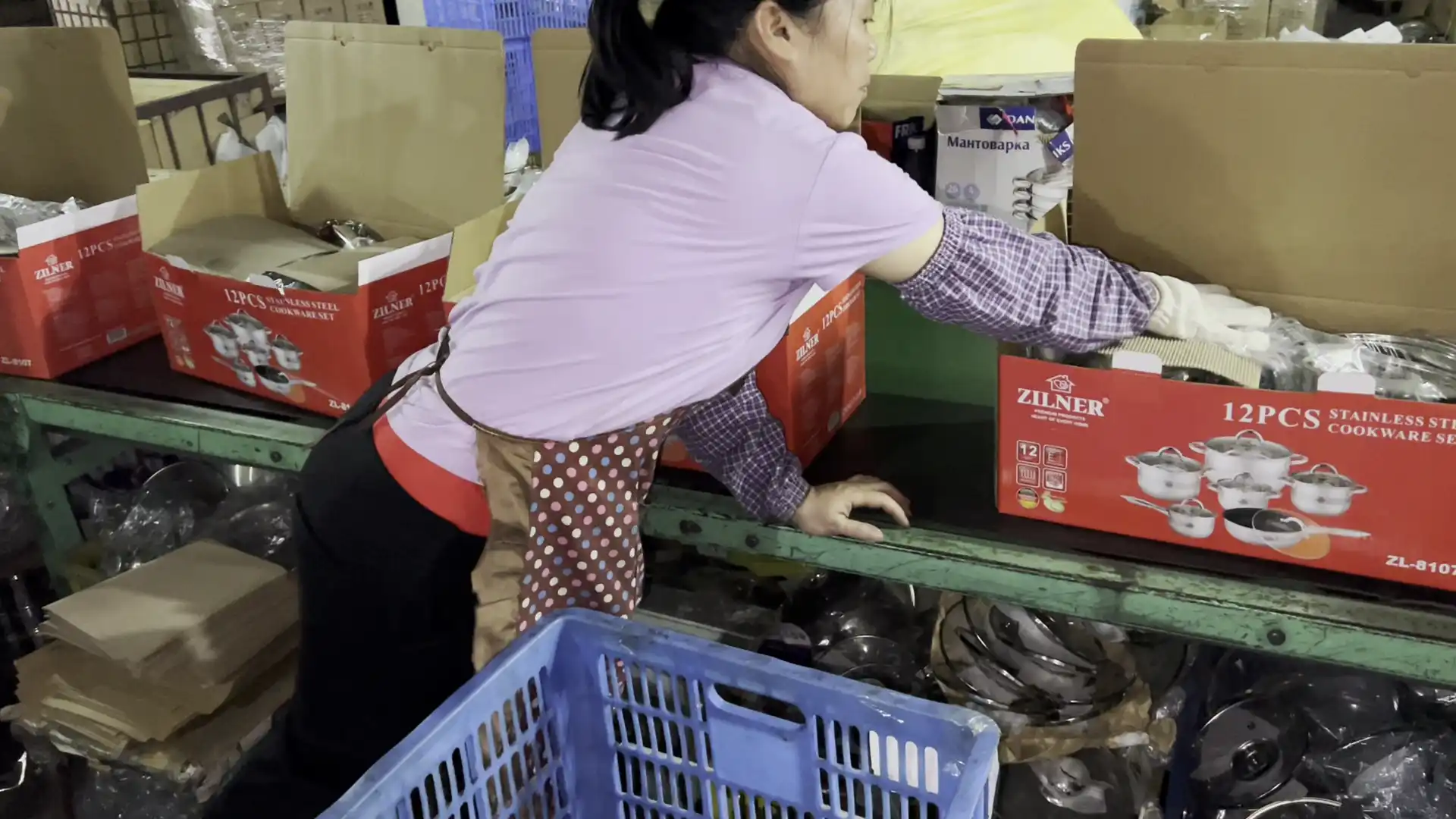
Recalculate dimensions and weight after palletizing. Check handle clearance, nesting, separators and glass-lid protection against the approved packaging sample. Include container condition, moisture protection and load securing in the packing plan.
LCL versus FCL: compare the complete quotation
With less-than-container load (LCL), your cargo shares a container with other shipments and goes through consolidation and destination deconsolidation. Check origin handling, container freight station (CFS) charges, destination services and final delivery, as well as ocean freight.
With full-container load (FCL), you book a container for your shipment even if it is not full. Compare complete LCL and FCL quotes for the same cargo, including packing feasibility, handling, delivery and warehouse receiving conditions.
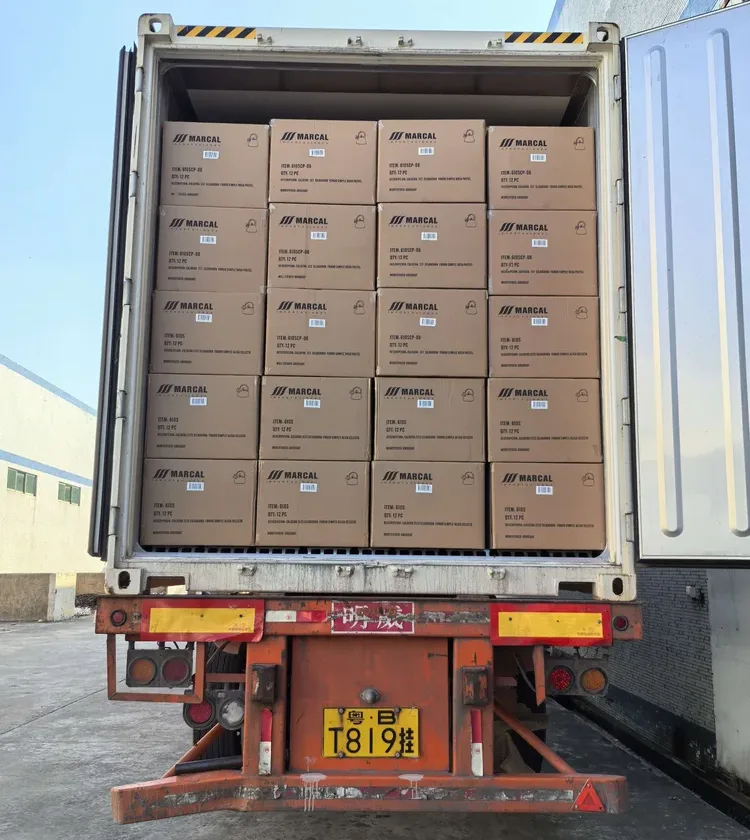
Give the forwarder the pickup point, destination port and warehouse postcode, packing totals, stackability, cargo-ready date, trade term, importer and unloading needs. Request written inclusions, exclusions, validity, charging basis, booking cutoffs, free time and insurance options.
5. Prepare Your Import Documents and Assign Responsibilities
Before booking, agree who will prepare and check each document. Use the table to allocate these tasks alongside the responsibilities set by the contract, transport service and applicable law.
| Document / data | Usual provider | Who checks / when |
|---|---|---|
| Quotation / PI | Seller; agreed by both parties | Buyer and finance before order/payment |
| Specifications / set contents | Factory or seller; buyer approves | Buyer and customs/compliance representatives before approval |
| Commercial invoice | Seller | Buyer and declarant before entry: transaction, quantities, value and disclosed adjustments |
| Packing list | Factory or seller from actual packing | Forwarder, buyer and declarant: carton contents, counts, dimensions and weights |
| Shipping instructions / transport document | Booking parties supply data; carrier/service provider issues B/L, sea waybill or AWB | Buyer, seller and forwarder before documentation cutoff |
| Export declaration | Exporter or appointed declaration agent | Export party before shipment, under Chinese requirements |
| ISF / ENS data | Relevant filing party or authorized agent, supported by supply-chain data | Importer and transport partners before applicable deadlines |
| Import authorization / identification / bond | Importer and relevant agent/provider | Importer and customs representative before entry |
| Origin evidence / product reports / insurance | Relevant supplier, issuing institution, laboratory or insurer | Buyer and responsible specialist; establish applicability before shipment |
| Delivery / exception records | Warehouse, consignee and transport provider | Buyer and claim parties at receipt and during follow-up |
Cross-check legal names, SKU descriptions, invoice reference, units, quantities, carton counts, currency and weights. Keep the commercial invoice and packing list consistent; they serve different purposes.
Agree the cargo-release method before shipment and align it with payment or bank-document conditions. An original bill of lading, a surrender arrangement and a sea waybill have different release procedures. Confirm with the carrier which documents and payments are needed to collect the goods.
For product reports, match the manufacturer, model, materials, components and intended use to the shipment. Use our cookware test-report review guide for the detailed checks.
6. Calculate Landed Cost Without Counting Costs Twice
Calculate the shipment’s cost to reach your warehouse, then add samples, tooling and tests to build the first-order project budget. Prepare a separate cash-flow plan for payment dates and taxes, including any import VAT that may later be recovered.
A cost-inclusion worksheet
For each row, record the quote reference, currency, amount, inclusion status and confirming party. Add only amounts not already covered.
| Cost item | Already included? | What to verify before adding it |
|---|---|---|
| Goods and agreed packaging | Yes / no / confirm | Selling units; retail box and export-carton scope |
| Pickup, export and origin handling | Yes / no / confirm | Overlap with the named delivery quotation |
| Main freight and surcharges | Yes / no / confirm | Route, charging basis, validity and exclusions |
| Cargo insurance | Yes / no / confirm | Existing cover, insured risks and deductible |
| Destination handling and customs broker | Yes / no / confirm | CFS, release and service fees; distinguish statutory fees |
| Duties, applicable additional duties and import fees | Yes / no / confirm | Product, origin, valuation, entry date and local rules |
| Tax / bond costs | Separate treatment | Tax recoverability; bond premium versus bond amount |
| Final delivery and unloading services | Yes / no / confirm | Warehouse address, appointment, equipment and empty return |
| Inspection, storage and delay charges | Conditional | Triggers, free time and actual liability |
| Samples, tooling and tests | One-time project line | Whether already in the price; any stated allocation |
Three quotations, one shipment: hypothetical example
Illustrative costs in USD, not GSK prices or current freight rates. The example uses the same 600 individual pans. No tax amount or rate is assumed.
| Illustrative item | USD |
|---|---|
| Goods and packaging | 9,000 |
| Origin charges | 500 |
| Main freight | 1,000 |
| Insurance | 100 |
| Destination handling | 300 |
| Customs broker service | 150 |
| Final delivery | 450 |
| Commercial subtotal before duties / statutory import fees | 11,500 |
Assume the three quotations explicitly include the following amounts:
| Quotation | Included USD | Commercial costs still to add | Subtotal |
|---|---|---|---|
| EXW named factory | 9,000 | 500 + 1,000 + 100 + 300 + 150 + 450 | 11,500 |
| FCA named terminal/warehouse | 9,500; all 500 origin charges expressly included | 1,000 + 100 + 300 + 150 + 450 | 11,500 |
| CIF named destination port | 10,600; origin, freight and insurance included | 300 + 150 + 450 | 11,500 |
Let D be confirmed duties and statutory import fees, excluding the broker service already listed. Before any additional non-recoverable destination tax, recurring landed cost is 11,500 + D and cost per imported selling unit is (11,500 + D) ÷ 600. Add any such tax to the total before calculating the final unit cost.
Adding 300 for samples, 600 for tooling and 300 for tests brings the first-order project budget to 12,700 + D, also before any additional non-recoverable destination tax. Allocating the extra 1,200 across 600 units adds 2 USD per unit to the project budget. Avoid counting the same development costs again in the goods price.
Customs value, VAT and cash flow
Under US transaction-value rules, buyer-supplied tooling may count as an assist even when it appears on a separate budget line. Ask your customs representative to confirm any required additions and the treatment of transport costs.
For EU imports, the import VAT base can include customs value, duties and relevant incidental expenses not already included. Put potentially recoverable VAT in the cash-flow plan and confirm eligibility, payment dates and any deferral arrangements with your tax adviser.
7. Check US or EU Import Requirements Before Shipment
For US or EU shipments, work through the relevant checks below with your importer and customs representative before booking freight.
United States: classification, duties and entry arrangements
- Establish the importer of record. Confirm authorization and customs-broker arrangements. Using an agent does not remove the importer’s reasonable-care responsibilities.
- Verify the complete HTS classification. Give your representative the construction, materials and set composition. Use USITC’s additional-duties guidance to check Chapter 99, including Section 301 and Section 232 where applicable, and any exclusions against the product description and entry date. Verify the classification rather than relying on a supplier’s generic code.
- Plan ocean ISF filings. For applicable shipments, 19 CFR 149.2 generally requires the first eight data elements at least 24 hours before loading. Stuffing location and consolidator information have different timing. Ask the filing agent about exceptions and earlier operational deadlines.
- Confirm bond, marking and fees. Check any required customs bond, country-of-origin marking and current entry fees. Budget the bond premium separately from the bond amount; a customs bond is not cargo insurance.
European Union: importer, customs and member-state checks
- Identity: confirm the importer and applicable EORI identification; assess VAT arrangements separately.
- Classification and measures: check TARIC for the actual goods, origin and date. It does not contain member-state VAT rates. Consider Binding Tariff Information where classification needs certainty.
- Pre-arrival data: assign ENS data and filing responsibilities under ICS2. The security declaration is distinct from the full import-clearance process.
- Valuation and taxes: confirm customs value, duty, VAT base and recoverability with the relevant specialists.
- Product evidence: check each food-contact component against the EU food-contact rules and destination-market requirements.
Ask your customs representative which origin evidence or certificate the shipment needs. If using wood pallets or dunnage, also check the destination’s treatment and marking requirements for the actual packaging material.
A report labelled “FDA” does not establish blanket approval of a complete cookware set, and CE marking does not apply to every product. Our kitchenware certification checklist covers matching test reports and other documents to the product and market. Added electrical or special functions need a separate assessment.
8. Confirm Release, Delivery and Arrival Checks
Before authorizing shipment, check:
- Final specifications and packaging match the approved sample and documents.
- Actual packing totals match the freight quote and document drafts.
- Filing owners, booking cutoffs and applicable verified gross mass (VGM) arrangements are confirmed.
- Release method, insurance, import funding and warehouse appointment are ready.
- Free time, charging triggers, last free day and any empty-container return are understood.
For container shipments where verified gross mass (VGM) applies, it covers the packed container, including its tare weight, rather than just the cargo. Follow the booking requirements and use our bulk-order cookware quality checklist for sample and shipment acceptance.
Arrival at port, customs release, carrier release and warehouse receipt are separate milestones. Schedule production, cargo readiness, vessel departure, arrival and final delivery separately; transit time alone does not establish a warehouse-ready date.
At receipt, record carton or container condition, seal details where relevant, quantities and visible damage or shortages. Keep identifiable photos, delivery notes, invoices, packing lists and transport records. Report problems promptly to the relevant provider, following the claim deadlines and evidence requirements in the contract or insurance policy.
Frequently Asked Questions
How much does it cost to import stainless steel cookware from China?
The total depends on the product, quantity, packaging, delivery term and destination. Start with the quoted inclusions, then add uncovered freight, handling, clearance, duties, applicable taxes and delivery. Keep one-time development costs and potentially recoverable tax separate. Obtain current quotations rather than applying a universal percentage.
What documents do I need to import cookware?
Common documents include a commercial invoice, packing list and the appropriate transport document. Product evidence, origin documentation, import authorization and advance filings depend on the destination and shipment. Assign a provider and checker to each item, and confirm requirements with your customs representative before booking.
Is FCA or FOB better for cookware shipments?
Choose according to the actual delivery point and transport arrangement. FCA is worth discussing when containerized cargo is handed to a carrier or terminal before vessel loading. FOB uses on-board delivery for sea or inland-waterway transport. Compare the named places, responsibilities and complete charges rather than the abbreviations alone.
Does CIF include import duty and delivery to my warehouse?
Under the normal CIF arrangement, the seller pays carriage and specified insurance to the named destination port, while the buyer handles import formalities. Duty and onward warehouse delivery are not automatically included. Confirm destination charges and unloading scope in writing, and remember that risk normally transfers on board at origin.
What is the HS code for tri-ply cookware?
There is no single code that this guide can assign to every tri-ply product worldwide. Classification needs the actual construction, materials, components, set contents and destination tariff system. Give those facts to your customs representative and seek a formal ruling or binding information where appropriate. Verify duties separately.
Should I use LCL or FCL for my first cookware order?
Request both options for the same final packing data when feasible. Compare total origin, freight, destination and delivery costs alongside handling, scheduling and warehouse conditions. FCL does not require a completely full container. No universal volume threshold makes one option cheaper for every route or shipment.
Prepare Your Cookware Import Quotation
Goldensea supports B2B tri-ply cookware and OEM/ODM projects. Send your product specifications, quantities and units, destination, packaging requirements and preferred trade terms to request a product quotation and packing data for shipping estimates. Confirm the transport and import arrangements for your particular project.

Mei is a dedicated Sales Specialist at Goldensea with over 10 years of experience in the B2B kitchenware industry. Possessing deep technical knowledge of manufacturing and sourcing, she has successfully helped global clients navigate complex supply chain challenges and develop suitable cookware solutions.
Connect with Mei on LinkedIn or reach out for professional kitchenware advice.