

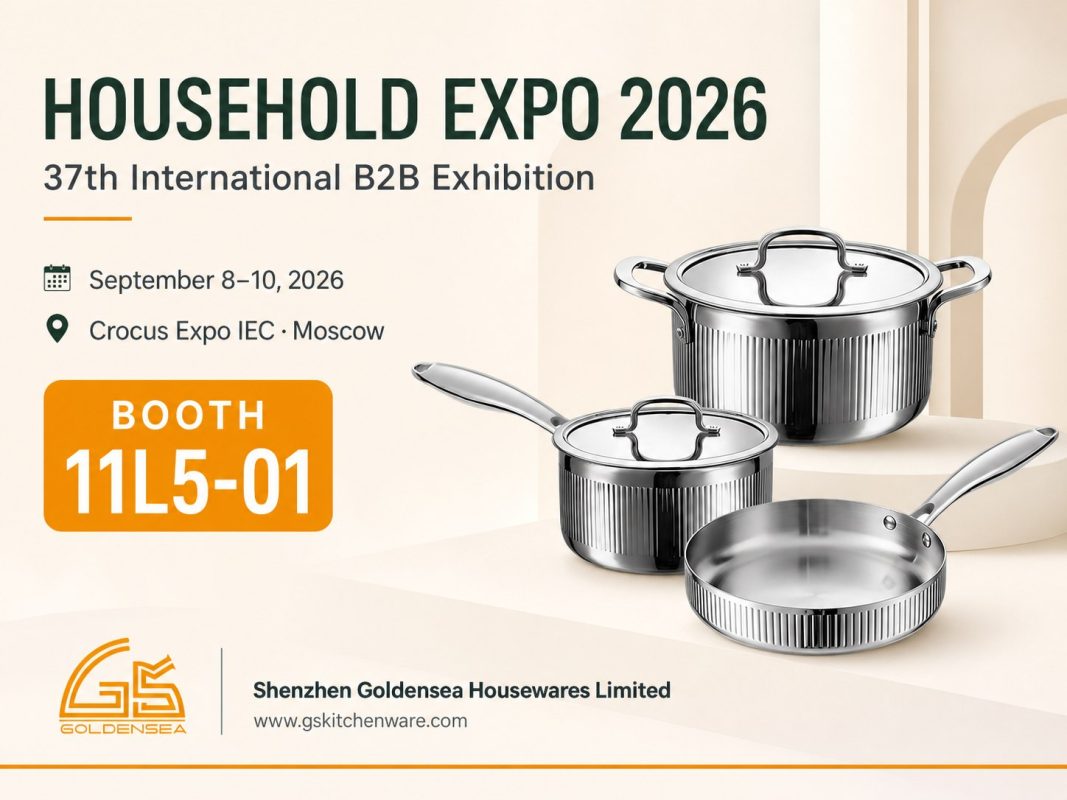
Russian buyers sourcing stainless steel cookware need to balance the target price with construction, useful capacities and verified hob compatibility. Importers and private-label brands also need Russian-language product information and packaging suited to their sales channel. Agreeing on these requirements early makes supplier quotations easier to compare.
Goldensea exhibited at HouseHold Expo 2026 at Crocus Expo in Moscow on September 8–10, at Booth 11L5-01. This article combines that exhibition background with Russian retail examples, organizer publications and standards information to help buyers prepare their next cookware request for quotation (RFQ).
Key Takeaways
- Match each price tier to a documented construction and the total cost under the agreed delivery terms.
- Compare layer materials, thickness distribution, base geometry and sample results when evaluating tri-ply cookware.
- Plan sets around a small-to-large capacity range and state clearly how lids count toward the advertised piece total.
- Develop Russian-language information, marketplace content and protective packaging alongside the product.
- Confirm compliance responsibilities and calculate MOQ for the specific configuration before committing to production.
Why HouseHold Expo Matters for Russian Cookware Sourcing
HouseHold Expo covers cookware alongside other household goods, with a focus on trade buyers and retail distribution. For a cookware project, the sales channel helps determine the assortment, packaging and replenishment plan.

Visitors arriving at the 37th HouseHold Expo at Crocus Expo, Moscow.
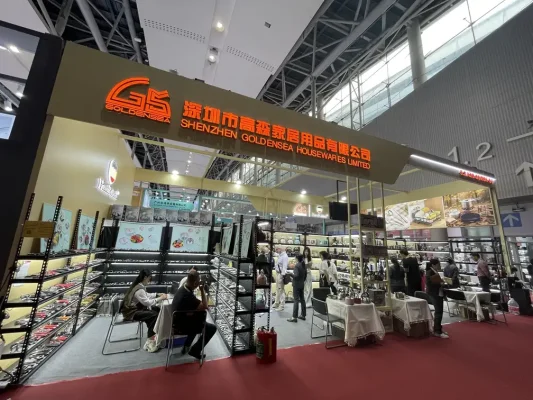
Goldensea / GS Kitchenware presented its cookware through Hongrui (Jiangmen) Metal Products Co., Ltd., its Jiangmen manufacturing entity and the exhibitor named on the Booth 11L5-01 fascia. Our pre-show announcement introduced the booth and the company’s tri-ply and private-label offering.
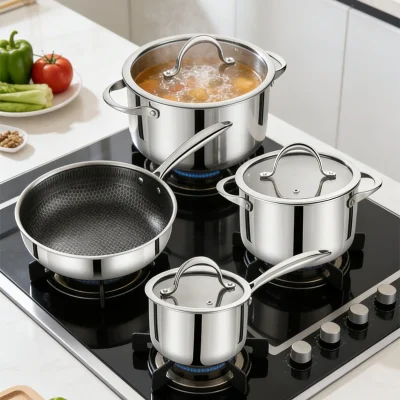
The display included stainless steel cookware, tri-ply sets and other kitchenware. The sourcing discussion below focuses on the cookware range: its price position, specifications and preparation for sale in Russia.
Before requesting samples, send the supplier your target channel, price range and proposed sizes. See our trade show and factory news for further company updates.
Match Cookware Construction to the Target Price Tier
INFOLine’s review of 2025 non-food retail reports price pressure, weak sales volumes in several categories and a shift toward lower-priced, private-label and unbranded products. For cookware buyers, this broader retail context makes the target selling price a useful starting point.
If your channel serves several price points, compare entry, core and premium options:
- Entry: prioritize essential sizes, shared components and straightforward packaging while preserving agreed product and safety requirements.
- Core: balance construction, useful capacities, handling and presentation for the intended everyday range.
- Premium: explain the specific material, finish, design or verified performance that justifies the additional cost.
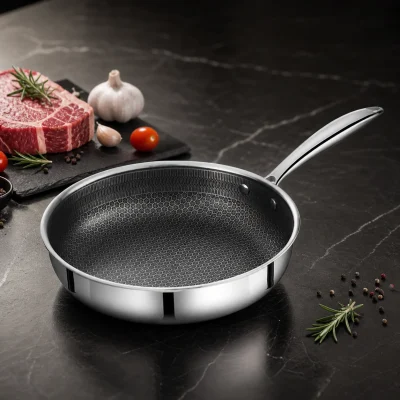
Full-body tri-ply and encapsulated-base cookware can serve different price positions. Compare the actual specifications and sample results, and ask the supplier to explain how changes in materials, handles or finishes affect cost.
Compare quotations on the same basis: product, logo, consumer packaging, transport protection, testing and delivery terms. Check for excluded costs, and record approved changes in the final specification and reference sample.
Make Multilayer Specifications Clear and Verifiable
The organizer’s 2026 kitchenware trend review highlights growing interest in multilayer stainless steel alongside other materials. Buyers considering tri-ply should first confirm where the bonded layers extend.
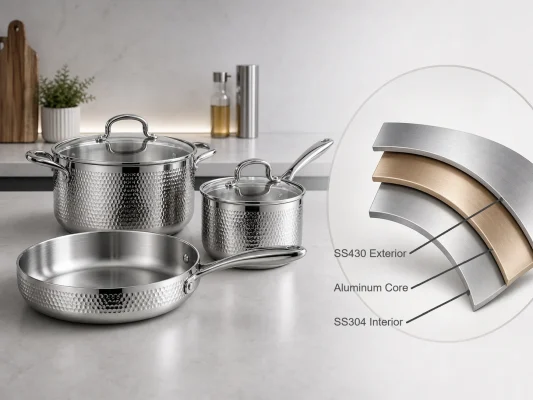
Fully clad tri-ply cookware has three bonded material layers across the base and up the sidewalls. In base-clad cookware, the added heat-distributing layers are concentrated at the bottom. Confirm the construction before comparing thickness or weight.
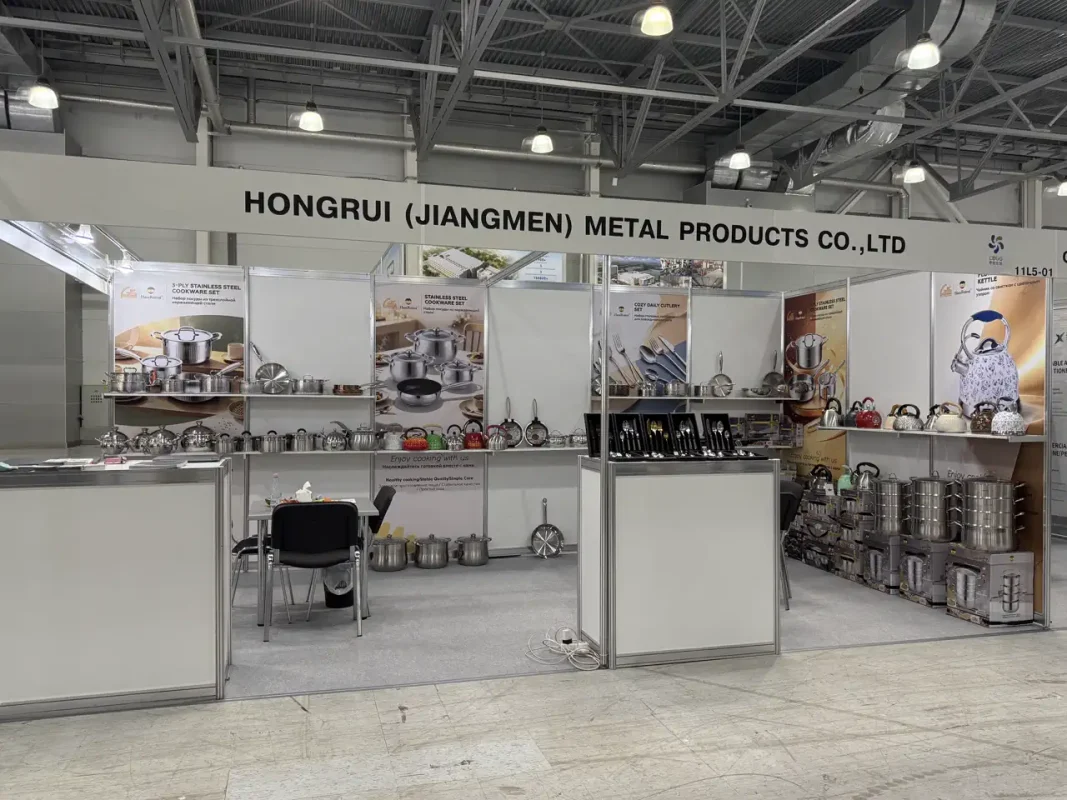
The Goldensea / Hongrui display at Booth 11L5-01, including stainless steel cookware and tri-ply cookware sets.
For a proposed tri-ply product, request the following:
- Material stack: the grade and purpose of each layer, including the food-contact surface and exterior.
- Thickness: total thickness, layer distribution and the agreed measurement locations on the finished vessel.
- Geometry: capacity, rim diameter, base contact diameter and the specified flatness condition.
- Consistency: target weight, tolerances, rim finish and the approved reference sample.
- Validation: appropriate checks for bonding, heating behavior, thermal cycling and deformation.
Goldensea can discuss an SS304 stainless steel interior, an aluminum core and an SS430 magnetic exterior. Confirm the selected stack, layer thicknesses and finished dimensions in the product specification and approved sample.
Agree on measurement locations and tolerances for each shape. Our tri-ply cookware thickness guide explains how to compare layer distribution, total thickness and finished weight.
Build Cookware Sets Around Capacity and Channel
Russian retail listings show several ways to combine small, medium and larger pots. These are assortment examples, not a national sales ranking. Compare the capacities and the way each retailer counts vessels and lids.
| Retail example | Listed vessel capacities | Planning observation |
|---|---|---|
| HOFF Prime, 6 pieces | 1.8 L saucepan; 2.6 L and 3.6 L pots; matching lids. | A compact small-to-medium range, with lids included in the piece count. |
| NADOBA Odri at HOFF, 6 pieces | 1.4 L, 3.4 L and 6 L pots with lids; 16, 20 and 24 cm rim diameters. | A wider capacity range that includes a family-size pot. |
| Edition Red at Posuda Center | 1.1 L, 2.4 L and 5.1 L pots with three lids; 0.9 L saucepan; 1 L milk pot. | Five vessels plus three lids. The retailer counts the five vessels as five pieces. |
Choose the capacities before settling on the advertised piece total. Itemize vessels and lids separately: the HOFF six-piece examples contain three vessels, while Edition Red contains five vessels plus three lids.
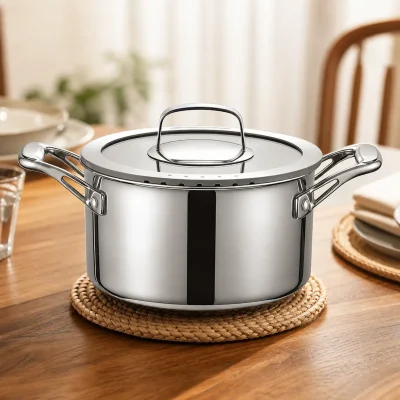
A 5–6 L pot is worth discussing if the channel needs a larger family-size vessel. Confirm nominal and usable capacity, shelf space, carton dimensions and handling weight before adding it to the range.
Also confirm whether individual sizes can be reordered and whether replacement lids will match the approved dimensions.
Verify Induction Compatibility and Everyday Features
The HOFF listings above clearly state hob compatibility and care information. Prepare the same details for the Russian product listing, using claims supported by the finished sample.
Check the magnetic base diameter, base flatness and performance on the intended induction hobs across the proposed sizes. An SS430 material specification alone does not confirm that every size and shape will perform equally well.
Record hob settings and measurements before and after agreed heating cycles. Include the acceptance criteria for heating behavior and deformation in the sample brief.
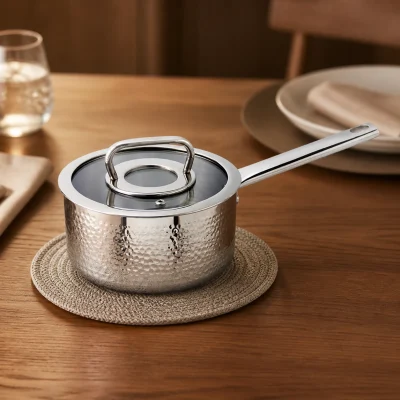
- Lids: assess fit, knob security, steam handling and the selected glass or steel construction.
- Handles: review attachment, loaded handling, clearance and temperature under the intended conditions.
- Use details: check pouring edges, readable capacity marks and cleaning access.
- Care claims: substantiate dishwasher or oven suitability for the complete assembly, including coatings, handles and lids.
If a handle or lid changes, review the affected care and performance claims before approving the Russian packaging and product listing.
Prepare Private-Label Products for Russian Sales Channels
For a Russian private-label launch, the pot, box, instructions and online listing need to describe the same product. Agree who prepares the Russian text and who approves it before printing.
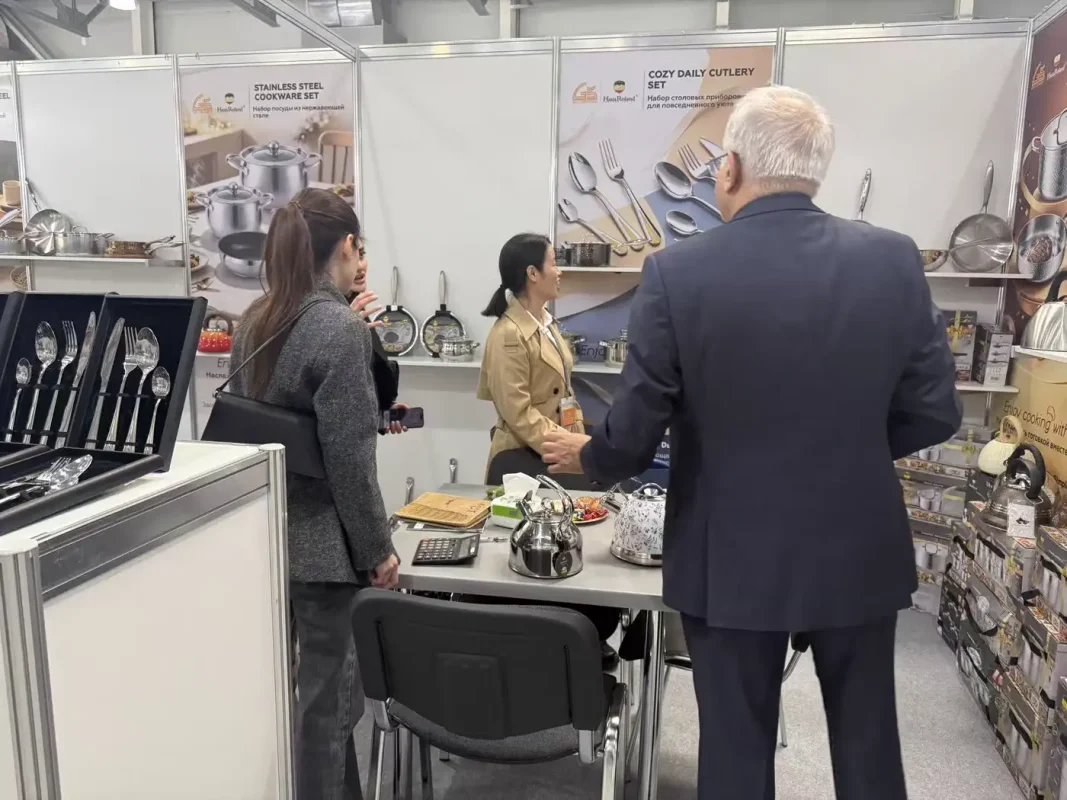
Visitors speaking with the Goldensea team at Booth 11L5-01.
Prepare the following with the importer:
- Product identity: brand, model reference, materials, dimensions, capacities and exact contents.
- Russian-language information: product naming, instructions, care information, warnings and the required responsible-party details.
- Sales content: accurate product photographs, size diagrams, set-content images and verified compatibility attributes.
- Packaging artwork: approved text, logo placement, barcode or platform-label areas and revision identification.
- Reorder controls: approved sample, component references and a process for confirming changes.
Have the importer approve the Russian wording and required manufacturer, importer or authorized-party details. Check capacities, piece counts and care instructions against the sample, packaging and online listing.
Use Goldensea’s custom cookware service to discuss the sizes, handles, lids, logo and packaging required for your range.
Include Compliance and Packaging in the RFQ
Confirm the product’s documentation route
Adult corrosion-resistant steel cookware appears in Russia’s national declaration-of-conformity list under Government Resolution No. 2425. The stainless-steel cookware entry in Resolution No. 2425 identifies code 7323 93 000 0 and references specified requirements and test methods in GOST 27002-2020. The Rosstandart record lists that standard as active.
Ask the Russian importer or conformity specialist to confirm the exact product classification, applicant, declaration scheme, test scope and supporting documents for the proposed SKU. A general request for an “EAC certificate” does not settle these questions, and FDA or LFGB references cannot replace the applicable Russian assessment.
Keep the sample reference, material description, test report and declared models consistent. Agree who arranges testing, provides samples and approves the final information before mass production.
Agree on Packaging and Delivery Protection
Check packaging requirements separately from the cookware’s conformity documents. The EAEU’s TR CU 005/2011 packaging regulation addresses packaging safety and identification.
For marketplace deliveries, have the seller check the current rules for the chosen fulfillment model, including the Wildberries FBS packaging guidance. The following are practical cookware protection checks to include in the packaging brief:
- Protect each glass lid, its edge and knob against contact and compression.
- Separate nested bodies to limit rubbing and surface damage.
- Keep handles and other projections from taking direct loads against the carton wall.
- Control movement inside the box and validate the final pack with an agreed transport-test protocol.
Specify carton dimensions, gross weight and any spare-lid or replacement-piece arrangement. Check the packed production sample, not only an empty printed box.
Recheck digital marking before printing or shipping
Russia’s household-goods digital-marking pilot has been extended to February 28, 2027. The amended Resolution No. 1458 incorporates the extension made by Resolution No. 1113 of August 31, 2026. An experimental period is not a universal mandatory-marking start date. Have the importer confirm the exact product scope, any subsequent final rules and the required label layout before printing or shipping.
Research reference date: September 11, 2026. Classification, applicable amendments and channel rules should be confirmed for the actual project.
A Practical RFQ Checklist for Russian Cookware Buyers
Use the table below as a supplier brief. Mark unresolved items as “proposal requested” so competing quotations explain their assumptions.
| RFQ field | Information to provide or request |
|---|---|
| Market and channel | Destination, retail / distributor / marketplace channel, buyer profile and target price tier. |
| Construction | Full-body multilayer or encapsulated base; material grades, layer thicknesses and required evidence. |
| Assortment | Vessel types, diameters, capacities, quantities by size and separate vessel / lid counts. |
| Components and performance | Handles, lids, finish, rim design, intended hobs, care claims and sample acceptance criteria. |
| Brand and localization | Logo method, Russian artwork, responsible-party information, product images and approval owner. |
| Packaging | Consumer and shipping packs, component protection, carton limits and transport-test expectations. |
| Compliance and inspection | Classification, applicant responsibility, testing, traceability and approved reference sample. |
| Order planning | First-order quantity, variants, replenishment forecast, sample schedule and delivery terms. |
MOQ depends on the sizes, components and packaging selected. Shared parts can help consolidate quantities, while custom tooling, finishes and Russian packaging print runs may require higher minimums. Request separate tooling, sampling and testing charges, and confirm first-order and reorder conditions.
Frequently Asked Questions
Is tri-ply stainless steel cookware gaining interest in Russia?
The HouseHold Expo organizer reports growing interest in multilayer stainless steel alongside other materials. This makes tri-ply worth evaluating for a Russian range. The choice should depend on the target price, channel and sample results.
What cookware set capacities should Russian buyers consider?
Compare small, medium and larger pots against the needs of your channel. The retail examples here include compact sets and combinations with a 5–6 L pot. List every vessel, its capacity and diameter, and the number of lids.
How should induction compatibility be specified?
Record the magnetic base diameter, flatness requirements and intended hob types. Agree on sample checks across the proposed sizes and use the results to support the final product listing. A steel grade alone cannot confirm performance.
Does stainless steel cookware need an EAC certificate in Russia?
Adult corrosion-resistant steel cookware appears in Russia’s national declaration-of-conformity list. Ask the importer or conformity specialist to confirm the classification and documentation route for the exact SKU. A generic request for an “EAC certificate” is insufficient.
What Russian-language information should a private-label project prepare?
Prepare the product name, materials, capacities, set contents, use and care instructions, warnings and required responsible-party details. Have the importer approve the wording and check that the packaging, manual and online listing agree.
What is the MOQ for a Russian cookware order?
MOQ depends on the sizes, set combinations, shared or custom components, finishes, branding and packaging quantities. Give the supplier your initial quantity and reorder plan, then request minimums and charges for that configuration.
Discuss Your Russian Cookware Project
Use our tri-ply stainless steel cookware range as a starting point for a specification discussion. Send Goldensea your target channel, price tier, construction, capacities, expected quantity, packaging format and Russian compliance requirements. We can review configuration options and a project-specific sampling plan.

Mei is a dedicated Sales Specialist at Goldensea with over 10 years of experience in the B2B kitchenware industry. Possessing deep technical knowledge of manufacturing and sourcing, she has successfully helped global clients navigate complex supply chain challenges and develop suitable cookware solutions.
Connect with Mei on LinkedIn or reach out for professional kitchenware advice.