


Public test data are too limited to rank honeycomb and dot-matrix cookware surfaces for food release, wear, or ease of cleaning. If you’re sourcing a tri-ply stainless steel frying pan or wok, ask for a cross-section of each finished surface and check where the coating sits. Then test the pans side by side under the same conditions. If the pan construction or coating differs, use the results to compare those two specific SKUs.
Key Takeaways
- In a typical honeycomb, the ridges connect. In a raised-dot array, the dots stand apart.
- Score food release before and after wear, utensil damage, and cleaning residue separately.
- Specify the finish in the request for quotation (RFQ) and reference the approved sample on the purchase order.
Contents
- What Honeycomb and Dot-Matrix Surfaces Look Like
- How Texture and Coating Work Together
- Food Release, Wear, and Cleaning
- What Buyers Should Specify Before Sampling
- Frequently Asked Questions
What Honeycomb and Dot-Matrix Surfaces Look Like
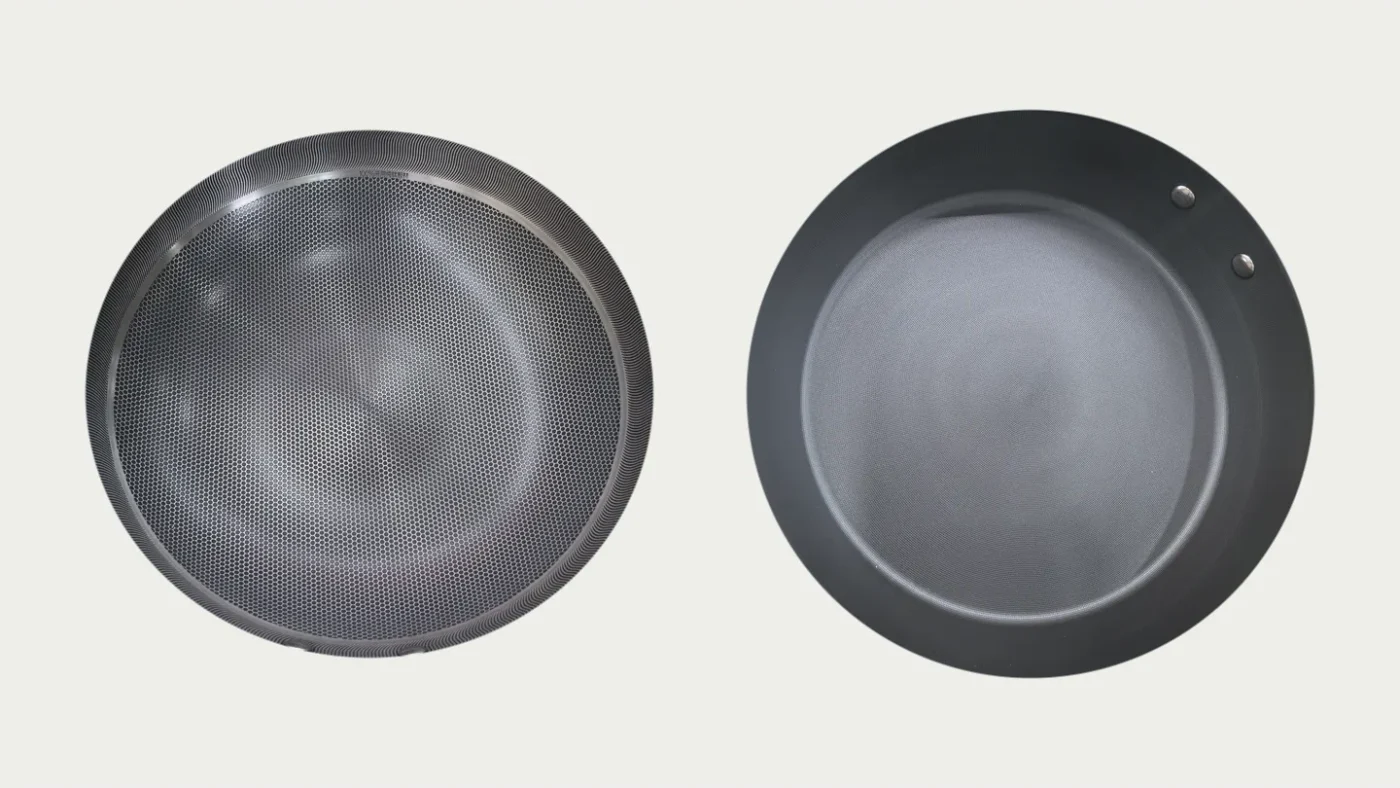
A typical honeycomb cookware surface has raised ridges that connect to form hexagonal cells. A typical raised-dot cookware surface has separate projections with lower areas between them. Suppliers use “dot matrix” for several finishes.
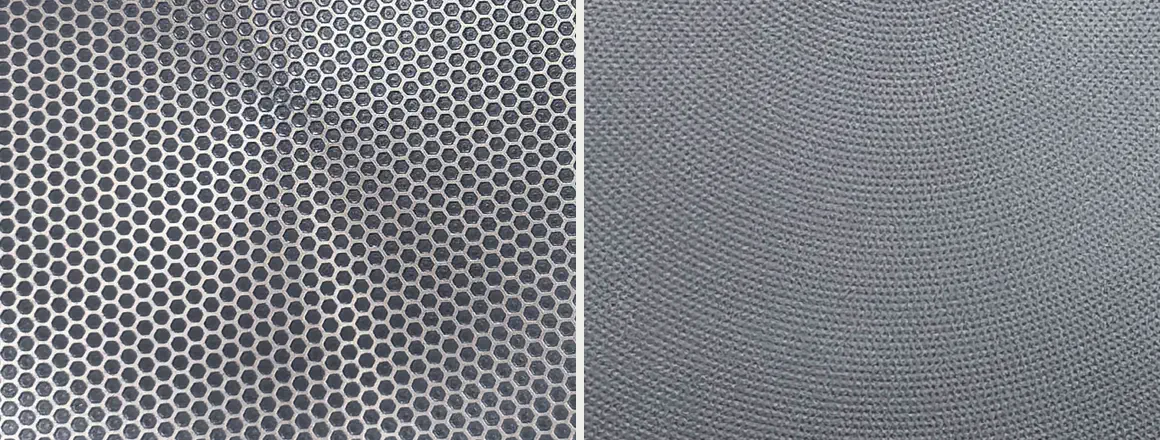
Connected hexagonal cells on the left and a fine dot-matrix pattern on the right. The close-ups use different magnifications.
The table compares typical raised profiles. Use a cross-section of the right-hand sample to check whether the dots are raised, recessed, or simply surface markings.
| Check | Honeycomb | Raised dots |
|---|---|---|
| Top view | Connected ridges outline hexagonal cells. | Separate dots form regular or staggered rows. |
| Cross-section | Ridges sit above the cell floors. | Dots rise above the areas between them. |
| Dimensions | Cell size, ridge width and height. | Dot diameter, pitch, height and top shape. |
| Coating and coverage | Check ridge tops, sides, cell floors and the grid boundary. | Check dot tops, sides, the spaces between dots and the array boundary. |
One surface can combine the two patterns. In one published design, hexagonal cells contain raised dots and the coating sits below the raised features. The red sample below shows how a grid and dots can appear together. A drawing or physical section of that specific sample would establish its profile and coating coverage. Cookware design CN204654589U
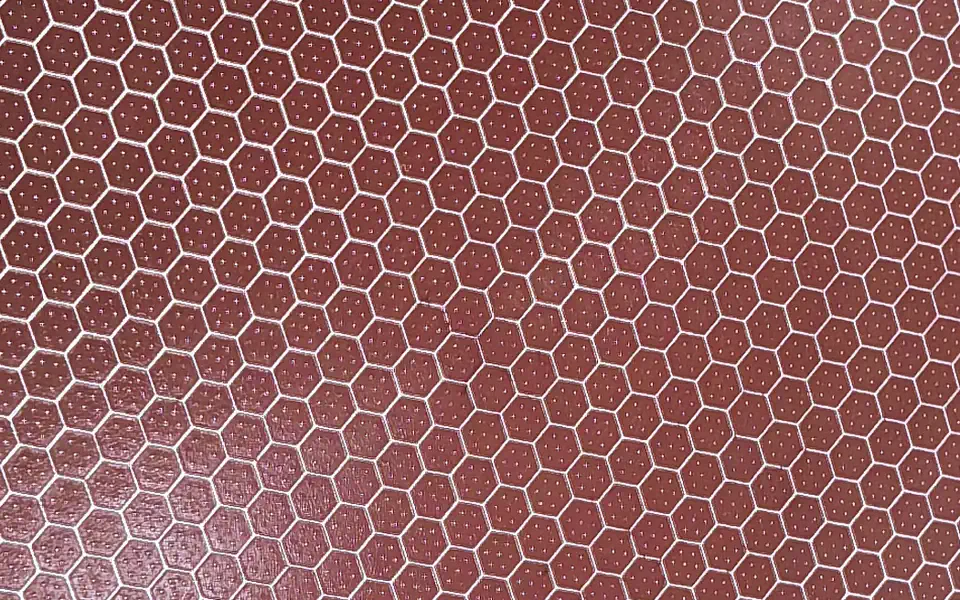
Factory-visit sample showing small dots within a red hexagonal pattern.
How Texture and Coating Work Together
Ask the supplier for a drawing or cross-section that shows which areas are coated and what material is exposed at the tops, sides, and in the recesses. If the pan is coated, get the coating code as well. In one published design, the ridge tops remain exposed while the coating covers the valleys and extends onto the sides. Partial-coating design US10368691B2
HexClad describes its current hybrid surface as laser-etched stainless steel ridges with a TerraBond™ ceramic coating in the valleys. Shangwey lists raised microdots and KFCC G8 ceramic coating for its PNF01-22 tri-ply frying pan. HexClad technology overview · Shangwey PNF01-22 specification
Ask how the supplier makes the pattern and when any coating, curing, or polishing takes place. When you approve the sample, mark where the texture and any coating start and stop on the drawing. See our cookware finishing and assembly guide.
Try the intended spatula on each sample. A broad, flat edge may ride across some tops while a corner can reach a lower area, depending on the spacing, profile and working angle. At the same pan temperature and measured oil dose, observe whether oil collects inside cells or spreads between dots. Keep those observations with the sample records and score actual food release and residue separately.
Food Release, Wear, and Cleaning
A controlled contact-frying study compared different surfaces using pancakes, defined frying temperatures, release scores and adhesion-force measurements. Separately, the Hong Kong Consumer Council tested 24 commercial pans, including mesh and honeycomb models. The lab applied 500 abrasion passes before five rounds of oil-free pancake release testing. Four of the 24 models fell short of the referenced EN 12983-1:2023 nonstick requirement. That is a result for the finished pans tested, whose constructions and coatings varied. DTU contact-frying study · Hong Kong Consumer Council test
How to Run a Side-by-Side Sample Check
To test the effect of texture, hold pan size, layer stack, thickness, coating system and coverage constant. If the supplier needs a different coating or body to manufacture one of the patterns, use the test to compare the two offered SKUs. Use several numbered pans per configuration, record their batch and agree the scoring criteria before testing.
- Initial food release. Use the same heat source, measured surface temperature, food portions, oil dose and turn time. Record whether the food comes away whole and where any residue remains. Run oil-free and measured-oil trials as separate conditions.
- Food release after wear. Agree the abrasive tool, load and number of passes. Repeat the original food test under the same conditions and compare the scores for each sample.
- Utensil contact. Specify the spatula material, edge, working angle and load. Record scratch locations and any coating damage separately from the food-release result. For a metal-utensil claim, match the tools and conditions to the proposed use instructions.
- Cleaning residue. Standardize the cool-down time, water temperature, detergent, sponge and number of strokes. Photograph the same positions on the raised areas, recesses and texture boundary before and after cleaning.
Have the lab identify the samples, method and pass criteria in its report. Compare the results under the conditions your customers will use. A private-label breakfast pan, for example, may need an egg-release check alongside a standardized pancake trial.
What Buyers Should Specify Before Sampling
For a range where the texture is a visual feature, compare pattern consistency under agreed lighting. For a range sold on easy release or cleaning, set measurable acceptance criteria based on the proposed use and validate them on finished samples.
- Surface drawing. Mark where the texture starts and stops on the flat cooking zone, sidewall and transition between them. Specify the dimensions, tolerances and measurement points at the center and edge.
- Materials and finish. List the body construction and the materials exposed at the tops, sides and low areas. For a coated version, record the formulation code, coverage, color and gloss. Ask the supplier to identify tooling or process charges, minimum order quantity, and sample and production timing for that configuration.
- Claims and documentation. Add the target market and proposed packaging or care claims. Request finished-SKU reports that identify the sample, test conditions and acceptance criteria for each relevant claim.
- Golden sample. Record the signed sample ID, drawing revision, photographs and measured values. Use the same revision on the purchase order, packaging artwork and first production inspection. If the texture, coating or an operation that can affect performance changes, review the relevant tests before approving the revision.
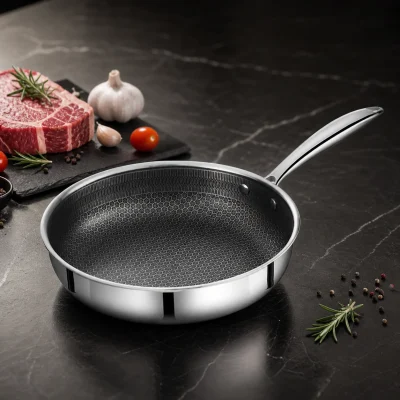
For example, Goldensea lists a honeycomb-pattern interior and a smooth polished stainless steel interior as two order configurations for the GS-01660-FP fully clad frying pan. Name the selected interior on the order and on the reference sample. To compare formats before sampling, browse the tri-ply stainless steel frying pan range. Confirm raised-dot availability, coating specifications and performance documentation with the supplier for the project.
Frequently Asked Questions
Can a honeycomb pan also have raised dots?
Yes. Some designs have raised dots inside the hexagonal cells. If you order this finish, specify the grid height and dot height separately.
Does a honeycomb pattern identify the coating?
Two pans with the same honeycomb pattern can have different finishes. Ask for the coating specification and coverage drawing for the exact SKU.
How can buyers compare food release after wear?
Run the same food-release test on each numbered pan before and after abrasion. Agree on the abrasive, load, and number of passes before testing.
Request Cookware Samples
Send us the pan size, order quantity, intended use, and destination market. Include any performance claims you want to verify and a reference photo or drawing if you have one. Contact Goldensea to plan your samples.

Shiva Yang is a Sales Manager at Goldensea, supporting global B2B buyers with tri-ply stainless steel cookware sourcing, private-label programs, and OEM/ODM project coordination.
Connect with Shiva on LinkedIn or contact Goldensea to discuss a cookware project.